Trailer tracking technology has been around a number of years, with a growing number of refrigerated and other food-related carriers deploying the technologies. But upcoming federal regulations will make it even more important.
“Trailer tracking was used as a ‘throw-in,’ but now if you aren’t tracking trailers, you are behind the curve,” says Chris MacDonald, vice president sales, StarTrak business for Orbcomm. MacDonald estimates that up to 80% of the top 100 fleets use trailer-tracking technologies. “The ROI comes from having the ability to effectively manage your trailer community in a more cost-effective way.”
Ad Loading...
For refrigerated carriers, industry estimates say that about a third of all refrigerated units on the road use some type of telematics, says Mark Fragnito, product manager, telematics, for Carrier Transicold. “The number of refrigerated fleets that use telematics systems has been steadily growing.”
Rules currently being developed as part of the Food Safety Modernization Act, signed into law in 2011, will likely drive more refrigerated and food carriers to adopt systems to comply with a new Sanitary Transportation of Food rule, expected to be published by the Food and Drug Administration in 2016.
Speaking at an industry event last spring, Bud Rodowick, manager, fleet performance at Thermo-King, said the act is “the most expansive change to food safety laws since 1938” and gives sweeping new powers to the FDA. While the law places the primary responsibility on food producers and processors instead of carriers, the new rule will require producers and processors to maintain records on transportation, storage and distribution.
“You need to be proactive and get out front,” on this, Rodowick said. “Find out where your shippers are in developing their plans and work with them.”
Carrier Transicold's refrigeration units, such as the X4 model 7500 are capable of interfacing with a wide variety of telematics equipment for trailers, intermodal containers and rail cars.
While it’s unclear what the final rules will include, Fragnito said the FDA’s “intent is to establish greater accountability in maintaining food safety throughout the distribution process.” As a result, he expects to see more data recording and tracking throughout the cold chain.
Ad Loading...
“There are a lot of things about this act that nobody knows what is going to be expected,” MacDonald said. “A lot of carriers are getting more proactive in tracking their loads, while some carriers are waiting to pull the trigger.”
A final rule could require the monitoring of cargo air temperature or product temperature or both, as well as documentation of these temperatures throughout the haul.
Norman Thomas, vice president operations at CarrierWeb, says the rule changes may require carriers “to not only ensure the continuity of temperatures in the trailer during transit, but that the carrier be required to validate that their drivers are certified to actually load/unload and monitor the foods being carried.” The certification required will vary by product type.
Thomas says that the rules will likely require carriers to install two-way data communication and tracking devices capable of monitoring and controlling the refrigerated engine status, remotely monitor and set the correct temperature setting, and note door open and close locations and duration.
Recordkeeping requirements will vary from food to food, but Thomas says the ability for carriers to associate temperature and environmental conditions for specific loads and shippers will be critical. As a result, some fleets are deploying remote monitoring technologies now, according to Gayatri Abbot, director, smart products and telematics at Thermo King. “Rather than remain unaware of cargo traceability practices or wonder if temperatures are properly maintained during the journey, companies are investing in remote temperature and asset monitoring technologies now to generate proof of delivery reports and get ahead of upcoming regulations,” she says.
Ad Loading...
A key element of meeting the expected guidelines will be close integration between the trailer tracking device, the reefer unit’s microprocessor, the truck’s telematics system and a carrier’s transportation management software.
An integrated system can deliver more benefits than a stand-alone system.
“While connected to the tractor, the trailer tracking device can report through the in-cab mobile computing platform,” says Jim Sassen, senior product marketing manager, Omnitracs. This means more frequent reporting intervals at a lower cost. Plus, using the vehicle’s telematics system to report status won’t drain the trailer tracking device’s battery.
Carriers have options when deploying systems to track and monitor refrigerated and other food loads. If product temperature monitoring is required, temperature probes that feed data into the refrigeration unit’s data recorder or to the vehicle’s telematics system can be used. Fragnito says another option for monitoring the product temperature would include portable, stand-alone data loggers attached to the cargo packaging. These devices would stay with the load from the point of origin to its final destination.
Orbcomm’s MacDonald notes that “the technology keeps getting better. From a sheer food safety perspective, the technology has come a long way” to include multiple temperature probes, the availability to multiple temperature readings and a variety of sensors that monitor reefer unit fuel level, trailer door openings, and trailer tire pressure monitoring.
Ad Loading...
With a final rule still at least two years away, carriers who have not deployed these technologies have time to do their homework.
Cargo theft has shifted from parking-lot break-ins to organized international schemes using double brokering, phishing, and even spoofing tracking signals. In this HDT Talks Trucking video podcast episode, cargo-theft investigator Scott Cornell explains what’s changed and what fleets need to do now.
Daimler Truck’s David Carson sees early signs of tightening capacity — yet buyers remain wary, extending trade cycles and resisting a pre-2027 emissions surge.
The American Transportation Research Institute's annual analysis of truck speeds through congested interchanges yielded a new worst bottleneck this year.
From pricing intelligence and compliance tools to charging infrastructure, diagnostics, tires, and AI, HDT’s 2026 Top 20 Products recognize the new tools, technologies, and ideas heavy-duty trucking fleets are using to run their businesses.
Artificial intelligence is evolving faster than fleets can keep up, and telematics must evolve with it, Cawse said during Geotab Connect. The future? A single AI coordinating every system — and leaders who know how to guide it.
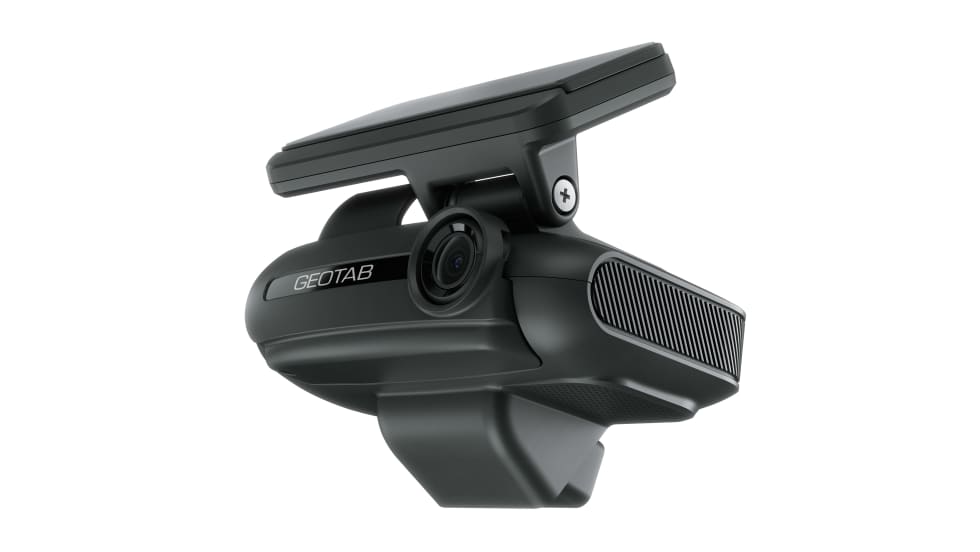
Geotab launches GO Focus Pro, an AI-powered 360-degree dash cam designed to reduce collisions, prevent fraud, and protect fleets from nuclear verdict risk.
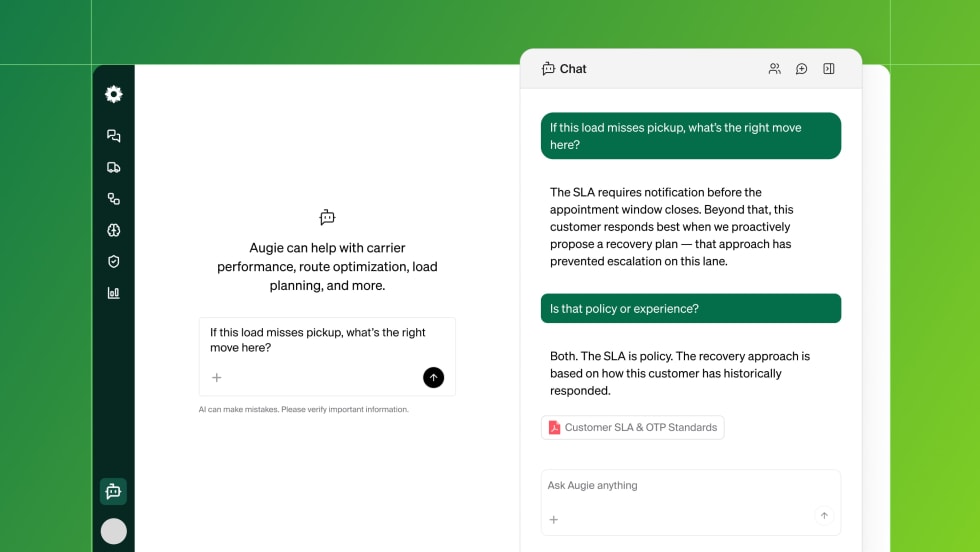
Knowledge Hub is designed to turn scattered tribal knowledge into execution-ready intelligence and help logistics teams make faster, more consistent decisions.
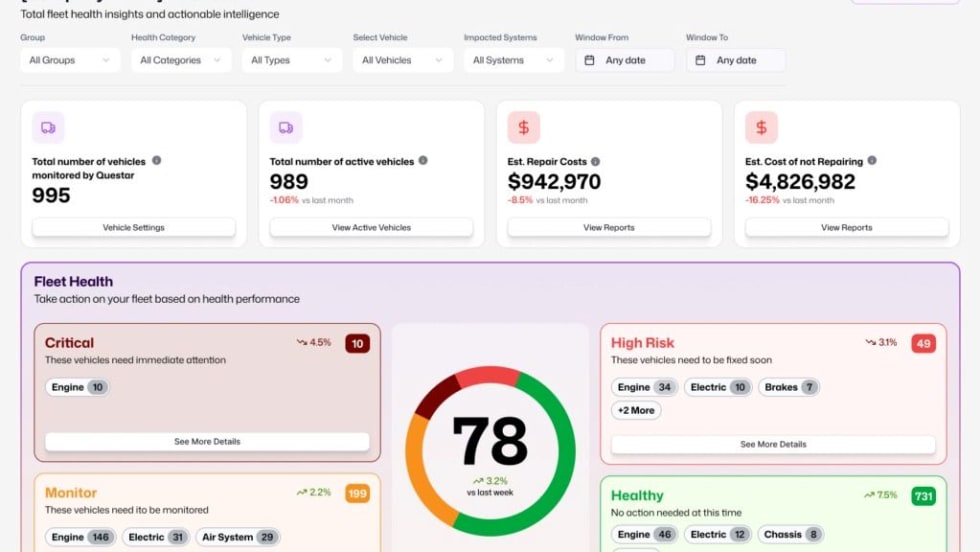
Quester’s AI-driven maintenance insights aim to help fleets reduce unplanned downtime, improve repair planning, and better understand the true cost of maintenance decisions.