




Supercenter Fleet Super at Collaboration
Meijer’s David Hoover finds working with suppliers and dedicated fleets makes innovation easier.


David Hoover
Director, Outbound Logistics for Meijer, Lansing, Mich.

David Hoover
Director, Outbound Logistics for Meijer, Lansing, Mich.
In 2006, David Hoover and his team were visiting the Detroit Diesel factory, where officials were showing the EPA-2007 engine and explaining how it would bridge to the EPA-2010 technology.
“They were explaining, ‘Here’s the one that’s going to get us where we’re going to,” says Hoover, who is director of outbound logistics for Meijer. I said, ‘I don’t want something that’s going to fill in the gap. I want the next technology.’”
So the Michigan-based supercenter chain bought a few more 2006 engines and extended its trade-in cycle until it could get the first of Detroit’s 2010 engines.
“In hindsight it was a smart move,” Hoover says, given the maintenance problems many fleets have had with the 2007 engines.
That doesn’t mean it was smooth sailing. The company started testing pre-production models for Detroit in 2009.
“It was a good learning experience,” Hoover says. “We knew there were gong to be some challenges going into it, especially with the pre-production engines. There was a lot of work that was done on both ends, learning and improving.”
Conveniently, the Detroit plant is only about 70 miles down the road. “It wasn’t unusual on a Monday morning to have four or five Detroit engineers here downloading information from the engines, making changes, seeing how they were running.”
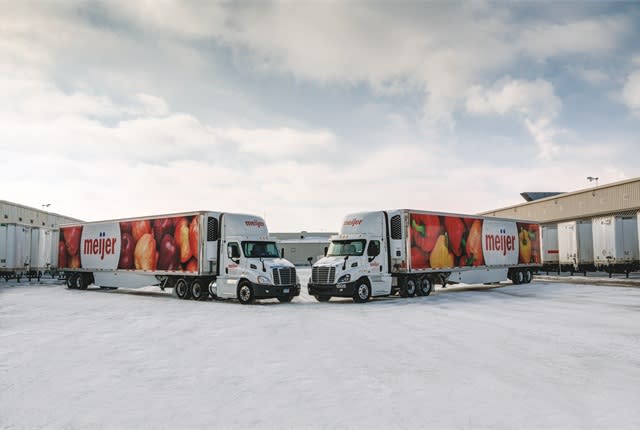
Meijer finished converting its 170-truck fleet of regional daycabs to the 2010 engines last fall. As a result of that commitment, the Meijer fleet realized a 47% reduction in particulate matter and a 5% increase in fuel economy, saving 105,570 gallons of fuel each year. In fact, it takes 47 of the new 2010-compliant trucks to equal the same emissions as one of the older trucks they replaced, Hoover says.
Last year the fleet started trading some of those in for the latest EPA/NHTSA 2014 engines in the Freightliner Cascadia Evolution. The new trucks are showing a 12% improvement in fuel economy over the ones they replaced.
Testing technology
Hoover has been in his current position since 2003 and before that was transportation distribution director. He originally went to work for Meijer to pay for his college education, where he earned a business management degree with a minor in transportation.
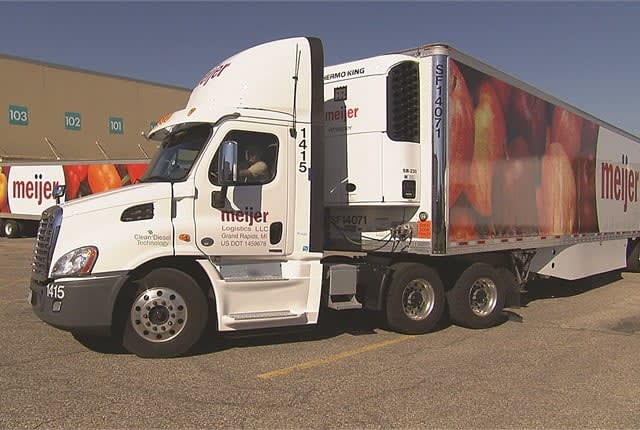
Meijer has tested aerodynamic wheel covers, various trailer skirts, aerodynamic boat tails and composite floors for trailers. Some have taken off, while others haven’t worked.
“I got my CDL and was planning to go to work for one of the trucking companies, but I looked around and realized I was already working for a great company with a lot of opportunity.”
Hoover says the key to his success in the 30 years since is collaboration.
“I think the best thing is you figure out you’re not the smartest person, but you get a bunch of engineers together and they can figure out how to fix it or make it better.”
The engine gamble is hardly the only innovation Meijer has adopted under Hoover. The fleet has been using aerodynamic trailer skirts for 10 years, long before California essentially mandated them. It worked with then-Terion a decade ago developing trailer tracking with remote temperature alerts.
“We’ve tested a lot of different technology with tires, with inflation devices, with monitoring systems; some have worked out well, some have not,” Hoover says. A few years ago, they worked with MIT to test power-generating shock absorbers, which so far are only being used on military vehicles. Meijer was such an early adopter of disc brakes on trailers that they had to postpone them because the German manufacturer only made a handful.
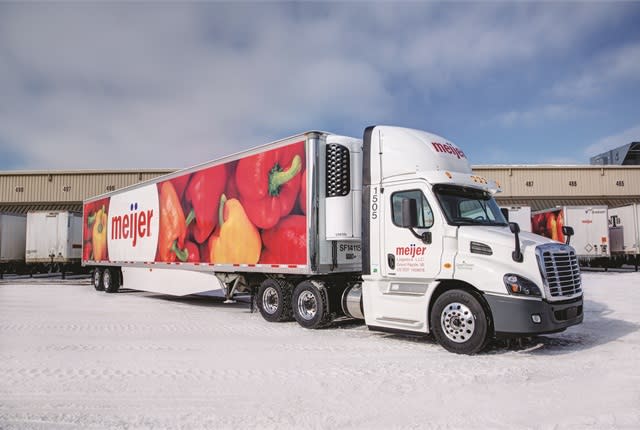
Meijer finished converting its 170-truck fleet of regional daycabs to the 2010 engines last fall.
The company was an early adopter of electronic logs, and Hoover says as a result the company has never had a CSA violation for logbook infractions. It embraced telematics by having Detroit Virtual Technician installed on all its trucks for improved maintenance and uptime.
“Dave is always looking for what’s next and how it can help Meijer,” says his boss, Tom McCall, vice president of logistics. “His great focus on continuous improvement over time leads to amazing long-term benefits.”
Meijer has tested aerodynamic wheel covers, various trailer skirts, aerodynamic boat tails, and composite floors for trailers. Some have taken off, while others haven’t worked for the fleet. For instance, Meijer has tested natural gas, but “it’s not going to make it in our world right now,” Hoover says. “You’ve got the cost of equipment, the fueling infrastructure and maintenance concerns. At heavy loads it was not very efficient.”
Innovation, Hoover says, “is within our company’s DNA. We invented the supercenter concept back in the ‘60s, the automatic belt you see at checkouts.”
While innovation in areas such as sustainability and environmental friendliness are important, he says, “it’s got to make good business sense, because at the end of the day the customer’s not going to pay more for it.”
However, he notes, “being a private company, our ROI can take some liberty and some new technology if it makes sense and we can justify it. It might not just be on the payback of financial savings over time, it’s also the safety, the compliance benefits we also gain.”
Collaboration is key
A part of Meijer’s approach is collaboration. Not only collaboration with suppliers like Detroit, but also sharing information with the for-hire fleets that also carry Meijer goods.
For instance, Hoover notes that the company has moved to automated transmissions because of an aging workforce and fuel economy gains – but also for safety.
“A transportation engineer I’m friends with at Frito-Lay was telling me about the reductions they were seeing in accidents, and that helped sell me on it. A lot of directions we go, it’s a collaboration with other people in the industry who give you advice that’s sound that we trust.”
It goes the other way, too. John Goempel, vice president of dedicated operations for U.S. Xpress, touts Hoover’s testing and implementation of innovative solutions. “He has freely shared his test results with U.S. Xpress,” Goempel says in his nomination. “I cannot think of any customer we have that has been so free to share information. He truly has the best interests of all parties involved, and the industry in general, in mind.”
That collaborative spirit doesn’t apply just to technologies, but also to network efficiencies.
Brian Dieringer, region vice president for J.B. Hunt Transport, notes that Hoover partnered with another one of J.B. Hunt’s dedicated customers to drive out empty miles within both networks.
“Without the open mind by Meijer private fleet to look at both sides of the supply chain, this type of ‘win-win’ could not happen,” Dieringer writes in his nomination of Hoover.
As Hoover himself says, “If it’s good for Meijer, it doesn’t matter who’s hauling it. I will not sub-optimize someone else’s routes to maximize my own fleet or vice versa. It’s what’s most efficient.”
Technology has helped drive this supply chain collaboration.
“We’re always working to improve the visibility of the product flow and the shipments both for ourselves and our dedicated partners for delivery into our facilities or our retail outlets,” Hoover says. “We’ve implemented several system upgrades that give our partners better visibility into the product flow. We were probably one of the first companies to go to a yard management system, similar to a warehouse system.”
Although Meijer may have invented the supercenter concept, today it faces stiff competition from Walmart and others. “We are a very competitive company,” Hoover says. “There’s a lot of great competitors out there that push us to be better – but I’m sure we push them to be better, too.”
The 2014 Truck Fleet Innovators
Shelby Green: Reinventing the Beverage Fleet
More Fleet Management

Color Match Smarter: Tools That Restore & Perform
For fleet managers and collision repair professionals keeping heavy-duty trucks on the road, getting the color right the first time isn't just about appearance — it's about efficiency, turnaround time, and bottom-line results. Discover how today's digital color tools are transforming the repair process from guesswork to precision.
Read More →
FMCSA Pauses Biennial-Update Enforcement Amid Motus Transition
Carriers whose updates were due on or after June 1 have more time, while FMCSA works to stabilize its new registration system and warns of phishing sites impersonating its new carrier registration system, Motus.
Read More →
2026 Blueprint for Countering Smarter Supply Chain Theft
Cargo theft is no longer just the cost of doing business. It's a multi-billion-dollar criminal enterprise exploiting vulnerabilities across your fleet, drivers, and supply chain.
Read More →


How Telematics Improves Visibility, Control, and Performance in Refrigerated Fleets
Explore how telematics help refrigerated fleets improve visibility, uptime, efficiency, compliance, and cargo protection across connected cold chain operations.
Read More →
What the U.S.-Canada Trade War Means for Trucking
Escalating U.S.-Canada tariffs could disrupt cross-border freight, reduce truck volumes, raise costs, and create new uncertainty for carriers on both sides of the border.
Read More →
What Are Trucking’s Top Concerns for 2026?
The American Transportation Research Institute wants to know what's worrying trucking fleet managers, drivers, and other stakeholders in its annual Industry Issues survey.
Read More →
American Trucking Associations Looks for a New Leader
ATA President and CEO Chris Spear abruptly left his job at the association on August 21, at a pivotal time for the trucking industry.
Read More →
Public Wi-Fi Cybersecurity Risks: How Truck Drivers and Fleets Can Protect Their Data
Public Wi-Fi can expose truck drivers and fleets to credential theft, malware, and other cyber threats. Here’s how to reduce the risk on the road.
Read More →
For Nicky Cupp, Fleet Innovation Starts With Frustration
HDT Truck Fleet Innovator Nicky Cupp turns everyday pain points at Fraley & Schilling into opportunities for better technology and smarter processes.
Read More →
Adam Buttgenbach’s Approach to Electric Trucks: Start With Where They Fit
HDT Truck Fleet Innovator Adam Buttgenbach helped PepsiCo build one of North America’s largest EV fleets by focusing on where electric trucks make operational sense.
Read More →