




Performance With a Purpose
Frito-Lay’s Mike O’Connell leads a team that focuses on adapting the best leading-edge technologies for its specific needs.


Mike O’Connell
Senior Director, Supply Chain
Frito-Lay
Plano, Texas
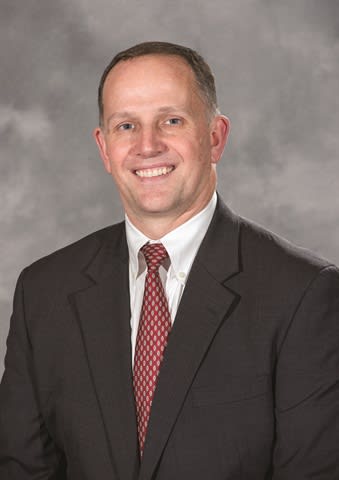
Mike O’Connell
Senior Director, Supply Chain
Frito-Lay
Plano, Texas
During his first years at Frito-Lay more than 20 years ago, Mike O’Connell was focused on the warehousing end of the distribution business. It wasn’t until he took on the lead role in revamping the operation’s maintenance efforts about eight years ago that he really started understanding the truck side of things.
But with the help of a talented team of engineers and others (who O’Connell is adamant about giving part of the credit for his success), he has turned the Frito-Lay fleet into a model of efficiency and sustainability and today is senior director, supply chain.
Parent company PepsiCo has a broad “Performance with Purpose” sustainability strategy that includes its fleet vehicles.
“We’ve been working on our fleet strategy for several years,” O’Connell explains. “Long story short, we look at people, processes and technology for ways to reduce our fuel consumption – and I can tell you since a 2008 baseline, we’re just shy of a 20% reduction in traditional diesel and gasoline usage. And we’re growing our business.”
The seventh largest fleet in the United States, O’Connell has responsibility for some 22,000 vehicles – everything from cargo vans up to Class 8 tractor-trailers. So Frito-Lay can hardly take a one-size-fits-all approach.
For instance, it has the largest all-electric package delivery fleet in the country. But for rural areas where electricity doesn’t make sense, the company is downsizing to more fuel-efficient Sprinter vans. “We’re putting in trucks in the 22-mpg range, up from the 9- to 10-mpg range,” he says.
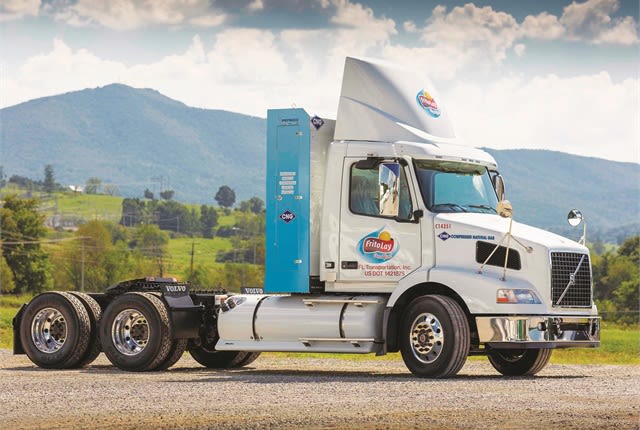
For its tractor-trailer fleet, Frito-Lay has nearly 200 natural gas tractors and is adding more.
They tested hybrids but found they didn’t meet the fleet’s needs.
“About anything going on in the industry, we’re at least piloting, testing or implementing,” McConnell says.
The right specs
Frito-Lay dramatically changed its business model regarding trucking assets after O’Connell took over the fleet.
“Frankly we were looking for opportunities to improve our business,” he recalls. “We were doing rebuilds, and we started to think that wasn’t the wave of the future.” They shut down the rebuild centers and started looking at maintenance for asset life.
Key to the new strategy was spending the time and effort to spec trucks that are perfectly suited for the Frito-Lay business.
“You can’t just buy a route truck off the shelf,” he says. So instead of relying on the standard offerings and options from the OEs, they hired engineers to design the best delivery truck for their needs.
Because Frito-Lay’s loads of chips and other snack foods are very lightweight, they were able to go to a lighter-duty cab-and-chassis vehicle and significantly downsize the engines. That first generation doubled the fuel efficiency.
Once they got that in place, along with a very good maintenance program, they added more engineers to focus on alternative fuels.
Today Frito-Lay has a team of engineers who work with drivers and route sales representatives to design the most efficient, safest trucks for those operations.
“At the end of the day, the biggest thing is meeting the needs of the delivery. From there we can optimize it,” O’Connell says.
For instance, he says, the choice of Smith Electric for the EV delivery vehicles was driven by the trucks’ box body, which perfectly accommodates Frito-Lay’s delivery methods of using carts and liftgates.
“If we can’t deliver our products, we can’t use that vehicle,” he says. “It’s really about the drive cycle.”
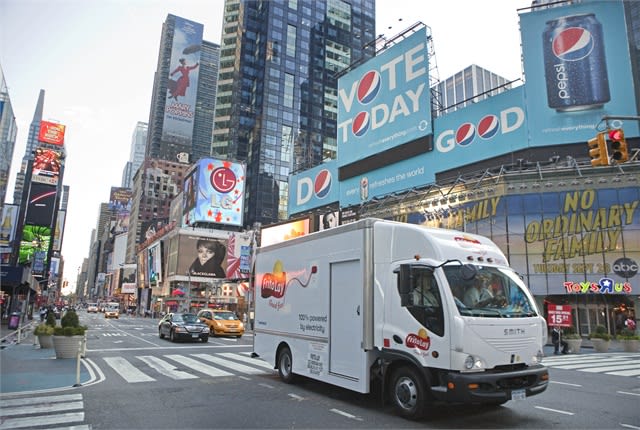
The seventh largest fleet in the United States, Mike O’Connell has responsibility for some 22,000 vehicles – from cargo vans up to Class 8 tractor-trailers. So Frito-Lay can hardly take a one-size-fits-all approach.
Because Frito-Lay keeps vehicles for their full useful life, rather than trading in every few years, they can focus on designing vehicles to meet their specific needs rather than for residual value at trade-in. Route trucks they keep 15 years or more; over the road, about seven years or around a million miles.
There’s also a heavy focus on total cost of ownership.
“A lot of people get hung up on the acquisition price,” O’Connell says. “If I’m going to keep it for 15 years and it gets double the fuel economy, it probably makes sense for us to pay a little more for it up front.”
That focus on total cost of ownership also extends to the choice of replacement parts and components. “If I pay 25% more and it lasts twice as long, that’s a better investment.”
In addition to the alternative fuels, this approach has led to specs that use lightweight materials, low-rolling-resistance tires, trailer skirts, gap fairings, etc.
More than equipment
There’s more to efficiency and sustainability than the equipment, however. O’Connell says the company looks at people, process and technology, and Frito-Lay doesn’t forget the people part of that equation.
A big step forward in getting field operations, such as manufacturing and distribution centers, to step up and be more fuel-efficient was separating fuel price from fuel consumption when measuring success.
“When the field team was responsible for price and consumption, it kind of gave up when prices shot up through the roof,” O’Connell explains. So they changes all the goals, scorecarding and reports to focus on consumption, such as use of gallons versus plan, idle scorecards and mpg scorecards, “charging” a standard price for each gallon used.
“Now they get charged a standard price for every gallon they use, so they get all excited because if they use less, they save. It really engaged the field and let them do something about it.”
More recently, Frito-Lay embarked on a huge fuel-efficiency driver-training program.
“We’ve really created a culture around it. It was no small undertaking to train 17,000, but over the last two and a half years we have trained a majority of our drivers to be more fuel efficient,” he says, noting that fuel-efficient driving is also safer driving.
Training in larger locations involved employees driving a passenger van through a mapped-out course, timing it and determining the fuel used. “Then we would teach the [fuel-efficient driving] habits and do the same thing.”
Drivers initially feared that fuel-efficient habits such as slower speed and more gradual acceleration and deceleration would result in longer time to run the route. However, the test runs proved them wrong.
“We had 15% to 20% better fuel economy and in most cases got there faster or close to the same time.”
The result of the training program, he says, was a sustainable 6% fuel economy improvement in the over-the-road fleet and double-digit improvements in the delivery fleet.
So what’s next? More natural gas tractors for sure, as well as development of a medium-duty box truck powered by natural gas. They’re studying hydrogen fuel cells, which California has been pushing; working on next-generation GPS; developing better data analytics for dynamic routing and other efficiencies; and looking for the next generation of getting closer to that true predictive maintenance program with the help of telematics.
“We are in the process of working on the next three- to four-year spec plan horizons,” O’Connell says. “Now that we have some core technologies in our fleet, the question is how many, how fast we go.”
The 2014 Truck Fleet Innovators
More Fleet Management

Color Match Smarter: Tools That Restore & Perform
For fleet managers and collision repair professionals keeping heavy-duty trucks on the road, getting the color right the first time isn't just about appearance — it's about efficiency, turnaround time, and bottom-line results. Discover how today's digital color tools are transforming the repair process from guesswork to precision.
Read More →
FMCSA Pauses Biennial-Update Enforcement Amid Motus Transition
Carriers whose updates were due on or after June 1 have more time, while FMCSA works to stabilize its new registration system and warns of phishing sites impersonating its new carrier registration system, Motus.
Read More →
2026 Blueprint for Countering Smarter Supply Chain Theft
Cargo theft is no longer just the cost of doing business. It's a multi-billion-dollar criminal enterprise exploiting vulnerabilities across your fleet, drivers, and supply chain.
Read More →


How Telematics Improves Visibility, Control, and Performance in Refrigerated Fleets
Explore how telematics help refrigerated fleets improve visibility, uptime, efficiency, compliance, and cargo protection across connected cold chain operations.
Read More →
What the U.S.-Canada Trade War Means for Trucking
Escalating U.S.-Canada tariffs could disrupt cross-border freight, reduce truck volumes, raise costs, and create new uncertainty for carriers on both sides of the border.
Read More →
What Are Trucking’s Top Concerns for 2026?
The American Transportation Research Institute wants to know what's worrying trucking fleet managers, drivers, and other stakeholders in its annual Industry Issues survey.
Read More →
American Trucking Associations Looks for a New Leader
ATA President and CEO Chris Spear abruptly left his job at the association on August 21, at a pivotal time for the trucking industry.
Read More →
Public Wi-Fi Cybersecurity Risks: How Truck Drivers and Fleets Can Protect Their Data
Public Wi-Fi can expose truck drivers and fleets to credential theft, malware, and other cyber threats. Here’s how to reduce the risk on the road.
Read More →
For Nicky Cupp, Fleet Innovation Starts With Frustration
HDT Truck Fleet Innovator Nicky Cupp turns everyday pain points at Fraley & Schilling into opportunities for better technology and smarter processes.
Read More →
Adam Buttgenbach’s Approach to Electric Trucks: Start With Where They Fit
HDT Truck Fleet Innovator Adam Buttgenbach helped PepsiCo build one of North America’s largest EV fleets by focusing on where electric trucks make operational sense.
Read More →