




Reinventing the Beverage Fleet
If you think you’ve been seeing fewer of those Pepsi bay-type delivery trailers with the roll-up doors, you’re probably right. PepsiCo North America Beverages is revamping the way it delivers its products, moving to specially spec’d dry van trailers, liftgates and pallets that were pre-loaded at the warehouse.


Shelby Green
Senior Fleet Director
PepsiCo North America Beverages
Somers, N.Y.

Shelby Green
Senior Fleet Director
PepsiCo North America Beverages
Somers, N.Y.
If you think you’ve been seeing fewer of those Pepsi bay-type delivery trailers with the roll-up doors, you’re probably right.
PepsiCo North America Beverages is revamping the way it delivers its products, moving to specially spec’d dry van trailers, liftgates and pallets that were pre-loaded at the warehouse. It saves work for drivers, saves fuel, and speeds deliveries to customers.
One of the leaders of this effort and others is Shelby Green, senior fleet director.
Green started his 28-year career with PepsiCo as a fleet supervisor at its Wichita, Kan., location. Although he went through many other roles, including about six years in a headquarters role handling the marketing equipment (vending machines, coolers, fountains), when he came into the senior fleet director role about eight years ago, he was happy to be working with trucks again.
“The fleet manager is out on the front line. I enjoyed it a lot. You got to know your vehicles and the people who drove them. So I’m very proud to be in this role, because it’s kind of where I started and I know what everybody’s going through.”
Today, Green oversees a fleet of about 14,500 vehicles ranging from Class 1 through Class 8, 11,600 trailers, plus forklifts and other material handling equipment.
In a quest for greater efficiency, the company is transitioning to a new delivery style it is calling geobox.
A new way to deliver
“We’re looking to co-mingle our grocery and our convenience and gas station deliveries,” Green explains. “This allows us to make deliveries to both large and small format retailers on one route using the same truck.”
Pallets are now being created to order in the warehouse, then loaded on the truck.
“The route driver just pulls those pallets off and delivers them to the store,” Green says. “So they’re not spending so much time in the parking lot or in the dock, trying to pick all this product off their truck and take it in. It maximizes the customer’s time in terms of how long we’re there, and it improves our productivity. We definitely get in and out a lot quicker.”
“We may deliver to a grocery store with the traditional pallet deliveries, then spend the rest of the time delivering on a smaller-pallet footprint that would be in that geography, so we’re much better at routing.”
That means saving fuel by using fewer trucks for the same number of customers. “So far we’ve seen about a 15% increase in the number of customers we can deliver to on one route,” Green says. “We’re much more efficient. We’re seeing less miles and less fuel usage because we’re routing more efficiently. We’re reducing labor costs on the delivery side. We see the safety and ergonomic benefits to the delivery person in regards to their work effort they have during the day.”
The right trailer
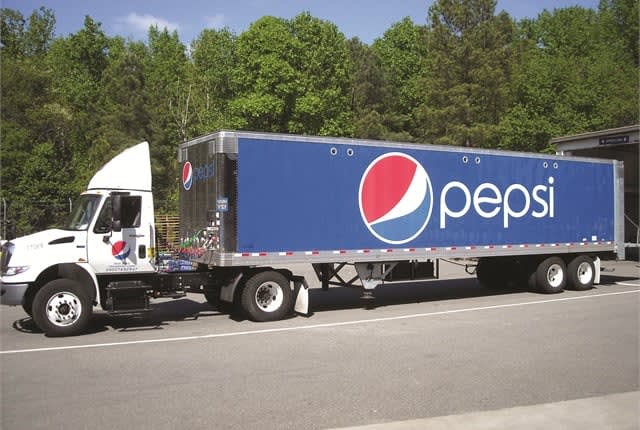
The North America Beverages Fleet spec team worked hard to spec a tractor-trailer that would take the most advantage of this new concept, which currently is being used at more than 70 locations across the United States and Canada.
“The go-to-market team here researched the available options out there,” Green says. “There were some existing ideas that were out there, and we worked with different suppliers to pick what would work best for our system. We challenged some of our suppliers to come up with ideas.”
The team was looking at ways to make the trailer liftgates more durable, making things better ergonomically for the driver, making maintenance easier and other factors.
One of the key specs on the new trailers was developed in collaboration with SAF-Holland.
As the day goes on, that trailer gets lighter. The SAF CBX40 Auto-PosiLift automatic axle lift air-ride suspension senses when enough of the load has been delivered that a tandem axle is no longer required. At that point, one axle of the trailer tandem automatically lifts, without driver intervention.
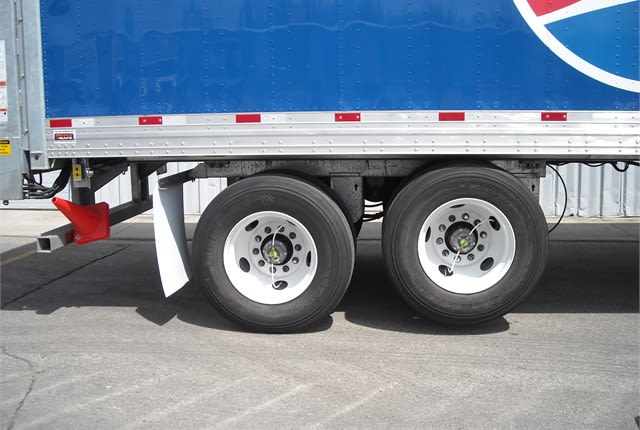
As the day goes on, the trailer gets lighter. A SAF CBX40 Auto-PosiLift senses when the tandem axle is no longer required.
The result is lower rolling resistance and thus better fuel economy. “You’re not scuffing as many tires, you’re not putting as much usage on the brake system,” Green says.
With the geobox system, the trucks drop 20% to 60% of their weight early on, then deliver to smaller accounts the rest of the day.
“We knew we had diminishing loads, and we knew that around 60% to 80% of the time we really only need one axle based on the average rolling payload that we have,” Green says. Once SAF-Holland offered it as a concept, he says, people got excited and put the energy behind it to come up with the final product in a very short time.
“Whenever they come to a stop or dock area and engage the parking brake system, the axle’s going to go down,” Green explains. “Once they’ve finished their stop and activated the air system and take off, it senses the weight and will raise it up.” It’s all quite seamless to the driver.
The clever lift axle wasn’t the only key to this trailer spec. For instance, it has LED lighting on both exterior and interior. For the liftgate system, there’s a battery backup system that charges while it’s moving down the road.
“That’s important that because we’re going from traditional usage on the liftgate was very infrequent, but now they’re utilizing the liftgate a lot more and there’s more draw on the battery system.”
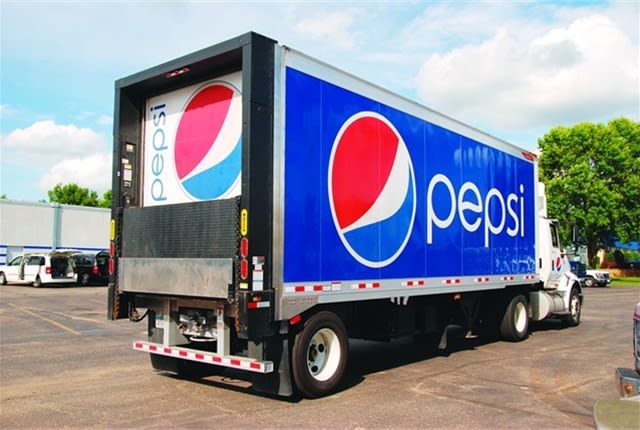
PepsiCo is moving to specially spec’d dry van trailers, liftgates and pallets that are preloaded at the warehouse.
The tire spec changed, not only to improve the fuel efficiency through low-rolling-resistance tires. And speaking of tires, the lift axle has changed maintenance procedures to rotate the tires to even out the usage. Obviously the ones on the lift axle get a lot less wear.
Collaboration is king
Of course, the PepsiCo North America Beverages fleet has a lot of other vehicles in it, and Green’s team has been innovative with those, as well. For instance, sales support vehicles are changing to Sprinter vans for higher fuel mileage. In urban areas where the stop-and-go traffic makes it feasible, service vans are using XL Hybrids’ electric hybrid technology. And it is piloting some Class 8 natural gas tractors, both CNG and LNG.
Developing equipment specs that work hand-in-hand with the beverage fleet’s changing delivery tactics is an exercise in collaboration and communication.
“We have such a collaborative spirit with all of the people within PepsiCo that have a hand in the process,” Green says. “Our go-to-market team consists of people from selling and delivery, warehouse, fleet and MEM. I think that’s the power of what we get done, the communication.”
More Fleet Management

Nominations Open for HDT Emerging Leaders
Heavy Duty Trucking is looking for accomplished trucking fleet professionals under 40 who are making an impact and helping lead the industry forward.
Read More →
Why Private Fleets Are Taking More Freight
Private fleets are putting their own trucks on demanding customers and high-cost lanes as companies seek greater control over service, costs, and capacity.
Read More →
Color Match Smarter: Tools That Restore & Perform
For fleet managers and collision repair professionals keeping heavy-duty trucks on the road, getting the color right the first time isn't just about appearance — it's about efficiency, turnaround time, and bottom-line results. Discover how today's digital color tools are transforming the repair process from guesswork to precision.
Read More →


FMCSA Pauses Biennial-Update Enforcement Amid Motus Transition
Carriers whose updates were due on or after June 1 have more time, while FMCSA works to stabilize its new registration system and warns of phishing sites impersonating its new carrier registration system, Motus.
Read More →
2026 Blueprint for Countering Smarter Supply Chain Theft
Cargo theft is no longer just the cost of doing business. It's a multi-billion-dollar criminal enterprise exploiting vulnerabilities across your fleet, drivers, and supply chain.
Read More →
How Telematics Improves Visibility, Control, and Performance in Refrigerated Fleets
Explore how telematics help refrigerated fleets improve visibility, uptime, efficiency, compliance, and cargo protection across connected cold chain operations.
Read More →
What the U.S.-Canada Trade War Means for Trucking
Escalating U.S.-Canada tariffs could disrupt cross-border freight, reduce truck volumes, raise costs, and create new uncertainty for carriers on both sides of the border.
Read More →
What Are Trucking’s Top Concerns for 2026?
The American Transportation Research Institute wants to know what's worrying trucking fleet managers, drivers, and other stakeholders in its annual Industry Issues survey.
Read More →
American Trucking Associations Looks for a New Leader
ATA President and CEO Chris Spear abruptly left his job at the association on August 21, at a pivotal time for the trucking industry.
Read More →
Public Wi-Fi Cybersecurity Risks: How Truck Drivers and Fleets Can Protect Their Data
Public Wi-Fi can expose truck drivers and fleets to credential theft, malware, and other cyber threats. Here’s how to reduce the risk on the road.
Read More →