




Cargo Securement: What You Don't Know Can Hurt You Under CSA
You can hide a multitude of sins inside a van trailer, but with an open deck trailer, any indiscretions are out in the open for all to see -- including DOT roadside inspectors

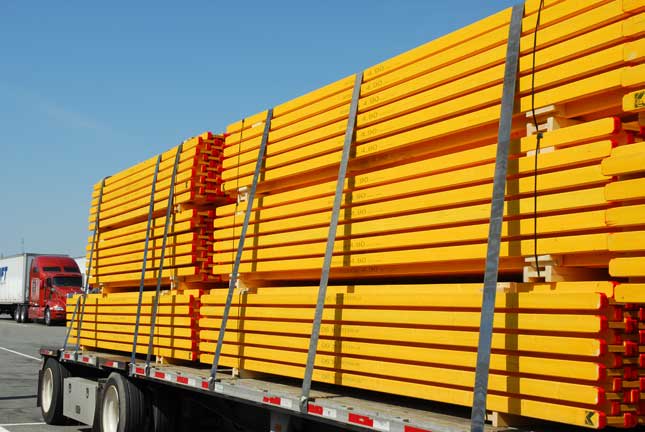
This great-looking load should be placed out-of-service for violations. How many can you spot? (See the answer at the bottom of the story.)
You can hide a multitude of sins inside a van trailer, but with an open deck trailer, any indiscretions are out in the open for all to see -- including DOT roadside inspectors.
Staying compliant means having a excellent understanding of the regulations as well as cargo securement equipment that is up to the task.
Keith Kerns, an investigator with the Public Utilities Commission of Ohio and a member of CVSA's International Safety Team, says the primary cause of cargo-related citations and out-of-service orders is not driver error or improper methods. It's the equipment itself.
"The statistics tell us that damaged or defective tie-downs, loose or unfastened tie-downs, and simply not having the required number of tie-downs are the most common violations we find at roadside," Kearns says. "The biggest issues related specifically to drivers are calculating the weight of the cargo plus any length requirements that might exist when determining the correct number of tie-downs required."
The two are related. If a driver correctly calculates the aggregate working load limits but uses sub-standard or under-rated equipment, he could still be cited, because the AWLL might be below minimums. That could result in one of several citations being issued, such as damaged securement systems, insufficient tie-downs or even cargo not immobilized or secured.
For example, a 5/16-inch grade 70 Transport chain has a WLL of 4,700 pounds, but if it's not marked as such, or the markings are not legible, an inspector would downgrade it to the equivalent of Grade 30 chain, which has a WLL of just 1,900 pounds.
"When using chains with binders and hooks, the 'weakest link' theory applies," Kearns points out. "The component with the lowest WLL in the assembly dictates the strength of the device. If you have a 4,700-pound chain with a 3,000-pound hook, the chain is only as good as its weakest link."
Similarly, unmarked webbed cargo straps in good condition are minimum-rated at 1,000 pounds WLL per inch of width. A properly marked 4-inch strap could be rated as high as 5,400 pounds. If that 5,400-pound strap were downgraded 4,000 pounds because the label or marking was missing or not legible, the driver could come up 1,400 pounds short per damaged strap in meeting the minimum AWLL for the cargo.
Damaged straps could be downgraded or zero-rated, depending on the extent of the damage, as determined by the strapping defect table in CVSA's Out-of-Service Criteria handbook.
"You can have a minimal amount of damage to the strap, and there are many variables there, but if the strap is so damaged that it meets the requirements of the defect table, the strap would be zero rated. In other words, it would be like that strap wasn't even there," Kearns says.
Ralph Abato, vice president of international sales at Ancra International, says drivers sometimes shoot themselves in the foot by using extra straps over a load.
"You can't have too many straps on a load, but if some of those straps are damaged, they will still be taken out of service and the driver cited," he says. "The truck may be okay to go because the driver has met the minimum with his good straps, but the extra straps he used - old straps laying in the bottom of the tool box - may end up causing a violation."
He advises going through your inventory and getting rid of all the damaged or worn-out devices and replacing them with good ones.
A common driver violation is not using the correct number of tie-down devices for the cargo. The driver has to consider the weight and length of the article(s) of cargo, and use the correct number of the proper tie-downs.
"We're looking for a minimum of one strap for every 10 feet and fraction thereof in length, with a minimum of two tie-downs for anything longer than 5 feet," says Kearns. "For example, an article that is 21 feet long and up against a header board would need a minimum of three straps based on its length and position on the trailer. If it's not against a header board or in contact with the cargo in front of it, it would need one additional strap. Drivers used to call this the penalty strap."
Weight also must be considered. Enough tie-downs are required to secure for half the weight of the article of cargo. For example, something weighing 20,000 pounds would require a minimum of 10,000 pounds WLL of cargo securement. Using the indirect method (over the cargo, anchor point to anchor point), two 5,400-pound rated straps (2 x 5,400 = 10,800 pounds AWLL), or three 4,700-pound-rated chains (3 x 4,700 = 14,100 pounds AWLL) would meet the AWLL requirements. In this case, two 4,700-pound chains would give you only 9,400 pounds AWLL; you need to secure for 10,000 pounds.
If the article was more than 10 feet in length (even if it were just 10 feet 1 inch), it would require an additional strap to satisfy the length requirements, as above, but the three chains would suffice.
If that article of cargo were a machine with built-in attachment points, and the driver used the direct method (a chain from a trailer anchor point to a cargo attachment point), five direct attachments would be needed - or four direct and one indirect.
When using the direct method, each tie-down device only gets half its rated working load limit. So, if the devices are rated for 4,700 pounds each, they would get a 2,350-pound allowance (5 x 2,350 = 11,750 pounds AWLL). Four 4,700-pound chains would give you only 9,400-pound AWLL.
Cargo securement isn't rocket science, but there's too much to be taken into account to let poorly trained drivers or sub-standard tie-down equipment ruin your company's safety record.
Answer to our cargo securement quiz:
The load appears to be unitized bundles stacked three layers high, so they must meet 393.118 and, accordingly, have tie-downs on both the second and third layers meeting all requirements of 393.100 through 393.114.
While difficult to see in the photo, the strap labels are badly frayed and the WLL markings are all but invisible. The WLL of the straps could be downgraded by inspectors.
The cargo straps should be strung inside of the rub rail "when practicable." In this case, it would have been practicable to route the straps accordingly.
Click here to read about the top cargo securement violations under CSA.
From the February 2012 issue of HDT
CSA Changes Available for Review, 3/28/2012
Synthetic-Web Strapping Under Scrutiny, 7/18/2011
More Fleet Management

Geotab Links Fleet Card to Vehicle Data
The new card combines fuel discounts with telematics-based purchase controls. Geotab’s analysis also points to potential savings from choosing lower-priced fuel stops.
Read More →
How MFA Helps Protect Trucking Fleets
Multi-factor authentication adds protection when passwords are stolen. Here’s how it works and where fleets should start.
Read More →
How Better Freight Data Helps Trucking Teams Get Ahead of Disruption
Trucking and logistics teams have plenty of data. The problem is getting the right information in front of the right people soon enough to act. Better-connected data can help teams spot trouble earlier and make smarter decisions before small problems become big ones.
Read More →

Trimble: Taking Artificial Intelligence in Trucking Beyond Faster Tasks
At Insight 2026, Trimble executives argued that fleets may need to redesign workflows to get more from AI as it introduced new products and enhancements. AI’s value will depend on how fleets combine automation with their people's knowledge.
Read More →
Build a bulletproof fleet: Uniting ELDs and dash cams for total compliance
An ELD can prove compliance, but it cannot always prove what happened on the road. Discover how uniting accurate ELD data with AI-powered dash cam video can help your fleet strengthen compliance, defend against liability, protect drivers and reduce operational costs.
Read More →
Nominations Open for HDT Emerging Leaders
Heavy Duty Trucking is looking for accomplished trucking fleet professionals under 40 who are making an impact and helping lead the industry forward.
Read More →
Why Private Fleets Are Taking More Freight
Private fleets are putting their own trucks on demanding customers and high-cost lanes as companies seek greater control over service, costs, and capacity.
Read More →
Color Match Smarter: Tools That Restore & Perform
For fleet managers and collision repair professionals keeping heavy-duty trucks on the road, getting the color right the first time isn't just about appearance — it's about efficiency, turnaround time, and bottom-line results. Discover how today's digital color tools are transforming the repair process from guesswork to precision.
Read More →
FMCSA Pauses Biennial-Update Enforcement Amid Motus Transition
Carriers whose updates were due on or after June 1 have more time, while FMCSA works to stabilize its new registration system and warns of phishing sites impersonating its new carrier registration system, Motus.
Read More →
2026 Blueprint for Countering Smarter Supply Chain Theft
Cargo theft is no longer just the cost of doing business. It's a multi-billion-dollar criminal enterprise exploiting vulnerabilities across your fleet, drivers, and supply chain.
Read More →