




Unhappy Drivers? Are Administrative Mistakes to Blame?
Truck drivers have enough problems to deal with. Dumping administrative issues on their shoulders too is a sure-fire way to make them miserable, argues CarriersEdge President Mark Murrell.
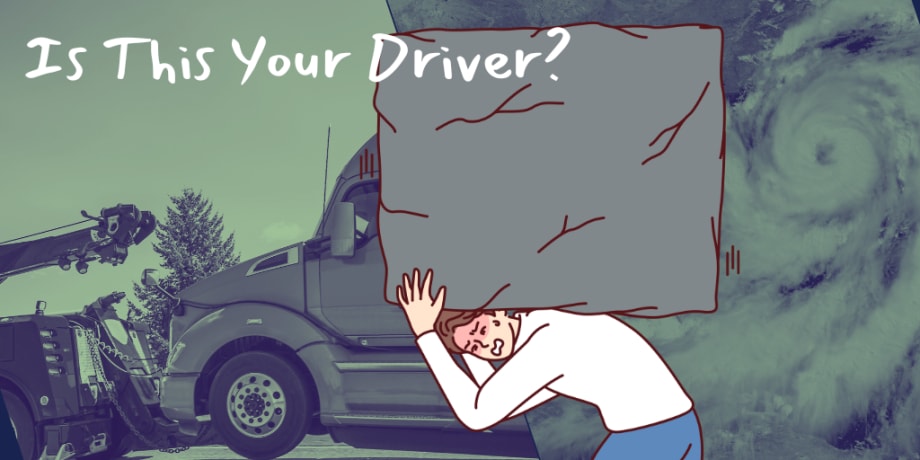
Are your fleet managers inadvertently putting unnecessary problems on your drivers' shoulders?
HDT Graphic
What makes the Best Fleets to Drive For stand out in terms of the workplace experience? What do those fleets offer their drivers (while also being well-run companies)?
For top notch fleets, the answer is that they don’t make “it” the driver’s problem. In essence, the “it” in question is any problem or issue a company is facing that ends up being downloaded onto the driver’s shoulders (but shouldn’t be).
Many companies in the industry are guilty of this and it can make life miserable for drivers. Best Fleets winners have found a way to re-take ownership of various issues and fix them at a level appropriate for the nature of the problem.
In the first part of this two-part series, we’ll look at what some of the problems are, and in part two, we’ll look at how these companies are avoiding those problems at a structural level and what other companies can do to replicate their success.
Making Maintenance the Driver’s Problem
Keeping trucks on the road requires paying steady attention to maintenance schedules and being able to respond efficiently if a breakdown happens.
Throughout the questionnaire and interview process of the Best Fleets competition, we at CarriersEdge get a chance to hear about different approaches to this sort of thing from a lot of different companies.
And the ones that appear to be well-prepared will give us a long list of maintenance schedules, describe the expertise of their mechanics and how modern their shops are. They even talk about the elaborate support contracts they have with third-party companies that handle breakdowns out on the road. That’s all great.
But when we ask them how their preventive maintenance schedules affect their drivers’ ability to keep working, a significant number told us they simply pull the driver off the road and have them wait.
Now, wait a second. If these drivers are paid by the mile, the company has suddenly made maintenance the driver’s problem. The same goes for mid-trip breakdowns.
For all the arrangements they may have with third-party support, when it comes to keeping the driver running in another vehicle, or getting them back home, or supplementing lost income or even just putting them up for the night—that’s still the driver’s problem.
Switch over to the Best Fleets winners, and you’ll start to see a different story. These companies will demand that preventive maintenance be coordinated with a driver’s time off in mind. If the driver comes in on a Friday, the work gets done on the weekend, and the driver is back at it on Monday, never having missed a mile. If the driver’s truck has more work that needs to be done, they’ll get the driver into a different truck. And out on the road.
Two things: Best Fleets winners tend to have emergency protocols for taking care of drivers when the unexpected happens, but they also tend to stay on top of their maintenance in the first place, vastly reducing the chance of a breakdown. Just because a problem affects the driver, that doesn’t mean it has to be the driver’s problem.
Making Mentoring Matter
There was a time when a mentoring program for a new recruit basically meant giving them the phone number of a veteran driver and leaving them to figure it out. The “it” in this case is the driver’s professional development, and for a long time, companies left that completely in the driver’s lap.
Because, on the one hand, shouldn’t a person’s own professional development be their responsibility? Sure, they should have a big hand in that.
But is it reasonable to expect a brand-new driver to immediately understand all the things they don't yet know, and figure out the best path to learning it?
Among the Best Fleets winners, they’ve realized that the driver’s success is also their success. Which is why so many of them have put formal coaching and mentoring programs in place.
By working out a system that provides structure, checkpoints and check-ins (not to mention opportunities for giving feedback on the process), these fleets have taken on the project of getting a recruit on a clear path of development so the driver can focus on the immediate job of actually driving.
Natural Disaster Planning
Natural disaster planning is starting to become more mainstream. That’s because, unfortunately, those kinds of disasters are (and will continue to be) more common.
When we interview fleets about this issue, a lot of the focus is on business continuity, work-from-home strategies, or redundancy for the terminal.
But what about their drivers? If they’re routed to an area that is under threat, what happens to them? Quite often, the answer we get is something like, “They’re the captain of the ship—they can decide what’s best.”
And while there is value in trusting the driver’s judgment about conditions, what these companies are really saying is, “If you want to make money, keep driving; if you make the call to stop, that’s on you.”
But there’s no reason a driver should have to choose between safety and a paycheck.
Best Fleets winners employ a set of different strategies to take ownership of this kind of issue—from pre-emptive rerouting to paid-for accommodations to paycheck guarantees—so that drivers don’t have to choose.
If a natural disaster is going to affect the company, there’s no reason that the “penalty” of delays should fall on the driver. If you prioritize safety, you have to put your money where your mouth and make it right by the driver. Driver safety should come before everything else.
How do I fix it?
The goal then, taking these three issues as examples, is to find those places in your business where responsibilities have been unnecessarily placed onto the shoulders of the driver, when in fact they belong (and are more easily solved) at the administrative level.
No doubt there are folks out there who will read this and think “that makes a lot of sense—I’ll get right on that.” They’ll create a list of responsibilities they shouldn’t offload onto their drivers.
And, that’s great.
To an extent.
The truth is, there are so many possible places where this kind of issue can pop up, it’s unlikely that you’ll see all—or even most — of them. So how do you get ahead of the problem and uncover those problems that impact drivers?
The answer to that will come in part two, where we look at changes you can make (and that Best Fleets winners have made) to the structure of the company that can help you find these pain points before they get out of hand.

Mark Murrell, President, CarriersEdge
Photo: CarriersEdge
About the Author: Mark Murrell is president of CarriersEdge, a leading provider of online driver training for the trucking industry, and co-creator of Best Fleets to Drive For®, an annual evaluation of the best workplaces in the North American trucking industry.
This contributed guest article was authored and edited according to Heavy Duty Trucking’s editorial standards and style to provide useful information to our readers. Opinions expressed may not reflect those of HDT.
More Fleet Management

Nominations Open for HDT Emerging Leaders
Heavy Duty Trucking is looking for accomplished trucking fleet professionals under 40 who are making an impact and helping lead the industry forward.
Read More →
Why Private Fleets Are Taking More Freight
Private fleets are putting their own trucks on demanding customers and high-cost lanes as companies seek greater control over service, costs, and capacity.
Read More →
Color Match Smarter: Tools That Restore & Perform
For fleet managers and collision repair professionals keeping heavy-duty trucks on the road, getting the color right the first time isn't just about appearance — it's about efficiency, turnaround time, and bottom-line results. Discover how today's digital color tools are transforming the repair process from guesswork to precision.
Read More →


FMCSA Pauses Biennial-Update Enforcement Amid Motus Transition
Carriers whose updates were due on or after June 1 have more time, while FMCSA works to stabilize its new registration system and warns of phishing sites impersonating its new carrier registration system, Motus.
Read More →
2026 Blueprint for Countering Smarter Supply Chain Theft
Cargo theft is no longer just the cost of doing business. It's a multi-billion-dollar criminal enterprise exploiting vulnerabilities across your fleet, drivers, and supply chain.
Read More →
How Telematics Improves Visibility, Control, and Performance in Refrigerated Fleets
Explore how telematics help refrigerated fleets improve visibility, uptime, efficiency, compliance, and cargo protection across connected cold chain operations.
Read More →
What the U.S.-Canada Trade War Means for Trucking
Escalating U.S.-Canada tariffs could disrupt cross-border freight, reduce truck volumes, raise costs, and create new uncertainty for carriers on both sides of the border.
Read More →
What Are Trucking’s Top Concerns for 2026?
The American Transportation Research Institute wants to know what's worrying trucking fleet managers, drivers, and other stakeholders in its annual Industry Issues survey.
Read More →
American Trucking Associations Looks for a New Leader
ATA President and CEO Chris Spear abruptly left his job at the association on August 21, at a pivotal time for the trucking industry.
Read More →
Public Wi-Fi Cybersecurity Risks: How Truck Drivers and Fleets Can Protect Their Data
Public Wi-Fi can expose truck drivers and fleets to credential theft, malware, and other cyber threats. Here’s how to reduce the risk on the road.
Read More →