




Automated Truck Weight Enforcement Comes to the Big Apple
New York City’s automated weight enforcement program for overweight trucks has already brought safer conditions to an aging half-mile portion of I-278.


New York City's Weigh-in-Motion program has led to a 64% reduction in overweight vehicles along the triple cantilever of the Brooklyn Queens Expressway.
Photo: Helena Lopes
New York City Department of Transportation (NYC DOT) Commissioner Ydanis Rodriguez announced that the nation's first automated enforcement program against overweight trucks has been a success. Known as the Weigh-in-Motion (WIM), Rodriguez said the program has already led to a 64 percent reduction in overweight vehicles along the triple cantilever of the Brooklyn Queens Expressway (BQE).
Inground Sensor Technology
NYC DOT currently operates WIM enforcement on the Queens-bound portion of the BQE triple cantilever in downtown Brooklyn, a portion of the I-278 highway known as "BQE Central."
During the first seven months of automated enforcement, a monthly average of 2,769 overweight trucks crossed the triple cantilever. Prior to the launch, a monthly average of 7,777 overweight trucks had traveled the same portion of the highway the seven months leading up to the launch of the program.
"New York City is leading the nation in efficiently and effectively keeping overweight trucks off the road through inground sensors on the BQE," said deputy mayor Meera Joshi. "This transformational technology protects and prolongs the lifespan of our critical infrastructure, like the triple cantilever portion of the BQE, and improves safety for all road users. We're grateful to our legislative partners who enabled this impactful program and look forward to expanding its use in New York City."
"Last year, we launched the nation's first automated enforcement program to protect the Brooklyn Queens Expressway from overweight vehicles – and it has yielded dramatic results," Rodriguez added. "Thanks to cutting edge roadway sensors, we have reduced the number of overweight vehicles on the BQE by 64 percent, reducing wear and tear on this critical infrastructure and extending its useful life."
The decline comes as the overall number of vehicles, including trucks, remains steady, with the share of overweight trucks falling from about 6.3 percent of all trucks on the roadway to 1.9 percent in most recent months.
The automated enforcement program on the BQE is in effect on the city-owned section of the BQE, between Atlantic Avenue and Sands Street, and was authorized by the enactment of S6246/A6225, sponsored by New York State Senator Andrew Gounardes and New York State Assemblymember Jo Anne Simon, and signed into law by New York Governor Kathy Hochul on July 28, 2023. Council Member Lincoln Restler also led the passage of a home rule message from the New York City Council in support of the state legislation.
Additional WIM Efforts Planned
Following the success of Queens-bound enforcement on the BQE, NYC DOT plans to launch WIM enforcement for Staten Island-bound traffic by the end of 2024. As with the Queens-bound portion last year, activation of violations will follow a well-publicized 90-day warning period.
"I'm pleased to see that WIM enforcement is working to prevent costly damage to Brooklyn's infrastructure," said Brooklyn Borough President Antonio Reynoso. "While we need to ensure that overweight trucks do not cause additional damage, it remains critical that we reimagine the BQE from top to bottom. I thank the NYC DOT for the success of their WIM enforcement and look forward to continued collaboration with government partners and community members to reimagine the BQE."
"As we consider the future of the BQE, I commend the NYC Department of Transportation for taking innovative steps to significantly lower the number of overweight trucks using the triple cantilever portion, whose structural integrity is increasingly at risk because of their passage," said Congressman Dan Goldman. "This automated enforcement measure has improved road safety for the surrounding communities and commuters alike, providing more time to solicit community input for any future redesign of the structure. As we chart a path forward, I will continue partnering with city, state, and federal officials to ensure any reimagining of the BQE brings equity, fairness, and justice for those adversely affected by the highway."
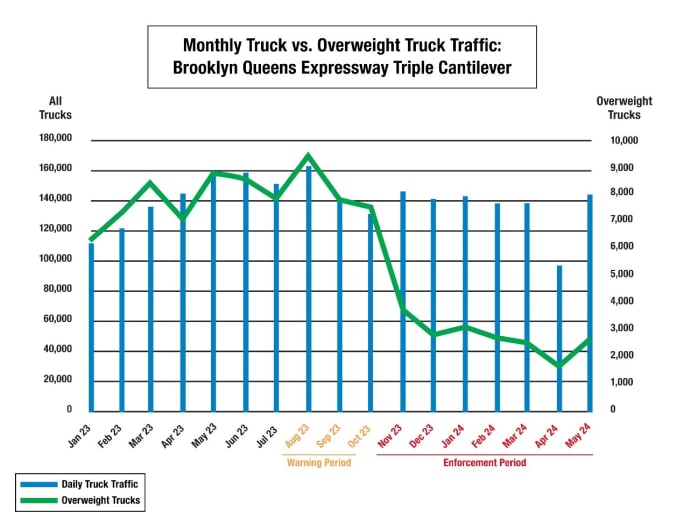
During Weigh-in-Motion's first seven months in operation, the system tracked a monthly average of 2,769 overweight trucks.
Graphic: NYDOT
"I'm thrilled that our first-in-the-nation WIM program is successfully getting rid of illegally overweight trucks that have caused significant damage to the BQE triple cantilever and to our environment," said Assemblymember Jo Anne Simon. "The WIM program will help extend the useful life of the BQE and give us time to reimagine the BQE as a 21st-century transportation corridor that reduces our reliance on polluting trucks and prioritizes climate justice. I'm proud of the effective collaboration between the city and state to enact my law and implement this innovative program. Thanks to NYC DOT for implementing WIM and to the BQE expert panel who first recommended we consider this technology."
"Weigh-in-Motion technology has successfully eliminated two out of three overweight trucks that had been illegally driving on the Queens bound portion of the triple cantilever of the BQE. We hope to see a similar reduction on the Staten Island side when it is finally implemented to help extend the lifespan of the triple cantilever structure," said Councilmember Lincoln Restler.
More Safety & Compliance

Marijuana and Trucking’s Drug-Testing Dilemma
Marijuana is getting stronger, laws are changing, and drug tests still can’t reliably establish impairment. What does that mean for truck drivers and the fleets that employ them?
Read More →
PrePass, Kodiak Connect Driverless Trucks to Roadside Enforcement
The system will allow enforcement agencies to verify Enhanced Inspection information and decide whether Kodiak’s autonomous trucks can bypass roadside screening sites.
Read More →
From One Generation to the Next: How Mentorship Builds Safer Truck Drivers
After three decades in trucking, Harold Perry shares what he's learned about driver safety, mentorship, and helping the next generation build confidence behind the wheel.
Read More →
FMCSA Pauses Biennial-Update Enforcement Amid Motus Transition
Carriers whose updates were due on or after June 1 have more time, while FMCSA works to stabilize its new registration system and warns of phishing sites impersonating its new carrier registration system, Motus.
Read More →
ZF Expands Commercial Vehicle Push in North America
ZF is expanding its North American commercial-vehicle presence with new transmission applications, electrification, trailer technology and autonomous-driving systems.
Read More →
Truck Drivers Need More Than Another Alert
Fleets have more visibility into truck health, safety events, and driver activity than ever. The next challenge is turning all that information into useful guidance for the person who has to decide what to do next.
Read More →
Tesla Wants a Self-Driving Semi. Are Cameras Enough?
Could Tesla’s camera-only autonomous driving technology work on an 80,000-pound Semi? In this commentary, HDT's Deborah Lockridge takes a look at Tesla, Cybercab, and how autonomous trucks see the road.
Read More →
What DOT’s Automated Vehicle Strategy Means for Trucking
The U.S. Department of Transportation issued a new automated-vehicle strategy that outlines plans for driverless-truck regulations, cross-state freight corridors, and federal safety standards.
Read More →
NYC Expands Speed, Pedestrian Safety Tech Across Fleet
New York City is expanding intelligent speed assistance and pedestrian-alert systems across its municipal fleet, moving the technologies from pilot programs into vehicle procurement and retrofit requirements.
Read More →
FMCSA Removes 110 Truck Driver Training Schools from Certified ELDT List
Federal regulators also are targeting more than 160 additional training providers and launching a nationwide audit of third-party CDL skills testers as part of a broader crackdown on trucking fraud.
Read More →