




Joint Venture Starts Electric Truck Pay-Per-Use Pilot
Juna, a joint venture between European companies Scania and Sennder Technologies, are piloting a program in Germany that pairs carriers with shippers in a pay-per-use model for battery-electric trucking.

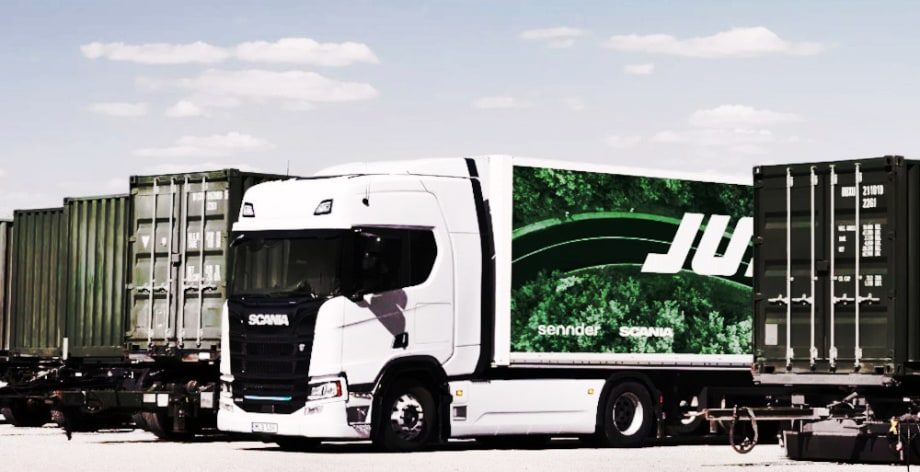
Juna, a joint venture, uses Scania battery-electric trucks in a partnership deal that also relies on Sennder Technologies and its ability to connect carriers with shippers.
Photo: Juna
Scania CV AB and digital road freight forwarder Sennder Technologies have formed Juna, a joint venture to introduce a pay-per-use model that provides European transport companies with access to electric truck solutions and guaranteed capacity.
By combining Sennder’s advanced technology with Scania’s electric truck offering, Juna aims to advance electric truck adoption, in line with the European Automobile Manufacturers’ Association's 2020 joint declaration with climate scientists committing to a goal that "by 2040 all new commercial vehicles sold must be fossil free.”
Scania said by combining its electric trucks and services with Sennder’s technology for connecting small and medium carriers with big-name shippers, Juna is leveraging the strength of both companies to accelerate the decarbonization of European road freight logistics.
Pay-Per-Use Model
Scania said Juna is introducing a pay-per-use model for electric trucks that will effectively clear the way for large-scale adoption of electric trucks.
Scania said Juna removes the obstacles to electric truck adoption, such as financial challenges associated with high upfront costs, residual value, and technology risk, and provides transport companies with commercial predictability through guaranteed incomes.
“Given that e-trucks cost two to three times more than diesel trucks and that 70% of all trucks in Europe are owned by small carriers with fewer than 10 trucks, the combination of Juna’s pay-per-use offering and Sennder’s capacity utilization will effectively remove the barriers to adopting e-trucks,” said David Nothacker, CEO of Sennder.
Pilot Project Launched
Scania said Juna’s innovative model offers the full package, including premium electric vehicles, repair, maintenance, insurance, digital, and analytics services. In addition to usage-based fees and guaranteed utilization, through data analysis, Juna optimizes electrification strategies and simulates routes for electric truck suitability.
A pilot project has recently launched, according to Scania. The first customer is using an electric truck supplied by Juna charged with renewable energy and performing up to 10 lanes per week just like its diesel predecessor.
The truck is operating for a well-known fast moving consumer goods shipper in the region of Stuttgart, Germany, according to Scania. The project relies on existing public charging infrastructure, with per-kilometer costs comparable to current diesel charges.
The first truck alone, Scania said, has the potential to achieve an annual reduction of 93 tonnes of CO2-equivalent emissions.
The pilot’s scope will be expanded to include long-distance routes during 2024.
More Fuel Smarts

Fleet Economics Shape Electric Truck Outlook
ACT Research expects costs, charging infrastructure, and technology improvements to drive zero-emission commercial vehicle adoption as federal regulations and incentives retreat.
Read More →
Wex Adds Cardless Fuel Payments for Over-the-Road Customers
A new fuel card feature for Wex customers offers convenience and security.
Read More →
New California Law Could Shed Light on Electric Truck Prices
Why do battery-electric Class 8 trucks remain so expensive? A California bill signed by Gov. Gavin Newsom would give fleets and state agencies more visibility into what manufacturers charge.
Read More →

How Volvo Updated Its D13 for EPA 2027 [Watch]
Volvo’s updated D13 promises lower emissions without sacrificing performance or fuel economy. Take a closer look at what changed inside the engine in this HDT Spotlight video.
Read More →
Diesel Price Spike Shortens Payback for Natural Gas Trucks, Report Says
Energy Vision estimates fleets could recover the higher purchase price of an RNG-fueled Class 8 tractor in 1.3 to 2.8 years under current fuel-price scenarios.
Read More →
Calstart Becomes Catalyst Mobility, Reflecting Broader Focus
Calstart is now Catalyst Mobility, reflecting the nonprofit’s growing national role in clean transportation, including zero-emission trucks, infrastructure and incentive programs.
Read More →
Record Diesel Prices Squeeze Trucking Fleets
Average U.S. diesel prices have climbed to nearly $6 a gallon, surpassing the 2022 record as tight refinery capacity and Middle East disruptions keep fuel costs elevated.
Read More →
How Fuel Delivery Shapes Engine Performance
Fuel delivery depends on more than what happens at the injector. For fleet, maintenance and technical professionals, looking at the full path from pump to injector can provide useful context for understanding engine performance.
Read More →
East Coast Port Launches $45M Electric Truck Push
The Port Authority of New York and New Jersey announced millions in incentives for zero-emission drayage trucks, yard tractors, and new charging hubs near the port.
Read More →
Detroit Opens Orders for EPA 2027 Engines
Detroit isn’t starting from scratch to meet EPA 2027 diesel emissions standards. Its Gen 6 DD13 and DD15 engines keep much of today’s platform while updating the fuel and aftertreatment systems.
Read More →