




Two Fleets Join Run on Less - Electric Depot Trial
Two more fleets have joined the North American Council for Freight Efficiency’s Run on Less – Electric Depot electric truck and charging infrastructure trials.

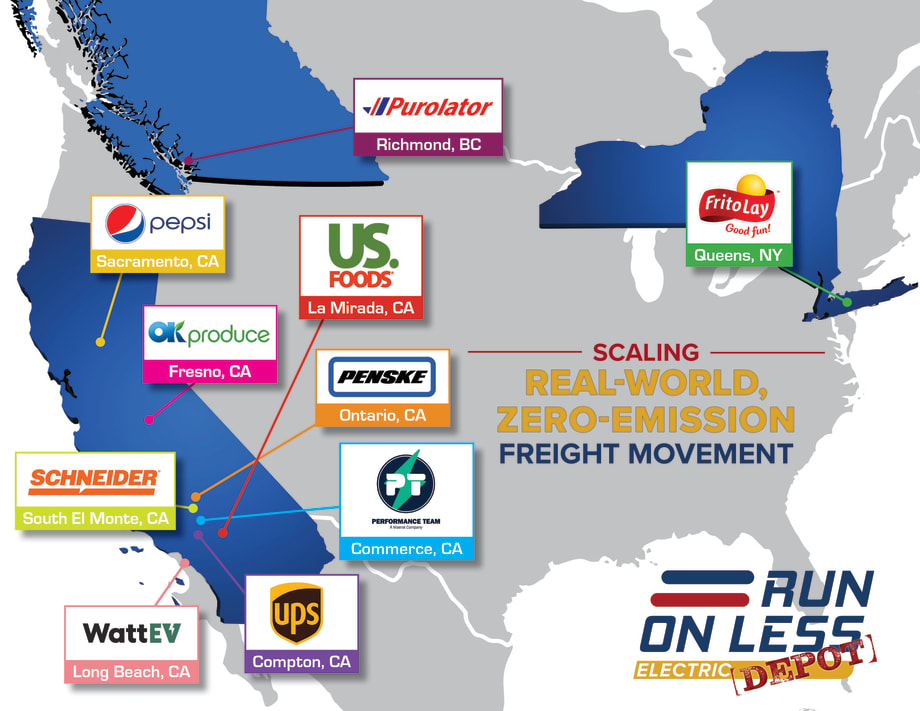
Purolator and U.S. Foods have joined NACFE's Run on Less E--DEPOT BEV trials, bringing the total number of partcipating fleets to 10.
Photo: NACFE
Two more fleets have joined the eight fleets already signed on for the North American Council for Freight Efficiency’s Run on Less - Electric Depot.
Run on Less – Electric Depot is a vehicle and operational trial that will evaluate battery-electric truck performance in real-world fleet operations. The study will also look at the current state of electric charging infrastructure for those fleets.
It also will work to determine best practices for procuring, installing and using new electric truck charging infrastructure in fleet operations.
Purolator, located in Richmond, British Columbia, and US Foods in La Mirada, California, will participate in the Run along with Frito-Lay, OK Produce, Penske, PepsiCo, Performance Team, Schneider, UPS and WattEV.
“We are thrilled to have so many fleets interested in being in Run on Less – Electric Depot and are looking forward to learning more about the operations at Purolator and US Foods,” said Mike Roeth, NACFE’s executive director. “It’s exciting to have a Canadian fleet participating and great to add another California fleet too.”
NACFE also has determined which trucks it will be following at the 10 truck depots participating.
Different Vehicles for Different Applications
“We are pleased that we will be following a variety of trucks during the Run,” Roeth said. “Some of the trucks are from manufacturers that did not participate in Run on Less – Electric in 2021. Others are from some of the biggest new names in trucking. And we are focusing on trucks of all sizes.”
These trucks include:
Two Ford eTransit vans at the Frito-Lay facility, which will be tracked operating in urban delivery.
At Penske, a GM BrightDrop, a Navistar eMV and a Freightliner eCascadia, representing light-, medium- and heavy-duty duty cycles, will be followed.
Two Tesla Semis at Pepsico will be tracked in heavy-load long-haul transport operations.
Two electric Volvo VNRs run by Performance Team will be tracked conducting short-haul port routes.
At Purolator, a Class 6 Motiv step van and a Ford eTransit will be tracked in e-commerce package delivery.
At OK Produce, a Volvo VNR Electric and an Orange EV terminal tractor will be tracked in local fruit and vegetable deliveries and terminal tractor applications, respectively.
Schneider’s two Freightliner eCascadias operating in slip-seated drayage will be tracked.
At UPS, a Freightliner Custom Chassis last-mile step van and a Freightliner eCascadia in a middle-mile duty cycle will be tracked.
At US Foods, two Freightliner eCascadias will be tracked in food delivery applications.
At WattEV, two Nikola Tre BEVs operating at the Port of Long Beach will be tracked.
Data Drives the Run
“We will be able to share more about these trucks and the data we will be capturing following our site visits to these 10 depots this summer,” Roeth said.
Throughout August and leading up to the Run starting on Sept. 11, NACFE will post Depot Profiles on its website that will detail the aspects of the infrastructure, trucks, routes and drivers.
While ROL-Electric Depot will focus on chargers and infrastructure, Roeth said, "The trucks are a key element of the Run, and having data on a variety of equipment will help fleets operating in a variety of duty cycles learn more about how to add electric vehicles to their operations."
The Run is made possible through sponsorships with PepsiCo as an executive sponsor and Cummins and Shell as title sponsors as well as a host of companies that are event and supporter sponsors.
Daily updates RoL--E Depot can be found on the NACFE website.
More Fuel Smarts

How Volvo Updated Its D13 for EPA 2027 [Watch]
Volvo’s updated D13 promises lower emissions without sacrificing performance or fuel economy. Take a closer look at what changed inside the engine in this HDT Spotlight video.
Read More →
Diesel Price Spike Shortens Payback for Natural Gas Trucks, Report Says
Energy Vision estimates fleets could recover the higher purchase price of an RNG-fueled Class 8 tractor in 1.3 to 2.8 years under current fuel-price scenarios.
Read More →
Calstart Becomes Catalyst Mobility, Reflecting Broader Focus
Calstart is now Catalyst Mobility, reflecting the nonprofit’s growing national role in clean transportation, including zero-emission trucks, infrastructure and incentive programs.
Read More →

Record Diesel Prices Squeeze Trucking Fleets
Average U.S. diesel prices have climbed to nearly $6 a gallon, surpassing the 2022 record as tight refinery capacity and Middle East disruptions keep fuel costs elevated.
Read More →
How Fuel Delivery Shapes Engine Performance
Fuel delivery depends on more than what happens at the injector. For fleet, maintenance and technical professionals, looking at the full path from pump to injector can provide useful context for understanding engine performance.
Read More →
East Coast Port Launches $45M Electric Truck Push
The Port Authority of New York and New Jersey announced millions in incentives for zero-emission drayage trucks, yard tractors, and new charging hubs near the port.
Read More →
California Bill Could Shed Light on Electric Truck Prices
Why do battery-electric Class 8 trucks remain so expensive? A California bill headed to Gov. Gavin Newsom would give fleets and state agencies more visibility into what manufacturers charge.
Read More →
Detroit Opens Orders for EPA 2027 Engines
Detroit isn’t starting from scratch to meet EPA 2027 diesel emissions standards. Its Gen 6 DD13 and DD15 engines keep much of today’s platform while updating the fuel and aftertreatment systems.
Read More →
Zero-Emission Truck Corridor Planned for West Coast
California, Oregon, Washington, British Columbia and Baja California are coordinating plans for truck charging and hydrogen fueling from Canada to Mexico.
Read More →
A Closer Look at Kenworth’s Electric T880E Vocational Truck [Video]
Learn more about Kenworth's T880E battery-electric vocational truck at the Paccar Technical Center, including its range, applications, upfitting considerations, and PTO options, in this HDT Spotlight video.
Read More →