Whether you set rates by hours or miles, set them based on your trucking business.
Photo: Gettyimages.com/MicroStockHub
5 min to read
The need for a carrier to know its costs is ancient history. Five thousand years ago, the first cart builders noodled out how much to charge to haul stuff. But that doesn’t mean everyone does it well.
Ad Loading...
Setting rates can become a commonplace exercise. The danger is that as time slides by, how rates are set can become unmoored from reality — or drift into the purview of employees who are not up to speed on costs.
The answer would seem simple: Get better data faster, analyze it faster, and get it into the right hands faster. But what is ever simple in trucking?
Ad Loading...
To explore this challenge, HDT spoke with two fleet management experts known for thinking outside the box: Steve Rush, CEO of Carbon Express, and Darry Stuart, president/CEO of DWS Fleet Management Services.
Bypassing Willy-Nilly
“It always strikes me when fleets let their salespeople, even their dispatchers, set rates willy-nilly without having a true picture of the company’s costs,” says Rush, founder and owner of the Wharton, New-Jersey-based specialized tanker fleet. “I’ve no idea how many fleets allow this, but it appears to be very common.”
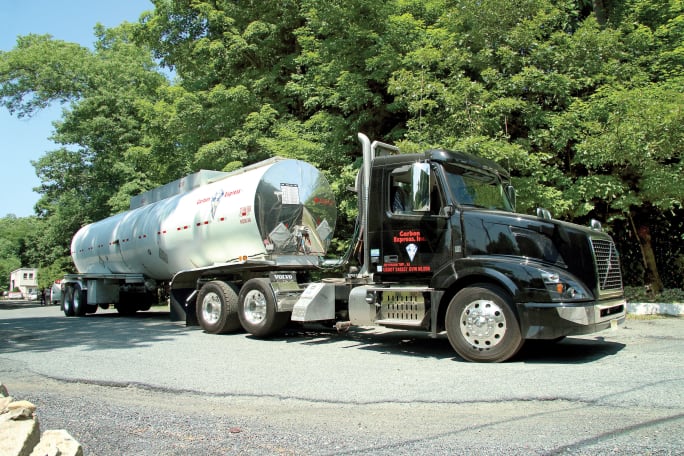
“We’ve not rated by the mile in 10 years,” says Steve Rush. “Our quote is always the number of hours to complete the trip times our hourly rate.”
Photo: Carbon Express
When he was transitioning in 1983 from owner-operator to a small fleet with his own authority (launching with 10 tractors and 10 trailers), Rush says, Carbon Express set rates “flying by the seat of our pants.”
Then the company grew more efficient, and smaller carriers couldn’t match its rates. “On the other hand, a large tank fleet said to me 10 years ago, ‘You have 30 trucks and I have 3,000, so I can do it cheaper.’ But they aren’t big because they’re cheap.”
Weighing Time
Then technology took a hand. Rush says that once changes to the hours of service rules kicked in, Carbon Express started to rate based on time.
Ad Loading...
“For example, I asked our controller if he could build an hourly rate for some brand-new business going into New York City, made up of short daily trips. You really can’t look at that type of job by miles. You need to look at in hours. Because in the city, the time you spend there can vary day to day.”
Despite such compelling logic, he says, “a lot of shippers want to be quoted a catchall rate. Instead, we look at all the variables for us to come up with an hourly rate.” The company looks at running costs, expenses (including for layovers, as his drivers overnight in motels), location factors, and lane density to come up with an hourly rate.
“You can’t capture all that by the mile,” Rush says. “We’ve not rated by the mile in 10 years. Our quote is always the number of hours to complete the trip times our hourly rate.”
Rating on time factors in the varying costs of running Carbon Express’ 13 different tank configurations for hauling bulk liquids. These include stainless insulated, stainless non-insulated, aluminum insulated, and aluminum-non insulated single and multi-compartment trailers. The fleet also runs flatbeds that can haul regular and hazmat loads. And the carrier operates a network of over 20 terminals, stretching from the Northeast to Florida and Colorado.
“Rating by the hour will open eyes,” he adds. “Customers may have to grasp the concept, but once they do, they see it is more transparent.”
Ad Loading...
Playing Horseshoes
“It’s tough to get your arms around everything, but you want to track all your costs,” says Wrentham, Massachusetts-based Darry Stuart, a 35+ year trucking veteran who provides a range of management services to fleets in various industry segments.
“It really comes down to how deep you want to drill — and that means how much do you want to spend to get accuracy,” Stuart says. “It’s like horseshoes. You can win just by getting close. If you set rates that way, it becomes about offering what it takes to get the business or to quote a deal.” If you don’t have accurate cost information, you don’t know how profitable — or unprofitable — that rate will be.
"It really comes down to how deep you want to drill — and that means how much do you want to spend to get accuracy,” says Darry Stuart.
Photo: Jim Park
“If you don’t capture everything, your costs will only be so accurate,” he says. “Most fleets track costs by dividing checks by cost per mile or hour. And then they measure that against other fleets.”
He cautions that “if you look at all fleets to get costs, you’re assuming everyone is on a level playing field. But they’re not. Every company has its own variables. So, you want to set rates at a given time, keeping in mind what the customer wants done. Today, it’s more about moving the freight.”
Stacking the Rate
With that approach in mind, Stuart lays out an example: “Look at a lane, in this case one from New York City to Boston. Build the rate by stacking your known costs. Start by dividing the cost of fuel to see its cost per mile based on average mpg. Say that’s roughly 80 cents a mile. With a driver cost of 40 to 60 cents per mile, you can put labor at a buck a mile. Take a stab at maintenance, maybe that’s 20 cents per mile. Throw in overhead. And don’t forget any tolls and extra time spent, as in driving in Manhattan, on the route.
Ad Loading...
“By the time you’re done,” he continues, “maybe you’re at $4 per mile and you say, ‘I can’t ask that!’ But if you know roughly where the competition is at, and you need this piece of business, truck utilization becomes the key. You get to a minimum price to run the freight. And then volume comes into play.”
While the “majority of routes end up being reasonably marginal, when someone calls you with a hot load, then they may go for that $4 rate,” he says. “And that’s why established rates should only be seen as a guideline.”
He also suggests that for some fleets, in the long term, moving customers to dedicated runs may be the best solution. Again, the best rates are the ones that are based on your fleet’s costs and other factors specific to your company.
“A lot of freight deals today are being put together on the basis of ‘we’ll pay you X percent over your costs.’” Stuart says. “The trucking company doesn’t lose this way, but it’s not for a typical LTL fleet. Truckload carriers can run it that way.”
Stuart offers another thought on tackling rates. “If you’re not willing to sign a one- or two-year agreement with shippers, you’ll be left to how your salesman wants to set rates.”
Ad Loading...
How the Pandemic Hit Costs
A key to assessing if your costs are generally in line or somewhat out of whack is to consult a trusted industry source, such as the American Transportation Research Institute’s annual report, “An Analysis of the Operational Costs of Trucking.”
The latest edition is based on detailed 2020 financial data provided by motor carriers of all sectors and fleet sizes.
“The various line-item cost centers clearly document the numerous impacts that the COVID-19 pandemic had on trucking and the economy in general,” ATRI observed.
In addition, the findings document the effect that faster truck speeds — due to low overall traffic levels during the pandemic — had on multiple line items. And also apparent were the sector and commodity volatility that occurred as consumers were forced to dramatically change spending habits.
Some of the other “considerable” COVID-19 impacts included:
● Deadhead miles jumped by 20.6%.
● annual operating miles fell to 89,358 miles per truck.
● fuel costs dropped by nearly 20% in 2020, to 30.8 cents per mile.
Unrelated to the pandemic, insurance costs kept climbing, soaring more than 18% to 8.7 cents per mile — marking the highest uptick in the report’s history.
An interesting pair of stats is that while truck driver wages increased from 2019 to 2020, benefits costs per mile decreased. Overall, driver compensation was 73.7 cents per mile. Safety and retention bonuses increased by 10.5% and 14.2%, respectively. On the other hand, starting bonuses dropped by 10%, reflecting the soft driver marketplace in early 2020.
The average marginal cost per mile for motor carriers in 2020 dropped by 5 cents per mile to $1.64. Hourly costs dropped slightly to $66.87.
This article first appeared in the April 2022 issue of Heavy Duty Trucking.
The new card combines fuel discounts with telematics-based purchase controls. Geotab’s analysis also points to potential savings from choosing lower-priced fuel stops.
Trucking and logistics teams have plenty of data. The problem is getting the right information in front of the right people soon enough to act. Better-connected data can help teams spot trouble earlier and make smarter decisions before small problems become big ones.
At Insight 2026, Trimble executives argued that fleets may need to redesign workflows to get more from AI as it introduced new products and enhancements. AI’s value will depend on how fleets combine automation with their people's knowledge.
An ELD can prove compliance, but it cannot always prove what happened on the road. Discover how uniting accurate ELD data with AI-powered dash cam video can help your fleet strengthen compliance, defend against liability, protect drivers and reduce operational costs.
Private fleets are putting their own trucks on demanding customers and high-cost lanes as companies seek greater control over service, costs, and capacity.
For fleet managers and collision repair professionals keeping heavy-duty trucks on the road, getting the color right the first time isn't just about appearance — it's about efficiency, turnaround time, and bottom-line results. Discover how today's digital color tools are transforming the repair process from guesswork to precision.
Carriers whose updates were due on or after June 1 have more time, while FMCSA works to stabilize its new registration system and warns of phishing sites impersonating its new carrier registration system, Motus.
Cargo theft is no longer just the cost of doing business. It's a multi-billion-dollar criminal enterprise exploiting vulnerabilities across your fleet, drivers, and supply chain.