Nikola Could Roll Electric Trucks Off the Line by Late 2021
Electric heavy-duty trucks – including a Euro-style high cabover for the North American market – could begin driving off the assembly line at Nikola's new Coolidge, Arizona, manufacturing facility in as little as 12-14 months, albeit in hand-built, very limited numbers.
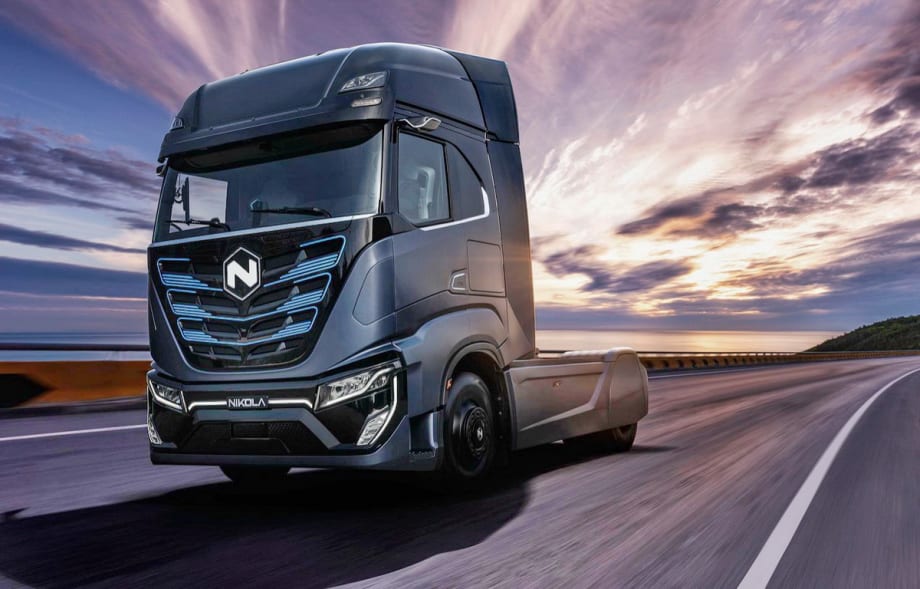
Nikola says the first truck to come off the assembly line at Coolidge, Arizina will be a battery-electric version of the Tre COE. A Fuel-cell version will follow about a year later.
Photo: Nikola
7 min to read
Electric heavy-duty trucks – including a Euro-style high cabover for the North American market – could begin driving off the assembly line at Nikola's new Coolidge, Arizona, manufacturing facility in as little as 12-14 months, albeit in hand-built, very limited numbers.
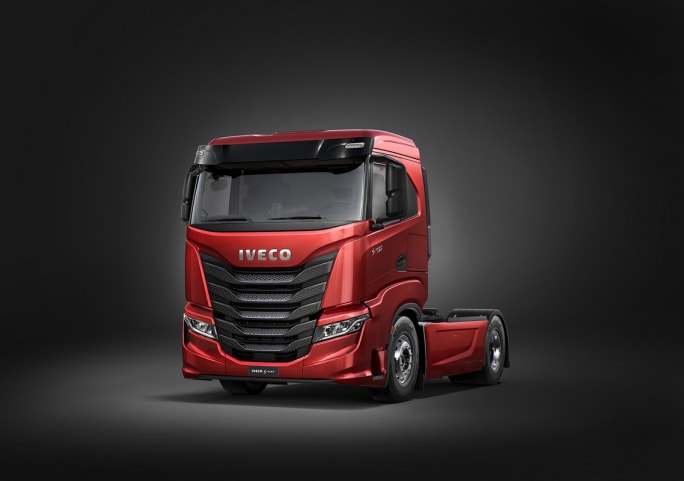
The first trucks to roll off the line will be battery-electric versions of the Tre, which is based on the newly minted Iveco S-Way European cabover tractor, unveiled in July 2019 in Madrid, Spain. It's the successor to the long-running Stralis model.
Ad Loading...
Nikola Executive Chairman Trevor Milton said the company partnered with Italian truck-maker Iveco to gain the advantage of its manufacturing experience. The relationship will see Nikola's battery-electric and hydrogen fuel cell technology sold in Europe in Iveco chassis under the Nikola badge.
“That was something we lacked at Nikola, and [Iveco] has 20-30 years of experience in building chassis,” Milton said. “We have a lot of experience, but we wanted people that have been in the field, people that are experts; chassis manufacturing experts, warranty service and maintenance experts, and we got that with Iveco.”
On the Fast Track to Electric-Truck Production
Nikola's plan is to get one building up and running with very limited capacity while the rest of the facility is completed. That first phase should be complete next year. The second phase will be completed about 12 months following that, and then the third phase about 12 months later, sometime in 2023.
Ad Loading...
Capacity will ramp up gradually. By the time production hits its stride, the plant is expected to produce about 35,000 trucks per year on two shifts. Output will be a mix of battery-electric and fuel-cell electric trucks, in the Nikola Tre and Nikola Two models, with different versions for different applications.
“The total spending, when we're done, will be around $600 million,” Nikola's new CEO, Mark Russell, told HDT in an interview.
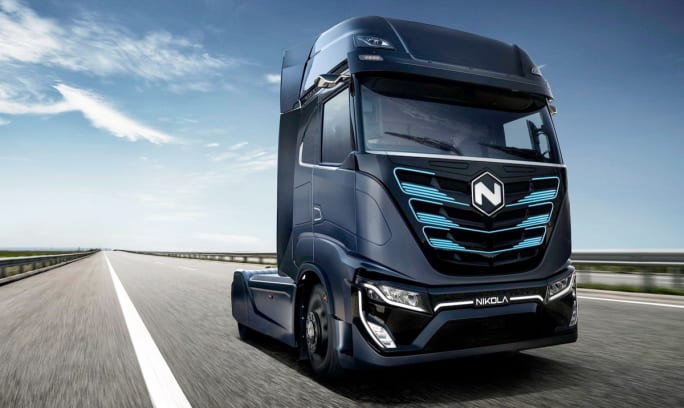
Five Tres are currently being built at an Iveco plant in Ulm Germany. They will be tested and validated there before they're brought to America to be built here, says Nikola boss, Trevor Milton
Photo: Nikola
“In most construction projects of this size, it takes months to develop the engineering to be able to do this,” said Mark Duchesne, Nikola's head of Global Manufacturing, in remarks made during the groundbreaking ceremony on July 23. “We are truly fast-tracking this to get going as fast as we possibly can. Trevor said we'll have the buildings up in 12 months. I'm going to say today that I’m going to try to do much better than that. I'm going to try to build things up in six months and start building trucks here as soon as we possibly can, while we finish off the rest of the construction."
In remarks prior to the groundbreaking ceremony, Milton said, “We will be the first OEM that we know of to hit the market with a 300-plus-miles, zero-emission semi-truck. We have five of them coming off the assembly line right now in Ulm, Germany. They're being built in Germany, tested in Germany, validated in Germany, and they're brought to America to be built here.”
Milton has said that battery-electric trucks, both Tre and Two, will emerge first, followed about a year later by the fuel-cell versions.
Ad Loading...
The plant is modeled on the Toyota concept, where any number of different models can be built on the same production line. Russell said they will be able to adapt the line to build fuel-cell as well as battery-electric trucks on cabover (Tre) or conventional (One and Two) platforms in different configurations for certain target markets.
Duchesne, Nikola's head of Global Manufacturing, has 20 years of experience with Toyota, and Nikola's production partner, Iveco, uses much the same approach at its plant in Madrid.
“Iveco produces a multitude of different vehicles on the same line at that facility,” Russell said. “To make that work, you need a certain level of standardization. We will have a base platform that'll be global with variations on that base platform for each application.”
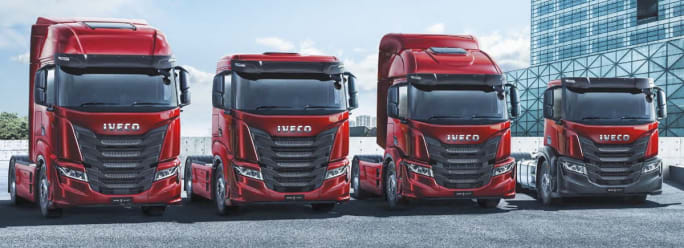
The complete Iveco S-Way line includes four models, from a high-roof double bunk highway truck, to low-roof day cab.
Photo: Iveco
The COE Makes a Comeback
There has long been a simmering demand for the return of COE heavy-duty tractors in the U.S., though probably not enough to convince a major OEM to retool a line for limited production. Freightliner's Argosy, for example, proved pretty popular in glider kit form until the anti-glider wave swept it back out to sea.
Russell said Nikola’s COE Tre model proved more than a curiosity when it appeared on the show floor at Nikola World in April 2019. It was originally slated for just the European market, but in the fleet meetings that followed the event, more than a few North American fleets expressed interest in the Tre.
Ad Loading...
“From the first group of fleets that came in to the last, almost universally, they said, ‘if you build that truck for the U.S. market, we would buy it for our urban and metro delivery applications,’” he said.
Many of the reasons COE tractors disappeared from American highways wouldn't apply in this case, like poorer aerodynamics at highway speeds and less-than-ideal driver conditions, such as sitting atop a roaring diesel and very stiff 12,000-pound suspension. The drivers who operated COEs weren't sad to see them go. However, in an urban setting, maneuverability and visibility are unsurpassed. Fewer highway miles means that poorer aero isn't a big negative.
And then there's the European heritage of the Tre.
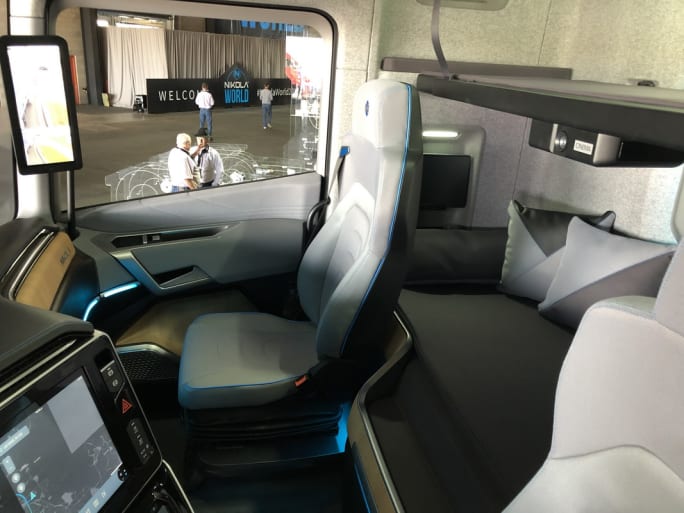
This image, captured at Nikola World in April 2019, shows the interior of the Tre on display there with upper and lower bunks and camera/displays rather than traditional mirrors.
Photo: Jim Park
Anyone who has ever driven a European COE tractor will tell you they are nothing like their American cousins. The ride better than many North American conventionals, aero is surprisingly good for their shape, and since in this case there’s no noisy diesel to deal with, an electric Euro COE would be a treat to drive.
Converting a European Tre to North American won't be difficult, Russell said. Many of the previous hurdles were emissions-related, but since there's no diesel, there’s no emissions to worry about. Refitting North American braking systems to the truck is just a matter of engineering. Many North American components would find their way onto the chassis fairly seamlessly, such as suspensions and axles. And of course, it would be offered in more reasonable wheelbases and 6x2 configurations, because the length restrictions that keep the European trucks short won't apply here.
Ad Loading...
BEV, FCEV & Range
The North American version of the Tre will have one advantage over the European version: more room for batteries. European regulations limit the wheelbase to about 4 meters (158 inches), while here batteries are constrained more by cost and weight than by frame space.
The current plan calls for 720 kW/hr of capacity with a range of 300 miles. That bests the current eCascadia's 550-kWh battery pack and 250-mile range.
“You can't let the batteries get so big and heavy that they take away some [payload capacity] or get so expensive that they price the vehicle out of the range of affordability,” said Russell. “We think that 300 miles of range, depending on the route parameters, and something like 720 kilowatt hours on board is what the market needs. We think that will cover 90-plus-percent of the use cases for local delivery.”
Nikola will use a modular battery array, Russell said, with nine modules in a 3x3 arrangement: three between the frame rails and three on each side outside the frame. At 720 kW/hr, using a nominal weight of 15 pounds per kilowatt/hour, the Tre's battery complement might weigh somewhere between 8,000 to 10,000 pounds.
This Iveco mid-roof model is equipped with a 23-inch single bunk.
Photo: Iveco
“If we had to take one row out in a 4x2 setup, that takes our battery capacity down by a third,” Russell said.
Ad Loading...
The first Tre trucks seen here will be tandem setups in all likelihood, though whether fleets opt for the 6x4 or 6x2 configuration remains to be seen. As for the Tre itself, in Europe, the Iveco S-Way is offered in four standard configurations: tall-roof/two-bunk; medium-roof/two-bunk; low-roof/single-bunk; and short-roof/day-cab. It’s also offered overseas as a rigid model, or straight truck as we call them.
The Tre seen on most of the literature, on the Nikola website, and on the floor at Nikola World last year was the tall-cab double-bunk version. Nikola has not confirmed which variant we'll see here when production begins.
The low-roof single bunk model would be a more practical truck for urban and metro deliveries. Nikola hasn't said positively one way or another which version of the S-Way-modeled Tre we will see first in North America.
Photo: Iveco
“We will start with one configuration of the Tre BEV, but will do at least one variation, the Tre FCEV, on that base,” Russel said. “Of course, in the longer-term future we may do additional variations, but the BEV and FCEV versions are the two that will be coming to market in 2021 and 2023, respectively.”
Nikola has said there's a great deal of standardization between the Tre and Two models in both the BEV and FCEV versions, so producing each variant on the assembly line won't be a huge challenge.
Finally, Russell told HDT the marketing plans for the FCEV versions of either truck will be on a bundled lease arrangement, while the BEV version will likely be outright purchases.
Ad Loading...
“The customers, so far, are interested in buying the battery truck outright,” he said. “And I think the major reason for that is battery and battery charging infrastructure. It’s relatively easy for them to install, and those trucks will be returning to base overnight to recharge. They don't have the same concerns about charging a BEV that they have about the fuel-cell trucks. Not everyone can put in a hydrogen station, and we take care of all that in the bundled lease.”
Volvo’s updated D13 promises lower emissions without sacrificing performance or fuel economy. Take a closer look at what changed inside the engine in this HDT Spotlight video.
The Michelin X Multi Energy D2 is a regional haul drive tire engineered to help fleets improve fuel efficiency, durability and traction in demanding stop-and-go operations.
ZF is expanding its North American commercial-vehicle presence with new transmission applications, electrification, trailer technology and autonomous-driving systems.
Could Tesla’s camera-only autonomous driving technology work on an 80,000-pound Semi? In this commentary, HDT's Deborah Lockridge takes a look at Tesla, Cybercab, and how autonomous trucks see the road.
The U.S. Department of Transportation issued a new automated-vehicle strategy that outlines plans for driverless-truck regulations, cross-state freight corridors, and federal safety standards.
The Port Authority of New York and New Jersey announced millions in incentives for zero-emission drayage trucks, yard tractors, and new charging hubs near the port.
The National Highway Traffic Safety Administration says it lacks authority to regulate medium- and heavy-duty truck engines separately from complete vehicles, but the existing standards have not yet been eliminated.
Detroit isn’t starting from scratch to meet EPA 2027 diesel emissions standards. Its Gen 6 DD13 and DD15 engines keep much of today’s platform while updating the fuel and aftertreatment systems.