




ZF Reports Achieving Targets for First Half of 2018
ZF Friedrichshafen AG has reported that in the first half of this year, its sales rose to 18.7 billion euros ($21.9 billion) and its adjusted operating profit (EBIT) amounted to approximately 1.1 billion euros ($1.3 billion).

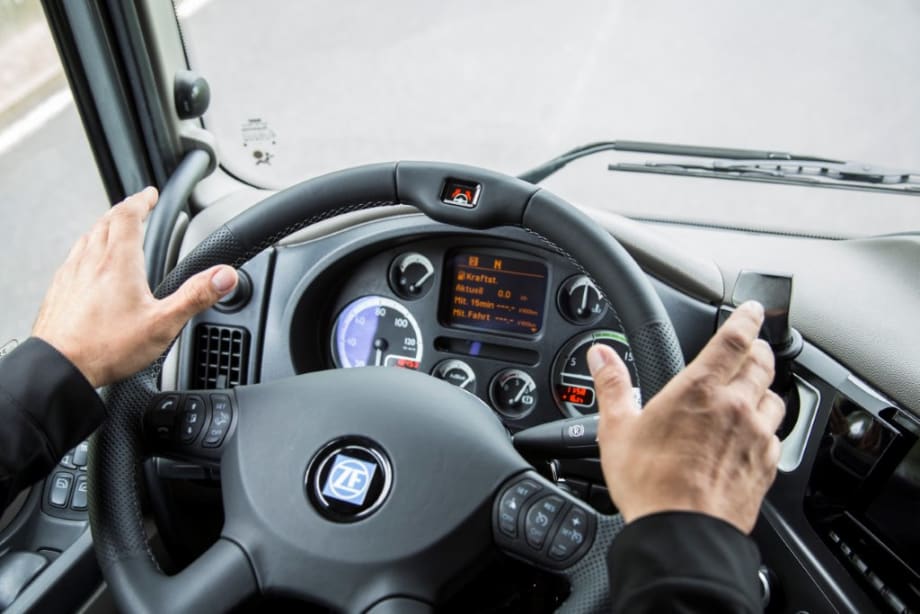
Steering wheel of ZF's Innovation Truck automated vehicle.
ZF Friedrichshafen AG
In the first half of 2018, Germany-based component manufacturer and advanced-technology provider ZF Friedrichshafen AGhas reported it has “achieved its targets” for the first half of 2018. Namely, that its sales rose to 18.7 billion euros ($21.9 billion) and its adjusted operating profit (EBIT) amounted to approximately 1.1 billion euros ($1.3 billion).
At the same time, ZF said it was able to further reduce the debts incurred from its acquisition of TRW and to “significantly increase investments in property, plant, and equipment as well as expenditure in research and development.”
"The strong organic sales growth of around 8% shows that we are offering the right products for the global markets," said ZF CEO Wolf-Henning Scheider. "We achieved significant growth in China and the U.S.A in particular, where we grew faster than the industry average, especially in the passenger car segment."
The company also stated, however, that sales development was “held back by the appreciation of the euro, particularly against the U.S. dollar and other currencies.” Total ZF Group sales included pro-rated sales for the first four months from the Global Body Control Systems Business Unit, which ZF sold in spring 2018. Taking into account exchange rate effects and the sale of the Global Body Control Systems Business Unit, the increase in sales reported on the balance sheet amounted to approximately 2%.
ZF said it was able to further reduce its gross financial debt by approximately 450 million euros. At the same time, the company “increased its investments in the future” by spending 1.1 billion euros on research and development, with a focus on the technologies of autonomous driving, electromobility, and active and passive safety technology. In addition, ZF invested 500 million euros in property, plant, and equipment improvements.
"Despite further significant debt reduction and enormous investments in the future, we ended up within range of our issued profit target of around 6%," said ZF CFO Konstantin Sauer. "Our main focus in the second half of 2018 will be on earnings quality."
ZF said it is “cautiously optimistic” about the second. The company stated that the “predicted weakening demand for passenger cars in the North American and Asia-Pacific markets can presumably be compensated for by significant growth rates in the commercial vehicle sector. In Europe, the automotive industry continues to develop in a positive direction, with opportunities and challenges arising from technology shifts. South America is now growing strongly – starting from a low level, however.”
"Even if conditions become somewhat rougher in the second half of the year – especially due to impairments of free trade – we are sticking to our forecast," added Sauer.
For the overall year of 2018, ZF said it expects consolidated sales of approximately 36.5 billion euros with its EBIT margin expected to be 6% and with its free cash flow anticipated to exceed 1 billion euros.
Related: ZF Unveils its Latest Roadmap to Electric and Automated Trucks and More
More Fleet Management

Color Match Smarter: Tools That Restore & Perform
For fleet managers and collision repair professionals keeping heavy-duty trucks on the road, getting the color right the first time isn't just about appearance — it's about efficiency, turnaround time, and bottom-line results. Discover how today's digital color tools are transforming the repair process from guesswork to precision.
Read More →
FMCSA Pauses Biennial-Update Enforcement Amid Motus Transition
Carriers whose updates were due on or after June 1 have more time, while FMCSA works to stabilize its new registration system and warns of phishing sites impersonating its new carrier registration system, Motus.
Read More →
2026 Blueprint for Countering Smarter Supply Chain Theft
Cargo theft is no longer just the cost of doing business. It's a multi-billion-dollar criminal enterprise exploiting vulnerabilities across your fleet, drivers, and supply chain.
Read More →


How Telematics Improves Visibility, Control, and Performance in Refrigerated Fleets
Explore how telematics help refrigerated fleets improve visibility, uptime, efficiency, compliance, and cargo protection across connected cold chain operations.
Read More →
What the U.S.-Canada Trade War Means for Trucking
Escalating U.S.-Canada tariffs could disrupt cross-border freight, reduce truck volumes, raise costs, and create new uncertainty for carriers on both sides of the border.
Read More →
What Are Trucking’s Top Concerns for 2026?
The American Transportation Research Institute wants to know what's worrying trucking fleet managers, drivers, and other stakeholders in its annual Industry Issues survey.
Read More →
American Trucking Associations Looks for a New Leader
ATA President and CEO Chris Spear abruptly left his job at the association on August 21, at a pivotal time for the trucking industry.
Read More →
Public Wi-Fi Cybersecurity Risks: How Truck Drivers and Fleets Can Protect Their Data
Public Wi-Fi can expose truck drivers and fleets to credential theft, malware, and other cyber threats. Here’s how to reduce the risk on the road.
Read More →
For Nicky Cupp, Fleet Innovation Starts With Frustration
HDT Truck Fleet Innovator Nicky Cupp turns everyday pain points at Fraley & Schilling into opportunities for better technology and smarter processes.
Read More →
Adam Buttgenbach’s Approach to Electric Trucks: Start With Where They Fit
HDT Truck Fleet Innovator Adam Buttgenbach helped PepsiCo build one of North America’s largest EV fleets by focusing on where electric trucks make operational sense.
Read More →