




ZF Deploys Drones to Deliver Parts on Factory Grounds
ZF says it is the first manufacturer in Germany to deliver parts via drones during manufacturing operations.

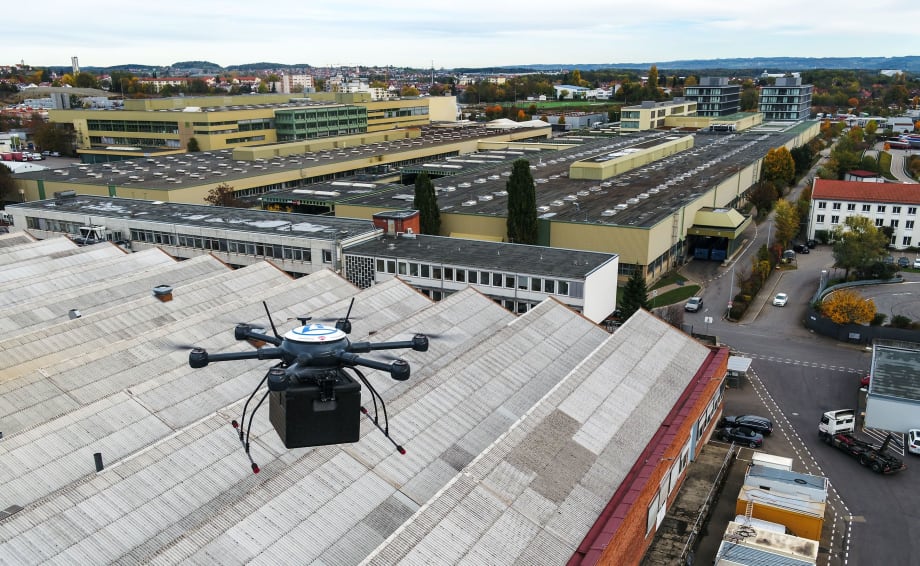
The ZF “hexacopter” flies at speeds up to 20 mph over the roofs of plant buildings and only crosses driveways and sidewalks where there is no alternative.
Photo: ZF
ZF says it is the first company in Germany to receive official approval for automated drone flights over factory premises. A drone prototype is now flying spare parts such as sensors or control cards from the central warehouse to work areas. ZF says this will help to relieve vehicle traffic at the plant and save time on the approximately one-kilometer-long delivery routes that often end on the upper floors of buildings. In the long term, packages could even be delivered outside of factory premises, for example to facilitate package delivery in residential areas that are difficult to access.
According to ZF, the six-motor drone can transport up to five kilograms in weight by air – or three kilograms of goods when accounting for the grippers and transport box. This is enough for the vast majority of spare parts and tools that need to be transported on company premises.
Safety is also a top priority when transporting goods by drone, ZF says. The 20-mph “hexacopter” flies over the roofs of plant buildings, only crossing driveways and sidewalks where there is no alternative. The rechargeable battery, which provides around 30 to 40 minutes of flight operation, has built-in redundancy, as do the propellers and motors. The drone is therefore still maneuverable even if one motor or key part fails.
“At the IAA Commercial Vehicles show in Hanover this year, we showed the technologies which we are developing to enable the autonomous depot. With the drone, we are taking the transport chain to the next level,” said Fredrik Staedtler, head of ZF’s Commercial Vehicle Technology division.
“Chief Maintenance Technician Michael Wiest took advantage of ‘agile working’ at ZF and very quickly and creatively implemented logistics-by-drone from an initial idea. He pushed the project forward when policymakers were only considering allowing fully automated drone flights but had not yet drafted legal provisions,” continued Staedtler.
Drones, mostly equipped with cameras, could until recently in Germany only be used privately or commercially for mapping, monitoring factory fences or surveying, for example.
“We still need to make some adjustments to achieve a completely smooth flight before our delivery drone can be permanently integrated into the logistics process chain,” said Matthias Haberstroh, head of supply chain management at ZF’s Commercial Vehicle Technology division. “The transport system was extensively tested by our supplier, but we still had to further test a number of different navigation sensors on site in Friedrichshafen which also ensure precise positioning between the plant halls.”
In the mid-term, other companies might also use the delivery drones industrialized by ZF on their premises. In the long-term, delivery drones could also be used outside of protected factory premises to support couriers, express and parcel services where their delivery vehicles cannot enter narrow cul-de-sacs or other delivery areas which are difficult to access.
More Fleet Management

Why Private Fleets Are Taking More Freight
Private fleets are putting their own trucks on demanding customers and high-cost lanes as companies seek greater control over service, costs, and capacity.
Read More →
Color Match Smarter: Tools That Restore & Perform
For fleet managers and collision repair professionals keeping heavy-duty trucks on the road, getting the color right the first time isn't just about appearance — it's about efficiency, turnaround time, and bottom-line results. Discover how today's digital color tools are transforming the repair process from guesswork to precision.
Read More →
FMCSA Pauses Biennial-Update Enforcement Amid Motus Transition
Carriers whose updates were due on or after June 1 have more time, while FMCSA works to stabilize its new registration system and warns of phishing sites impersonating its new carrier registration system, Motus.
Read More →


2026 Blueprint for Countering Smarter Supply Chain Theft
Cargo theft is no longer just the cost of doing business. It's a multi-billion-dollar criminal enterprise exploiting vulnerabilities across your fleet, drivers, and supply chain.
Read More →
How Telematics Improves Visibility, Control, and Performance in Refrigerated Fleets
Explore how telematics help refrigerated fleets improve visibility, uptime, efficiency, compliance, and cargo protection across connected cold chain operations.
Read More →
What the U.S.-Canada Trade War Means for Trucking
Escalating U.S.-Canada tariffs could disrupt cross-border freight, reduce truck volumes, raise costs, and create new uncertainty for carriers on both sides of the border.
Read More →
What Are Trucking’s Top Concerns for 2026?
The American Transportation Research Institute wants to know what's worrying trucking fleet managers, drivers, and other stakeholders in its annual Industry Issues survey.
Read More →
American Trucking Associations Looks for a New Leader
ATA President and CEO Chris Spear abruptly left his job at the association on August 21, at a pivotal time for the trucking industry.
Read More →
Public Wi-Fi Cybersecurity Risks: How Truck Drivers and Fleets Can Protect Their Data
Public Wi-Fi can expose truck drivers and fleets to credential theft, malware, and other cyber threats. Here’s how to reduce the risk on the road.
Read More →
For Nicky Cupp, Fleet Innovation Starts With Frustration
HDT Truck Fleet Innovator Nicky Cupp turns everyday pain points at Fraley & Schilling into opportunities for better technology and smarter processes.
Read More →