




Workhorse Reveals All-Electric Medium-Duty Step Van
Workhorse Group lifted the curtain on its all-electric W56 Class 5-6 step van, a new zero-emissions vehicle that features a customized chassis and an ergonomically designed driver’s cab area.

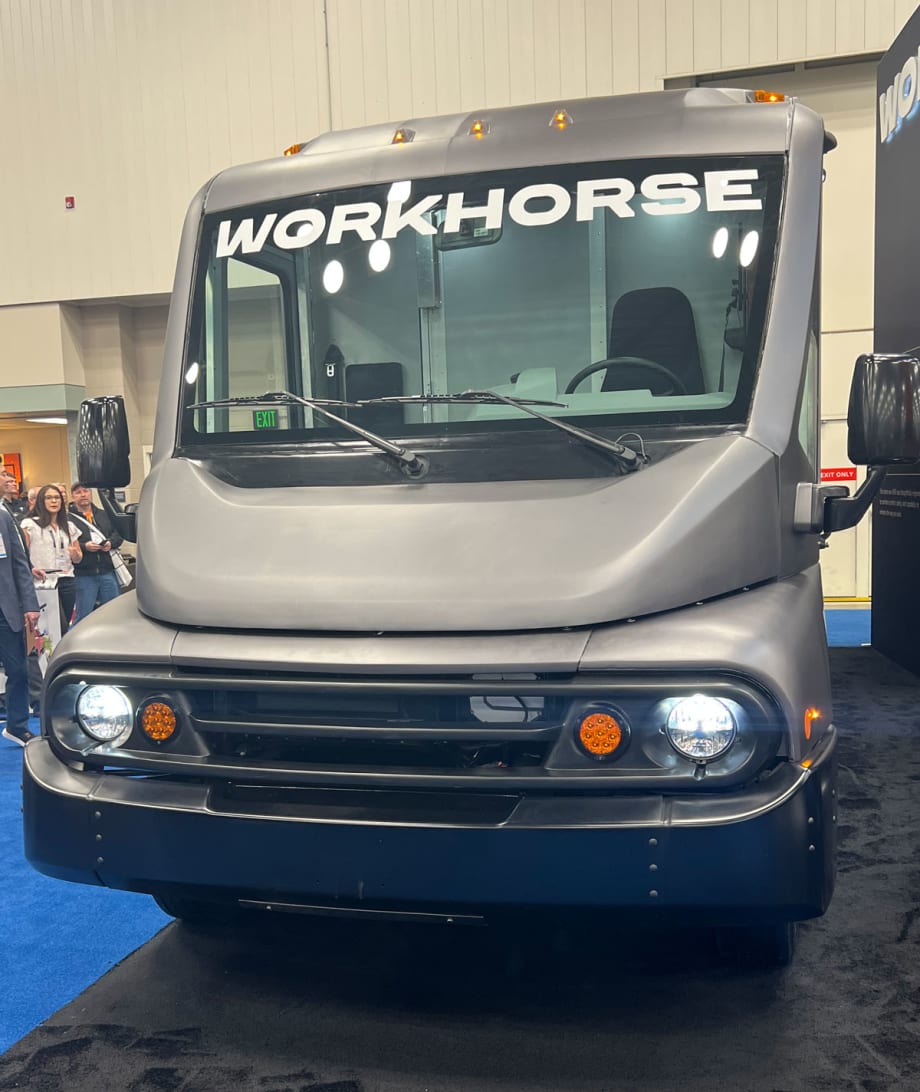
The new all-electric Workhorse W56 step van is designed for medium-duty Class 5-6 applications. It offers payload capacity of 10,000 pounds with a range of up to 150 miles.
Photo: David Cullen
Workhorse Group lifted the curtain on its all-electric W56 Class 5-6 step van, a new zero-emissions vehicle that features a customized chassis and an ergonomically designed driver’s cab area.
The W56 was rolled out at a March 8 press conference at the NTEA Work Truck Show in Indianapolis. First deliveries of the new truck are slated for late this year.
“The W56 marks the first official vehicle designed and produced under our revamped team and is the culmination of many hours of hard work combined with process enhancements implemented over the past 18 months,” said Workhorse CEO Rick Dauch.
“This vehicle incorporates the extensive on-road learnings of our legacy vehicles and improves upon those models with a new custom-designed chassis, demonstrating the caliber of trucks that we will produce for years to come,” he continued.
Dauch said that with Workhorse’s “transition from a technology startup to a pioneering commercial EV OEM,” the company is looking forward to starting production and making initial deliveries later this year. He noted that the W56 has completed piloting package deliveries by working with UPS.
He emphasized the development work that has gone into the W56, pointing out that along with leveraging existing Workhorse designs, 9 million plus miles of service time on the road helped inform the engineering of the new battery-electric truck.
It will be offered in various configurations tailored to meet work truck applications.
E-Axle Power
The W56’s custom-designed chassis is fitted with an e-axle that Workhorse said provides higher driveline efficiency and reduced maintenance. Battery voltage is 718-725v and connectors support Level 2 AC (20kW) and Level 3 AC/Dc (100kW) charging.
The Class 5-6 vehicle supports what Workhorse calls “benchmark payload capacity” of up to approximately 10,000 pounds while delivering a single-charge range of up to 150 miles. The W56 also offers a large cargo box of over 1,000 cubic feet. The truck’s Class 6 GVW rating is 23,000 pounds.
The van also features lowered step-in and a wide cabin door for easier entry and exit. Built with the delivery driver in mind, the cabin has been ergonomically designed while still providing safety and comfort during even the longest shifts, according to the company.
Earlier this year, Workhorse announced it was discontinuing its all-electric C-1000 delivery vehicles so it could focus its resources on advancing its product roadmap for the W4 CC, W750, and W56 vehicles. Read more from HDT sister brand Work Truck Magazine.
More Equipment

How Volvo Updated Its D13 for EPA 2027 [Watch]
Volvo’s updated D13 promises lower emissions without sacrificing performance or fuel economy. Take a closer look at what changed inside the engine in this HDT Spotlight video.
Read More →
Michelin Tire Improves Efficiency and Durability for Regional Fleets
The Michelin X Multi Energy D2 is a regional haul drive tire engineered to help fleets improve fuel efficiency, durability and traction in demanding stop-and-go operations.
Read More →
ZF Expands Commercial Vehicle Push in North America
ZF is expanding its North American commercial-vehicle presence with new transmission applications, electrification, trailer technology and autonomous-driving systems.
Read More →
Tesla Wants a Self-Driving Semi. Are Cameras Enough?
Could Tesla’s camera-only autonomous driving technology work on an 80,000-pound Semi? In this commentary, HDT's Deborah Lockridge takes a look at Tesla, Cybercab, and how autonomous trucks see the road.
Read More →
Kodiak: Driverless Long-Haul Truck Launch on Track for 2026
Kodiak AI says its driverless long-haul safety case is 93% complete and it remains on track to begin commercial operations by year-end 2026.
Read More →
What DOT’s Automated Vehicle Strategy Means for Trucking
The U.S. Department of Transportation issued a new automated-vehicle strategy that outlines plans for driverless-truck regulations, cross-state freight corridors, and federal safety standards.
Read More →
East Coast Port Launches $45M Electric Truck Push
The Port Authority of New York and New Jersey announced millions in incentives for zero-emission drayage trucks, yard tractors, and new charging hubs near the port.
Read More →
PlusAI Going Public to Fund Autonomous Truck Launch
A SPAC deal could provide PlusAI with up to $300 million as it works toward a 2027 commercial launch of factory-built autonomous trucks.
Read More →
NHTSA Moves to Rewrite Truck Fuel-Economy Rules
The National Highway Traffic Safety Administration says it lacks authority to regulate medium- and heavy-duty truck engines separately from complete vehicles, but the existing standards have not yet been eliminated.
Read More →
Detroit Opens Orders for EPA 2027 Engines
Detroit isn’t starting from scratch to meet EPA 2027 diesel emissions standards. Its Gen 6 DD13 and DD15 engines keep much of today’s platform while updating the fuel and aftertreatment systems.
Read More →