




Will Biden's 24/7 Port Plan Alleviate Supply Chain Problems?
The White House plan to open up the gates at the Ports of Long Angeles and Long Beach 24/7 doesn't address many of the core issues clogging up the supply chain, say trucking groups.

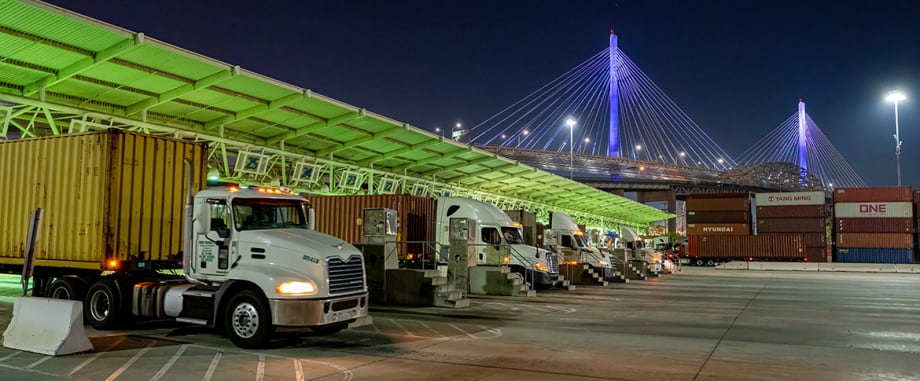
The Port of Long Beach opened up for extended hours several weeks ago.
Photo: Port of Long Beach
More gate hours at the southern California ports is only one part of the solution to supply-chain bottlenecks, said trucking groups and others in the wake of President Biden’s Oct. 13 press conference.
The president announced a deal where the Port of Los Angeles to operate 24 hours a day, seven days a week. This followed a similar move by the Port of Long Beach. But chassis shortages, warehouse hours, inefficient use of containers, labor shortages and more were cited as factors that need to be addressed before more gate hours will make much of a difference.
“While we commend the Biden Administration’s focus on our ongoing supply chain crisis, extended gate hours cannot resolve major systemic issues truckers at ports have long faced,” said Shawn Yadon, California Trucking Association CEO, in a statement. “Truckers and cargo owners are taking on costs, including fees for not returning equipment to ports that cannot accept them, burdensome rules that create inefficiency, and lack of equipment due to chassis sitting idle under empty containers.”
Yadon’s comments were echoed by the Harbor Trucking Association, which represents drayage companies at the West Coast ports. In a statement, HTA said the Biden administration action “does not address the core issues that have been plaguing the supply chain here at America’s port for years.”
Inefficiencies Need to be Addressed
Some terminal operators said it makes no sense to add hours when they already have pickup slots going unused, according to a report in the Wall Street Journal. “We are open 90 hours a week now with 60% utilization,” said Sal Ferrigno, vice president of SSA Terminals, which operates three terminals at Long Beach.
The Harbor Trucking Association took issue with comments like that.
“While steamship lines and their marine terminal partners have been pointing the finger at the trucking industry for not utilizing appointments during this crisis, the underlying causes have continued to compound unchecked,” the association said in a statement. “Challenges faced by truckers doing business at the ports stem from productivity and efficiency issues that are not alleviated by merely shifting to 24/7 gate operations.”
The HTA says thousands of empty containers sit in motor carrier yards on top of chassis that are unable to be returned into the port complex because of overly restrictive appointment requirements.
“For instance, if truckers can’t secure an appointment to return an empty container, they can’t free up the chassis to move an import off dock, so those appointments go unused.”
On top of that, HTA explained, if a trucker can’t count on consistent skilled staffing levels during the second half of the second shift (on top of the empty return restrictions), those appointments go unused.
“This is not an issue of unwillingness to pick up cargo,” HTA said. “The entire supply chain wants this cargo moved. It is instead a tangled web of shifting constraints that impede and discourage participation.”
Beyond the Ports
The dwell time, or average number of days containers are sitting at the port before they get moved out, “keeps going up and up and up” at the Los Angeles and Long Beach ports, over five days on average, said Eric Starks, CEO of transportation forecasting firm FTR, in an Oct. 14 webinar. And it’s not just the West Coast ports, he pointed out. The Port of Savannah in Georgia recently went as high as 12 days, he said.
FTR’s Todd Tranausky, vice president of rail and intermodal, said there are problems at inland intermodal terminals, as well. He compared it to a game of Whack-a-Mole; as soon as you get the congestion cleared up in one place, it just pops up in another. “We’re going to be playing this game until at least the second half of 2022.”
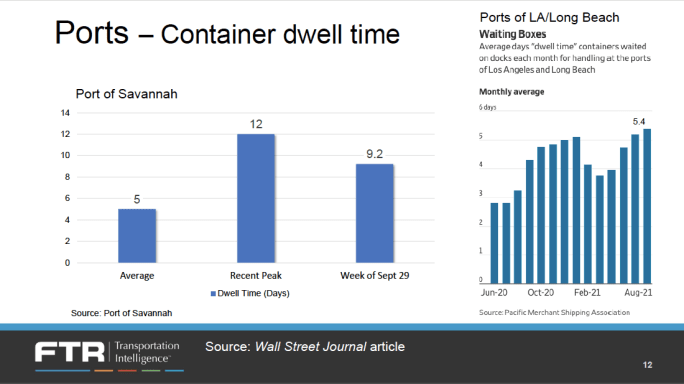
FTR pointed out that the West Coast ports aren't the only ones with backups.
FTR graphic
The availability of intermodal chassis is a big part of the problem, both at the ports and at inland rail terminals. And it’s not necessarily a matter of there not being enough chassis in existence; it’s that they are often sitting empty.
“The chassis manufacturers and suppliers have said they’re not going to inject more equipment into the systems,” Tranausky said. Chassis need to be turned around more quickly, he explained, in two or three days, instead of a week.
“We’ve seen at some terminals that the [intermodal container] box is available but no chassis.” Or the box is available, but the port or railroad can’t get to the box because it’s stuck in the middle of a stack and there’s not enough manpower to dig it out.
Team Effort Needed
When asked whether the new 24-hour gate hours will help the situation, Tranausky’s answer was, “It depends.”
“You need warehouses to be open, you need drayage truckers being willing to pick up at those off hours. It’s going to take everyone working together to pull additional capacity out of the ports.”
It’s not just an LA/Long Beach issue, he said. “If you look to the east, they also have congestion. There’s only a certain volume the ports can handle, the rail network can handle, with labor issues, and [problems with] chassis availability at the inland terminals.”
One of the things that has hurt throughput, he said, is the fact that “rail service has not been great.” Average intermodal train speeds are below the five-year average. “It’s going to take something to change… chassis availability, additional crews … something’s going to have to change.”
Bjorn Vang Jensen, vice president of global supply chain at Denmark-based marine data company Sea-Intelligence ApS, told the Wall Street Journal that this is a good first step.
“It is also encouraging to see that President Biden is meeting with representatives of both importers as well as the trucking and rail communities,” he added. “Without the full engagement of all these supply chain constituents, you could keep the port open round the clock for nothing, as containers would just continue to pile up in the yard.”
The White House does seem to realize that it’s going to take more than just opening the gates longer at the ports. Bloomberg reported that White House officials and Transportation Secretary Pete Buttigieg “met with transportation and industry officials at a virtual roundtable to talk about more ways to alleviate congestion, including a temporary expansion of warehousing and rail service, better data sharing at ports, and improving both the recruitment of truckers and quality of trucking jobs.”
As Buttigieg told NPR in an interview, opening the gates at the ports is necessary, but it’s not enough.
“Next, we've got to make sure that we have all of the other players going through those gates, getting the containers off of the ship so that there's room for the next ship, getting those containers out to where they need to be. That involves trains. That involves trucks … so many steps between the ship and the shelf.
“And part of what we've been doing, including our convening at the White House today with everybody from retailers to shippers to the port leaders, is to get all of those players into the same conversation. Because even though they're all part of the same supply chain, they don't always talk to each other.”
More Fleet Management

How Innovative Trucking Leaders Turn Change Into an Advantage
As the pace of change accelerates in trucking, the fleets that adapt best have more than the latest technology. They have cultures that embrace improvement.
Read More →
Freight Broker Bonds Just Got Harder to Get. Here's What That Means for Your Fleet.
When it gets harder for a freight broker to prove they are financially sound, the ones who cannot clear that bar get pushed out of the market. And those are exactly the brokers who used to leave motor carriers holding the bag.
Read More →
Long-Awaited Canadian Border Bridge to Open in Detroit
For trucking, the bridge opening should offer immediate improvements in efficiency and reliability, with new customs facilities, expanded inspection capacity, and direct freeway-to-freeway connections.
Read More →
Aurora Rolls Out Next Generation of Driverless Trucks for Commercial Freight
Aurora's latest autonomous trucks it's rolling out with International feature lower-cost hardware designed for a million miles as the company expands commercial driverless freight operations across the U.S. Sun Belt.
Read More →
Freight Tonnage Down, Rates up, as Lower Capacity Powers Trucking Recovery
The recovery from the freight recession continues to be driven by reduction in capacity rather than by increased demand.
Read More →
Think Your Trucking Fleet Isn't Using Much AI? Think Again
Shadow AI — the use of unauthorized artificial intelligence tools at work — is becoming increasingly common, putting sensitive company data at risk. Learn how trucking fleets can protect sensitive data while embracing AI.
Read More →
ArcBest Consolidates Brands, Cuts Workforce
The company will bring three business units under the ArcBest brand, eliminate about 2% of positions, and expects the changes to generate $40 million in annual savings.
Read More →
Trucking Fleets Faced Record Operating Costs During Third Year of Freight Recession
ATRI's annual operational cost report shows carriers trimmed fleets, delayed equipment purchases, and ran older trucks as expenses continued to outpace freight rates.
Read More →
Michelin Adds AI Assistant to MyConnectedFleet Platform
Michelin’s new generative AI tool delivers instant fleet insights, helping managers analyze fuel use, tire maintenance, vehicle status, and operational performance without manually creating reports.
Read More →
LytxOne Platform Now Features AI, Compliance, and Asset Tracking Tools
New enhancements add AI-powered insights, asset tracking, compliance automation, and configurable privacy controls to Lytx's all-in-one fleet management platform.
Read More →