




What's Happening With FMCSA Proposed Rules? Not Much Before 2025
Jack Van Steenburg, a former top career official at the Federal Motor Carrier Safety Administration, shared insights on safety ratings, speed limiters, the slow pace of rulemakiing, and more at Heavy Duty Trucking Exchange.

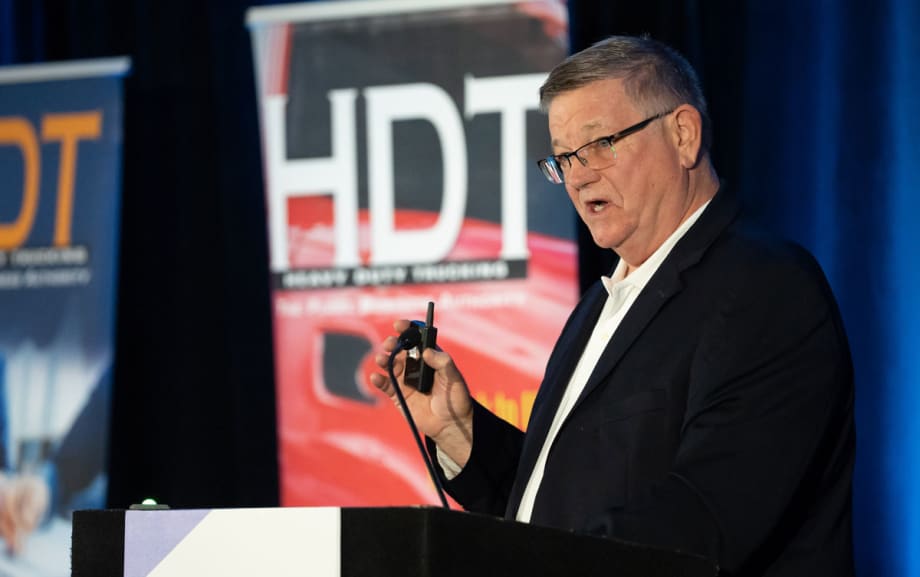
Jack Van Steenburg finds himself consulting for motor carriers and trucking defense attorneys in his retirement from FMCSA.
Photo: Ross Stewart Photography for HDTX
Jack Van Steenburg has a trucking company client with a problem: The motor carrier has no safety rating. It stands to lose a major customer because of this. Yet having no safety rating is the rule rather than the exception.
There are approximately 19,000 motor carriers with satisfactory safety ratings, said Van Steenburg, who retired from a longtime career at the Federal Motor Carrier Safety Administration and is now consulting, during the opening night keynote address at Heavy Duty Trucking Exchange Sept. 4.
But, he said, there are about 750,000 motor carriers with operating authority in the U.S., meaning only about 3% have satisfactory safety ratings. The overwhelming majority have no safety rating at all. Even those with satisfactory safety ratings, he says, may have gotten that rating 20 years ago and perhaps aren’t the safe carrier they once were.
Van Steenburg is quite familiar with these issues; in his 15 years at FMCSA he was executive director, chief safety officer, and assistant administrator of the agency.
Motor carrier safety fitness ratings of Satisfactory, Unsatisfactory, and Conditional currently are determined by a compliance review, also called a DOT audit. The only way a carrier can get a safety rating is through one of these reviews.
Van Steenburg looked at his client’s business and found it’s a very safe carrier. Its CSA scores are good. So FMCSA is not going to do a compliance review; it’s going to focus on carriers that for one reason or another, such as bad CSA scores, look like they might not be operating as safely as they should.
A revamp of how the agency does safety ratings, Van Steenburg said, “is long overdue. We need to get more carriers with ratings. But how do we do that?”
FMCSA Wants to Change its Safety Rating Process
That’s exactly the question the agency asked when it put out an advance notice of proposed rulemaking about potential changes to the safety rating process just over a year ago. The agency held several listening sessions over the summer.
Some of the questions FMCSA posed:
Should the current three-tiered rating system (Satisfactory, Unsatisfactory, Conditional) be changed to a single rating issued only when a carrier is found to be Unfit?
How could the agency use inspection data and FMCSA’s Safety Measurement System (SMS) in determining safety ratings?
Incorporating driver behavior into SFD ratings.
Revising the list of safety violations used to calculate the rating.
Adjusting the weights allocated to particular violations, including increasing the weight for unsafe driving violations.
“From what I see, they want to use your roadside inspection data in future ratings,” Van Steenburg said.
Sounds logical — until you start digging into the data on out-of-service violations vary by state, he said.
The industry has long complained that there’s a big disparity there, meaning those roadside inspection data being used for a safety fitness determination might not be fair depending on the states where the carrier operates.
For instance, he said, the national out of service rate for equipment violations is around 20%. Yet it’s only 10% in Mississippi, but 43% in Nebraska.
Similarly, the national driver OOS rate is 6%, yet California is only 3% and Arizona is 12.5%.
“How do the feds make up for that disparity” if they were to use the roadside inspection data for safety fitness ratings? “I don’t have that answer.”
Federal Safety Rulemakings in Limbo
At the moment, the safety fitness determination proposal is just one of a number of FMCSA proposals that are going nowhere until after the November elections.
The reason? Congress and a new presidential administration both have the power to review, and potentially throw out, new regulations that were finalized in the latter months of the previous administration.
“So the administration just stops” the rulemaking process, Van Steenburg said. Regulations must be reviewed by the White House Office of Management and Budget before they can be finalized, and the White House doesn’t want to put its stamp of approval on a regulation that may just be thrown out in a matter of months.
Van Steenburg offered his perspective and predictions on a few of the most significant delayed rulemakings:
Mandatory Speed Limiters
The latest projection from the FMCSA for the proposed rule to require heavy-truck speed limiters is May of 2025. But Van Steenburg believes “it’s not going anywhere. It’s dead on arrival.”
The joint advance notice of proposed rulemaking from the National Highway Traffic Safety Administration and the Federal Motor Carrier Safety Administration exploring mandatory speed limiters for heavy trucks drew more than 4,000 comments.
A projected date of December 2023 to put out an official proposal came and went. There’s been legislation in Congress to try to block the agencies from creating the rule.
As a former cop, Van Steenburg said, he shares concerns voiced by groups such as the Owner Operator Independent Drivers Association about the safety of “speed differentials,” where trucks end up going much more slowly than surrounding traffic, especially in states with high speed limits such as Texas.
This is the second time the federal government has looked at mandating speed limiters. A previous rulemaking in 2016 did not become a final rule.
Automatic Emergency Braking
“I thought for sure this would go final,” Van Steenburg said of the proposal to require automatic emergency braking on commercial trucks. As required by the Bipartisan Infrastructure Law, NHTSA and FMCSA last year proposed mandatory automatic emergency braking systems on new commercial vehicles over 10,000 pounds.
The final rule will “require and/or standardize equipment performance for automatic emergency braking systems on heavy trucks,” according to the regulatory agenda. Comments closed in September 2023. Last fall, the regulatory agenda showed a “final action” expected in April 2024. Now it says January 2025.
He noted that driver training needs to be part of an AEB mandate. And he pointed out that even without a mandate, trucking companies should keep in mind that plaintiffs’ attorneys love to pounce on trucking companies for not using the most current available safety technology.
Electronic Logging Devices
We’re still waiting for action from FMCSA on possible changes to the mandatory ELD rules after a 2022 advance notice of proposed rulemaking.
The agency asked for comments on potential changes in five areas:
Applicability to pre-2000 engines
ELD malfunctions
The process for removing ELD products from FMCSA’s list of registered devices
Technical specifications
ELD certification.
The latest regulatory agenda is projecting June 2025 for a proposed rule.
Why Is The Regulatory Process So Hard?
Now that he’s retired, Van Steenburg feels he’s able to share some insights into the inner workings of the agency.
“The rulemaking is the most frustrating thing at FMCSA,” he said.
Trucking people often bemoan the fact that most regulators don’t understand the industry. And it’s even worse for political appointees. Most longtime non-appointed staff do develop at least some knowledge of the industry.
“In my last two terms, we went through nine different administrators,” he said.
It takes about a year for an administrator to come in and get up to speed. When they’re out the door almost as soon as they get to a point where they understand what’s going on, it’s very difficult to get things done.
Add to that trying to balance the extremes of safety advocates with the realities of trucking.
Kicking the Can Down the Road
Many regulatory initiatives start with a Congressional order tucked away in a law, requiring the agency to promulgate a rulemaking. Which leads another frustration, Van Steenburg said: research.
It’s not that research isn’t a good thing. But “when Congress can’t make a decision, they punt. We’ll do a study, a pilot program. All they’re doing is kicking the can down the road.”
Some research and pilot projects that may actually be useful, he said, are:
The Safe Driver Apprenticeship pilot program.
Driver compensation (does pay by the mile make drivers take risks they wouldn’t if they were paid by the hour or a salary?)
Causal factors study: Trying to determine the real causes of truck accidents, which aren’t always obvious from a police report.
More Safety & Compliance

FMCSA Pauses Biennial-Update Enforcement Amid Motus Transition
Carriers whose updates were due on or after June 1 have more time, while FMCSA works to stabilize its new registration system and warns of phishing sites impersonating its new carrier registration system, Motus.
Read More →
ZF Expands Commercial Vehicle Push in North America
ZF is expanding its North American commercial-vehicle presence with new transmission applications, electrification, trailer technology and autonomous-driving systems.
Read More →
Truck Drivers Need More Than Another Alert
Fleets have more visibility into truck health, safety events, and driver activity than ever. The next challenge is turning all that information into useful guidance for the person who has to decide what to do next.
Read More →
Tesla Wants a Self-Driving Semi. Are Cameras Enough?
Could Tesla’s camera-only autonomous driving technology work on an 80,000-pound Semi? In this commentary, HDT's Deborah Lockridge takes a look at Tesla, Cybercab, and how autonomous trucks see the road.
Read More →
What DOT’s Automated Vehicle Strategy Means for Trucking
The U.S. Department of Transportation issued a new automated-vehicle strategy that outlines plans for driverless-truck regulations, cross-state freight corridors, and federal safety standards.
Read More →
NYC Expands Speed, Pedestrian Safety Tech Across Fleet
New York City is expanding intelligent speed assistance and pedestrian-alert systems across its municipal fleet, moving the technologies from pilot programs into vehicle procurement and retrofit requirements.
Read More →
FMCSA Removes 110 Truck Driver Training Schools from Certified ELDT List
Federal regulators also are targeting more than 160 additional training providers and launching a nationwide audit of third-party CDL skills testers as part of a broader crackdown on trucking fraud.
Read More →
Beyond DOT Compliance: What Makes a Trucking Fleet Truly Safe?
A trucking fleet can follow every rule and still make unsafe decisions. The real test comes when safety conflicts with freight, productivity, or cost.
Read More →
Hours of Service Pilot Programs: FMCSA Readies for 2027 Rollout
Two pilot programs could eventually reshape hours-of-service rules, giving truck drivers options to pause their 14-hour clock or use longer split sleeper rest periods.
Read More →
New Guide Offers Pet Safety Tips for Truck Drivers
Hundreds of thousands of pets travel in truck cabs. A new safety guide from Volvo Trucks and the Center for Pet Safety offers practical advice for truck drivers who bring dogs and cats along for the ride.
Read More →