




Westport Demonstrates Hydrogen Engine Technology in Sweden
Westport teamed up with Transportation and Energy Partners in Sweden to demonstrate hydrogen-powered internal combustion engine technology for commercial vehicles.

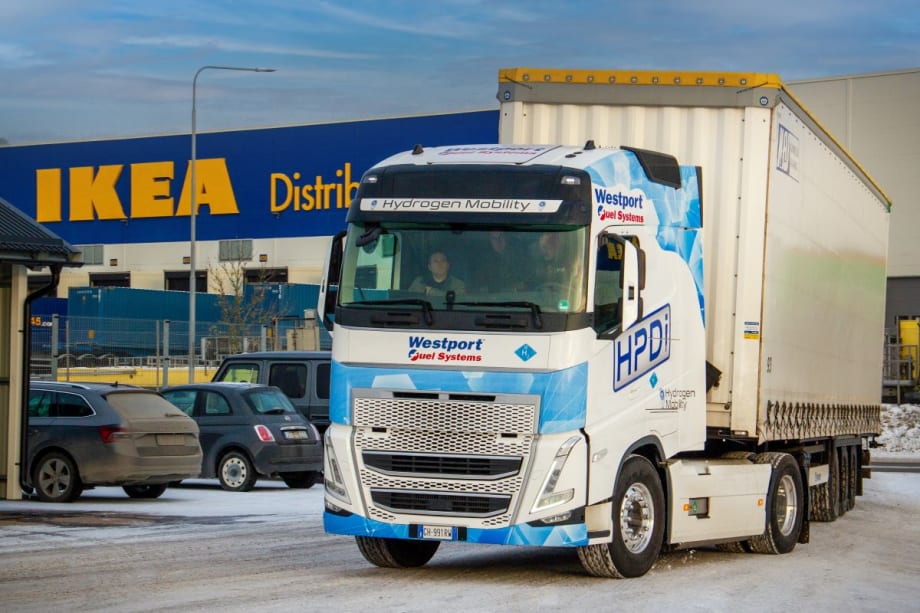
A Scania tractor equipped with Westport H2 HPDI (high pressure direct injection) fuel system-equipped prototype truck has completed a hydrogen ICE demontration run in Sweden.
Photo: Westport
Westport Fuel Systems said it has successfully completed a real-world evaluation of its hydrogen-powered internal combustion engine technology in Sweden.
Westport conducted the tests with KAJ Inrikes, hauling Ikea home-furnishing products.
The run featured a Scania truck equipped with a Westport H2 HPDI (high pressure direct injection) fuel system prototype. Westport said this is the second validation of the H2 HPDI system in a heavy haul application with a major fleet in the last 60 days.
A Complete Hydrogen Ecosystem
During the event, the complete hydrogen ecosystem was represented, including green hydrogen production; hydrogen filling stations; Westport’s HPDI technology; vehicle manufacturers; fleet operators; and the end user, Ikea, as a buyer of sustainable transportation services:
KAJ Inrikes, fleet operator, a “green-focused” haulage company, performing transport for Ikea and other key customers in the Älmhult and Jönköping area.
Smålandslogistik, large fleet owner, a long-haul and distribution company, which has identified the environment and decarbonization as important areas where they can have meaningful impact.
Metacon AB, hydrogen fuel provider, a Sweden-based supplier of energy technology, including electolyzers and reformers for refining biogas into fossil-free hydrogen.
Hydri AB, hydrogen infrastructure company, building and operating a complete network of green hydrogen refueling stations in Sweden.
“Scania is staying true to its purpose of driving the shift towards more sustainable transport systems," said Ola Henriksson, senior product manager at Scania. "The technology of using hydrogen in the internal combustion engine is an interesting decarbonization pathway because it represents an attractive solution with high maturity and quick time to market.”
Anders Johansson, vice president, Heavy-Duty OEM for Westport Fuel Systems, pointed out that heavy hauling is among the most challenging applications within transportation to decarbonize.
"These heavy transport fleets require sustainable technologies that are viable for their operations as well as practical and affordable for today’s market,” Johansson said. “We are encouraged to see a global retail giant such as Ikea field testing our H2 HPDI prototype truck as part of its decarbonization continuum.”
Westport’s Swedish demonstration comes on the heels of a similar run the company participated in earlier this year. In October, Westport conducted a heavy transport demonstration with its H2 HPDI fuel system equipped prototype truck hauling a refrigerated trailer in Madrid, Spain.
Clean, Robust, Affordable and Efficient Engine Technology
The European Commission has recommended a definition of a Zero Emission Vehicle as part of the upcoming HD CO2 regulation. Westport expects H2 HPDI-powered vehicles to meet this ZEV definition for a range of heavy-duty commercial vehicles.
In this collaborative effort, the Westport HPDI fuel system-equipped truck operating on hydrogen pulled a trailer filled with approximately 40 tons of Ikea home-furnishing products.
“As the first heavy transport hauler in Sweden to be Euro VI compliant, we take emissions reduction very seriously,” said Kaj Johansson, president of KAJ Inrikes “Westport’s H2 HPDI fuel system is an affordable and efficient technology because it keeps the current driveline and compression ignition engine platform while delivering the high performance we need at low cost for decarbonization in long-haul trucking.”
The Westport H2 HPDI technology impressed the team at Smålandslogistik.
"Its high efficiency, powerful performance, and the potential of long-range operations is a very attractive solution," said Nicklas Svensson, senior manager. "Our confidence is bolstered by its foundation on a traditional powertrain, ensuring minimal investment in new workshop facilities."
He noted that the adaptability of the system to biogas (renewable natural gas) is a significant advantage. "We can utilize local biomass and excess electricity, transforming them into fuel for our truck fleet."
More Fuel Smarts

How Volvo Updated Its D13 for EPA 2027 [Watch]
Volvo’s updated D13 promises lower emissions without sacrificing performance or fuel economy. Take a closer look at what changed inside the engine in this HDT Spotlight video.
Read More →
Diesel Price Spike Shortens Payback for Natural Gas Trucks, Report Says
Energy Vision estimates fleets could recover the higher purchase price of an RNG-fueled Class 8 tractor in 1.3 to 2.8 years under current fuel-price scenarios.
Read More →
Calstart Becomes Catalyst Mobility, Reflecting Broader Focus
Calstart is now Catalyst Mobility, reflecting the nonprofit’s growing national role in clean transportation, including zero-emission trucks, infrastructure and incentive programs.
Read More →

Record Diesel Prices Squeeze Trucking Fleets
Average U.S. diesel prices have climbed to nearly $6 a gallon, surpassing the 2022 record as tight refinery capacity and Middle East disruptions keep fuel costs elevated.
Read More →
How Fuel Delivery Shapes Engine Performance
Fuel delivery depends on more than what happens at the injector. For fleet, maintenance and technical professionals, looking at the full path from pump to injector can provide useful context for understanding engine performance.
Read More →
East Coast Port Launches $45M Electric Truck Push
The Port Authority of New York and New Jersey announced millions in incentives for zero-emission drayage trucks, yard tractors, and new charging hubs near the port.
Read More →
California Bill Could Shed Light on Electric Truck Prices
Why do battery-electric Class 8 trucks remain so expensive? A California bill headed to Gov. Gavin Newsom would give fleets and state agencies more visibility into what manufacturers charge.
Read More →
Detroit Opens Orders for EPA 2027 Engines
Detroit isn’t starting from scratch to meet EPA 2027 diesel emissions standards. Its Gen 6 DD13 and DD15 engines keep much of today’s platform while updating the fuel and aftertreatment systems.
Read More →
Zero-Emission Truck Corridor Planned for West Coast
California, Oregon, Washington, British Columbia and Baja California are coordinating plans for truck charging and hydrogen fueling from Canada to Mexico.
Read More →
A Closer Look at Kenworth’s Electric T880E Vocational Truck [Video]
Learn more about Kenworth's T880E battery-electric vocational truck at the Paccar Technical Center, including its range, applications, upfitting considerations, and PTO options, in this HDT Spotlight video.
Read More →