




Related: Wabco Launches OnLaneAssist Driver Assistance System
Wabco Offers Blind-Spot Detection System
Wabco has introduced the OnSide advanced blind-spot detection system for commercial trucks and trailers, which alerts drivers to any vehicle in a blind spot and provides a side collision warning to reduce accidents.
by Staff
October 20, 2017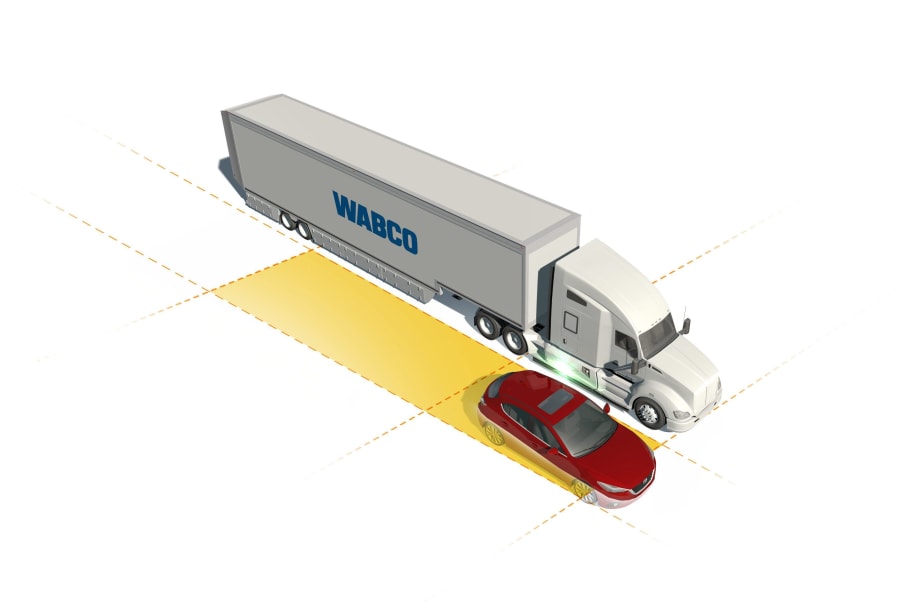
Wabco OnSide alerts drivers to a moving vehicle in a truck’s blind spot and provides a side collision warning to help reduce the risk of accidents. Image: Wabco
3 min to read
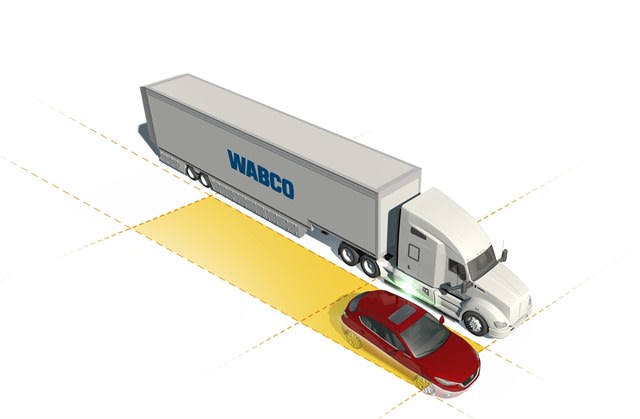
Wabco OnSide alerts drivers to a moving vehicle in a truck’s blind spot and provides a side collision warning to help reduce the risk of accidents.Image: Wabco
Wabco has launched the OnSide advanced blind-spot detection system for commercial trucks and trailers, which alerts drivers to any vehicle in a blind spot and provides a side collision warning to reduce accidents. The company has also inroduced its Intelligent Brake Interlock, an advanced electronic brake interlock system.
OnSide helps improve commercial vehicle safety by alerting drivers to a potential side collision with a vehicle in a truck’s blind spot. The system uses advanced short-range radar for vehicle detection and then alerts the driver with a visual signal. When the truck’s turn signal is engaged, the system provides a more assertive warning in the form of an audible signal or a seat vibration.
When used with Wabco’s OnLaneAssist lane-keeping assistance system, OnSide can automatically return the vehicle to the lane's center. If a lane change is initiated and OnSide detects a vehicle in the blind spot, OnLaneAssist applies a correction torque to the steering wheel to avoid the collision.
Wabco OnSide’s radar sensor enables a 160-degree field of view and provides coverage for up to 65% of a standard 53-foot trailer. The system performs reliably even in low visibility conditions, such as darkness, fog, rain or snow, according to Wabco.
OnSide can distinguish moving vehicles from objects that do not pose a hazard to minimize false warnings. The system can be mounted out of sight behind fairings on either side of the vehicle and features plug-and-play functionality that does not require alignment or calibration.
“We are proud to present OnSide, the latest in a long history of Wabco innovations that improve commercial vehicle safety,” said Jon Morrison, president of Wabco Americas. “This advanced blind-spot detection system not only provides a solution to help reduce side collisions involving commercial vehicles, but it also provides capability for active collision avoidance for the autonomous vehicles of the future.”
Intelligent Brake Interlock
Wabco has also introduced its Intelligent Brake Interlock, an advanced electronic brake interlock system that improves the safety of tank trailers hauling hazardous materials or that are equipped with cryogenics.
Intelligent Brake Interlock can improve the safe operation of tank trailers by preventing a vehicle from moving during loading and unloading. The system monitors vehicle speed, as well as the position switch, and locks the foundation brakes electronically. An electronic fail-safe adds an additional layer of safety by preventing inadvertent brake activation while the vehicle is in motion.
“We are excited to showcase Wabco’s Intelligent Brake Interlock at MCE 2017 and to offer an advanced solution to improve the safety of tank trailers in the region,” said Jon Morrison. “As the latest addition to Wabco’s Intelligent Trailer Program of advanced trailer technologies, this innovative system further differentiates Wabco as a technology leader in North America and around the globe.”
More Safety & Compliance

From One Generation to the Next: How Mentorship Builds Safer Truck Drivers
After three decades in trucking, Harold Perry shares what he's learned about driver safety, mentorship, and helping the next generation build confidence behind the wheel.
Read More →
FMCSA Pauses Biennial-Update Enforcement Amid Motus Transition
Carriers whose updates were due on or after June 1 have more time, while FMCSA works to stabilize its new registration system and warns of phishing sites impersonating its new carrier registration system, Motus.
Read More →
ZF Expands Commercial Vehicle Push in North America
ZF is expanding its North American commercial-vehicle presence with new transmission applications, electrification, trailer technology and autonomous-driving systems.
Read More →
Truck Drivers Need More Than Another Alert
Fleets have more visibility into truck health, safety events, and driver activity than ever. The next challenge is turning all that information into useful guidance for the person who has to decide what to do next.
Read More →
Tesla Wants a Self-Driving Semi. Are Cameras Enough?
Could Tesla’s camera-only autonomous driving technology work on an 80,000-pound Semi? In this commentary, HDT's Deborah Lockridge takes a look at Tesla, Cybercab, and how autonomous trucks see the road.
Read More →
What DOT’s Automated Vehicle Strategy Means for Trucking
The U.S. Department of Transportation issued a new automated-vehicle strategy that outlines plans for driverless-truck regulations, cross-state freight corridors, and federal safety standards.
Read More →
NYC Expands Speed, Pedestrian Safety Tech Across Fleet
New York City is expanding intelligent speed assistance and pedestrian-alert systems across its municipal fleet, moving the technologies from pilot programs into vehicle procurement and retrofit requirements.
Read More →
FMCSA Removes 110 Truck Driver Training Schools from Certified ELDT List
Federal regulators also are targeting more than 160 additional training providers and launching a nationwide audit of third-party CDL skills testers as part of a broader crackdown on trucking fraud.
Read More →
Beyond DOT Compliance: What Makes a Trucking Fleet Truly Safe?
A trucking fleet can follow every rule and still make unsafe decisions. The real test comes when safety conflicts with freight, productivity, or cost.
Read More →
Hours of Service Pilot Programs: FMCSA Readies for 2027 Rollout
Two pilot programs could eventually reshape hours-of-service rules, giving truck drivers options to pause their 14-hour clock or use longer split sleeper rest periods.
Read More →