




Volvo Truck’s Latest Autonomous Push: Predictive Behavior Technology
Accounting for unpredictable human behavior is a major problem for autonomous vehicle control systems. Volvo Truck North America's new partnership with Perceptive Automata is seeking answers to that puzzle.

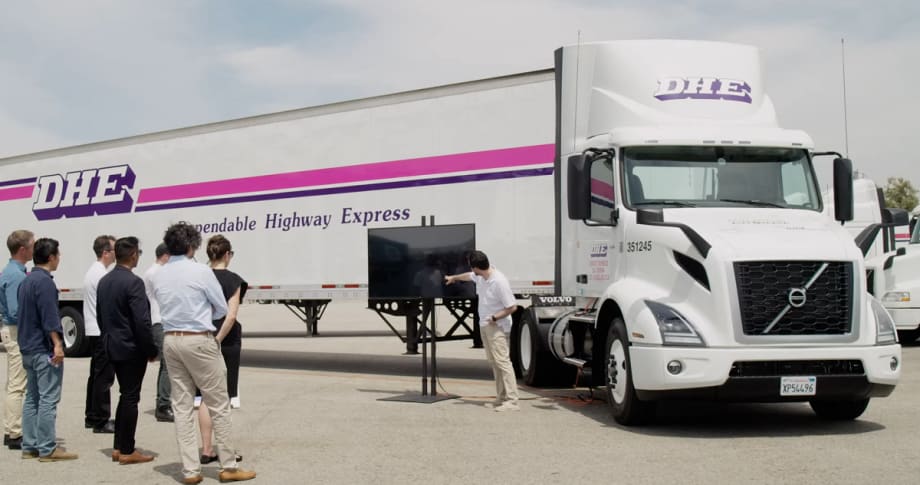
A Volvo VNR 300 equipped with Perceptive Automata’s artificial intelligence software is displayed at DHE headquarters in Ontario, California.
Photo: Volvo Trucks North America
Volvo Trucks North America is working with a developer of predictive human behavior technology in order to fine-tune autonomous vehicle control systems. Recently, Volvo and Perceptive Automata, along with Dependable Highway Express, a West Coast-based LTL carrier, and Volvo customer, showcased a collaborative project designed to strengthen safety capabilities for the trucking industry through automation.
The project leveraged human-intuition artificial intelligence that "reads" the intention and awareness of vulnerable road users, such as pedestrians, cyclists, and motorists, to enhance the situational awareness of truck drivers, according to VTNA.
Boston-basedPerceptive Automata is a technology company that focuses solving one of the most challenging problems for automated vehicles: Understanding the state of mind of humans in the roadway environment. Its AI software ingests data from on-vehicle sensors and, like humans, assesses in real-time the likely intention and awareness of pedestrians, cyclists and other drivers by reading visual cues such as eye contact, posture, physical orientation, and head movements.
Increased safety is achieved through continuous 360-degree monitoring of human road users near the truck and, when warranted, signaling to the truck driver and on-board automated systems increased risk based on changes in human intention. This enables earlier preventive actions by the truck driver, supported by the truck’s automated systems, to reduce the likelihood of accidents and to help modulate the amount and severity of braking and acceleration.

Perceptive Automata's artificial intelligence system is able to track, in parallel and with a 360-degree field of view, a practically unlimited number of pedestrians, cyclists, and vehicles to enhance professional drivers' situational awareness.
Photo: Volvo Trucks North America
VTNA said it has recognized the critical need for improved safety for all road users, specifically in improving the ability of onboard computers to “learn” situational awareness and better anticipate human behavior while on the road.
To meet this need, the OEM said it has developed proof-of-concept software together with Perceptive Automata, which was successfully demonstrated at DHE headquarters in Ontario, California, recently. At the event, attendees experienced Perceptive Automata’s artificial intelligence software on a Volvo VNR 300 regional-haul model. Attendees also got to observe the AI in action during live drives.
“Safety is a core value at Volvo Trucks, and we continue to explore new and innovative ways to further enhance transportation safety, as well as improve driver support and comfort,” said Aravind Kailas, research and innovation manager at Volvo Group North America. “We are very proud of the collaboration with Perceptive Automata and DHE, who share our vision for increasing safety and have worked diligently over the last six to eight months to bring this project to life.”
“Advanced automation in trucking is an important application of our human behavior prediction technology, and we are excited to team with Volvo Trucks and DHE to demonstrate its impact on trucking safety,” said Sid Misra, CEO of Perceptive Automata. “Volvo Trucks’ culture of safety and DHE’s service excellence align with our vision for the future of automated trucking and advanced driver support, and this project showcased how automation technology can enhance the situational awareness of truck drivers to reduce cognitive load and driver fatigue, and, ultimately, safe lives.”
DHE's participation was integral to the project as it provided real-world data from its fleet operations to customize the AI software to its LTL application, VTNA noted.
“DHE’s quest for excellence in all areas, especially safety, is obvious as we specify all our Volvo truck models with every safety feature available from its factory,” said Joe Finney, COO of DHE. “We are excited to play a part in the research and development of this automation technology and the positive impact it can have in keeping everyone safer on the roads of the world.”
“Automation and driver support enhancements that help predict and prevent potential incidents will be essential to improving road safety now and in the future,” added Volvo's Kailas. “While we recognize highly automated processes progress gradually and over time, we have gained valuable information from this collaboration in a short period of time.”
More Safety & Compliance

FMCSA Pauses Biennial-Update Enforcement Amid Motus Transition
Carriers whose updates were due on or after June 1 have more time, while FMCSA works to stabilize its new registration system and warns of phishing sites impersonating its new carrier registration system, Motus.
Read More →
ZF Expands Commercial Vehicle Push in North America
ZF is expanding its North American commercial-vehicle presence with new transmission applications, electrification, trailer technology and autonomous-driving systems.
Read More →
Truck Drivers Need More Than Another Alert
Fleets have more visibility into truck health, safety events, and driver activity than ever. The next challenge is turning all that information into useful guidance for the person who has to decide what to do next.
Read More →
Tesla Wants a Self-Driving Semi. Are Cameras Enough?
Could Tesla’s camera-only autonomous driving technology work on an 80,000-pound Semi? In this commentary, HDT's Deborah Lockridge takes a look at Tesla, Cybercab, and how autonomous trucks see the road.
Read More →
What DOT’s Automated Vehicle Strategy Means for Trucking
The U.S. Department of Transportation issued a new automated-vehicle strategy that outlines plans for driverless-truck regulations, cross-state freight corridors, and federal safety standards.
Read More →
NYC Expands Speed, Pedestrian Safety Tech Across Fleet
New York City is expanding intelligent speed assistance and pedestrian-alert systems across its municipal fleet, moving the technologies from pilot programs into vehicle procurement and retrofit requirements.
Read More →
FMCSA Removes 110 Truck Driver Training Schools from Certified ELDT List
Federal regulators also are targeting more than 160 additional training providers and launching a nationwide audit of third-party CDL skills testers as part of a broader crackdown on trucking fraud.
Read More →
Beyond DOT Compliance: What Makes a Trucking Fleet Truly Safe?
A trucking fleet can follow every rule and still make unsafe decisions. The real test comes when safety conflicts with freight, productivity, or cost.
Read More →
Hours of Service Pilot Programs: FMCSA Readies for 2027 Rollout
Two pilot programs could eventually reshape hours-of-service rules, giving truck drivers options to pause their 14-hour clock or use longer split sleeper rest periods.
Read More →
New Guide Offers Pet Safety Tips for Truck Drivers
Hundreds of thousands of pets travel in truck cabs. A new safety guide from Volvo Trucks and the Center for Pet Safety offers practical advice for truck drivers who bring dogs and cats along for the ride.
Read More →