




Related: Test Drive - There's Much to Like About Volvo's New VNL
Volvo Trucks Transitions to Full Production of VNL 760
Volvo Trucks has completed its transition from production of the outgoing VNL 670 model to the full production of the new VNL 760.
by Staff
April 3, 2018
Volvo Trucks recently completed full transition of production from the legacy VNL 670 model to the new VNL 760. Photo: Volvo Trucks
2 min to read
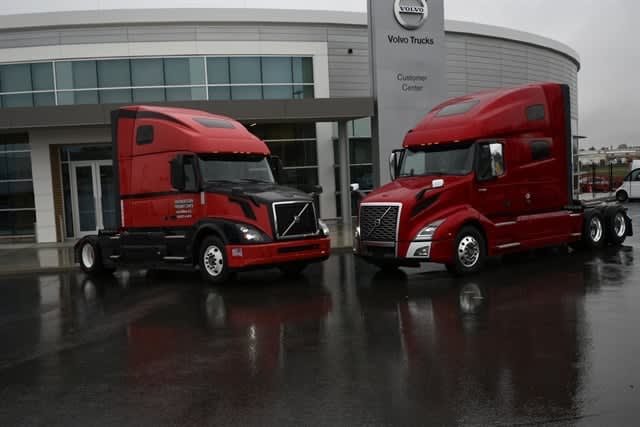
Volvo Trucks recently completed full transition of production from the legacy VNL 670 model to the new VNL 760.Photo: Volvo Trucks
Volvo Trucks has completed its transition from production of the outgoing VNL 670 model to the full production of the new VNL 760.
The VNL 670 has been in Volvo Truck’s lineup since 2002 and was its highest production volume model in North America, according to Goran Nyberg, president of Volvo Trucks North America. The VNL 760 was touted as Volvo’s first new Class 8 tractor design in 20 years when it was unveiled.
“Transitioning from the legacy VNL 670 into full production of the innovative new VNL 760 signifies the latest milestone on our long journey to deliver the safest, most comfortable and most efficient long-haul trucks on the market,” said Göran Nyberg, president of Volvo Trucks North America. “Exceptional design, efficiency and productivity-boosting interior features make the VNL 760 a fitting successor to the VNL 670.”
The VNL 760 builds on Volvo’s established design and includes new aerodynamic designs to reduce turbulent airflow. Driver productivity and comfort were also key to the VNL 760’s design with a more driver-centric interior, controls and gauge cluster.
The VNL 760 comes standard with the 13-liter Volvo D13 engine and I-Shift 12-speed automated manual transmission. It is also available with the D13 Turbo Compound engine which features a mechanical waste heat recovery system to capture wasted energy from the engine’s exhaust. It results in 50 additional horsepower fed back to the crankshaft and an improvement in fuel efficiency. The VNL 760 is also available with the 15-liter Cummins X15.
Volvo Active Driver Assist featuring Bendix Fusion is standard on all VNL models. The camera and radar-based system combines forward collision mitigation warnings and active braking, even with stationary vehicles. Volvo Enhanced Stability Technology, an electronic stability control system, is also standard on all VNL models to help detect imminent loss of control, jackknife, or rollover events.
All Volvo VNL models come standard with Volvo Remote Diagnostics, Volvo’s factory-installed telematics hardware that provides connectivity for proactive diagnostics and monitoring of critical engine, transmission and aftertreatment trouble codes. The same hardware also allows customers to perform powertrain software and parameter updates over-the-air with Remote Programming.
More Equipment

How Volvo Updated Its D13 for EPA 2027 [Watch]
Volvo’s updated D13 promises lower emissions without sacrificing performance or fuel economy. Take a closer look at what changed inside the engine in this HDT Spotlight video.
Read More →
Michelin Tire Improves Efficiency and Durability for Regional Fleets
The Michelin X Multi Energy D2 is a regional haul drive tire engineered to help fleets improve fuel efficiency, durability and traction in demanding stop-and-go operations.
Read More →
ZF Expands Commercial Vehicle Push in North America
ZF is expanding its North American commercial-vehicle presence with new transmission applications, electrification, trailer technology and autonomous-driving systems.
Read More →
Tesla Wants a Self-Driving Semi. Are Cameras Enough?
Could Tesla’s camera-only autonomous driving technology work on an 80,000-pound Semi? In this commentary, HDT's Deborah Lockridge takes a look at Tesla, Cybercab, and how autonomous trucks see the road.
Read More →
Kodiak: Driverless Long-Haul Truck Launch on Track for 2026
Kodiak AI says its driverless long-haul safety case is 93% complete and it remains on track to begin commercial operations by year-end 2026.
Read More →
What DOT’s Automated Vehicle Strategy Means for Trucking
The U.S. Department of Transportation issued a new automated-vehicle strategy that outlines plans for driverless-truck regulations, cross-state freight corridors, and federal safety standards.
Read More →
East Coast Port Launches $45M Electric Truck Push
The Port Authority of New York and New Jersey announced millions in incentives for zero-emission drayage trucks, yard tractors, and new charging hubs near the port.
Read More →
PlusAI Going Public to Fund Autonomous Truck Launch
A SPAC deal could provide PlusAI with up to $300 million as it works toward a 2027 commercial launch of factory-built autonomous trucks.
Read More →
NHTSA Moves to Rewrite Truck Fuel-Economy Rules
The National Highway Traffic Safety Administration says it lacks authority to regulate medium- and heavy-duty truck engines separately from complete vehicles, but the existing standards have not yet been eliminated.
Read More →
Detroit Opens Orders for EPA 2027 Engines
Detroit isn’t starting from scratch to meet EPA 2027 diesel emissions standards. Its Gen 6 DD13 and DD15 engines keep much of today’s platform while updating the fuel and aftertreatment systems.
Read More →