




Volvo Tests Self-Driving Refuse Truck in Urban Environment
Volvo Group is working with Swedish waste and recycling company Renova to test an autonomous, self-driving refuse truck in an urban environment.
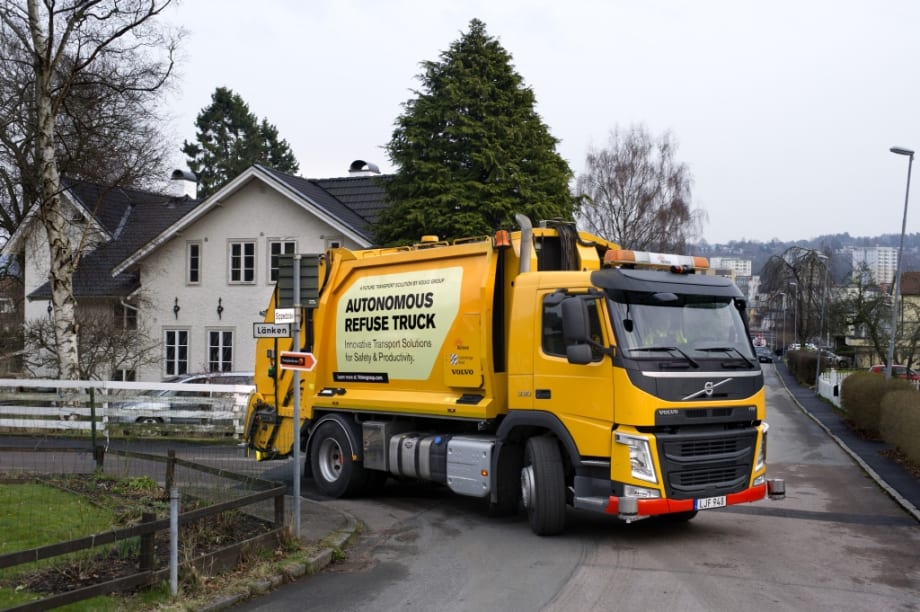
Photo: Volvo Group
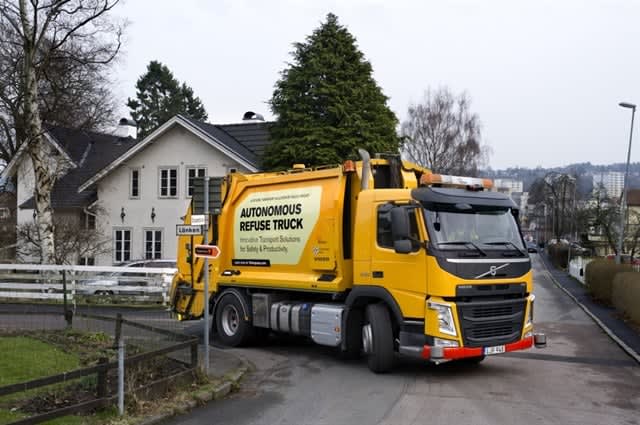
Photo: Volvo Group
Volvo Group is working with Swedish waste and recycling company Renova to test an autonomous, self-driving refuse truck in an urban environment.
The project will explore how an autonomous refuse truck can be used in a busy environment to improve traffic safety and working conditions and reduce environmental impact.
“There is amazing potential to transform the swift pace of technical developments in automation into practical benefits for customers and, more broadly, society in general,” said Lars Stenqvist, chief technology officer, Volvo Group. “Our self-driving refuse truck is leading the way in this field globally, and one of several exciting autonomous innovations we are working with right now.”
Volvo’s autonomous refuse truck is designed to make driving safer in built-up areas and while backing up. Sensors on the vehicle will monitor the vicinity and stop the truck immediately if an obstacle suddenly appears in its path. The route is pre-programmed and the truck drives itself to each location.
The driver can focus on refuse collection and does not have to climb in and out of the cab every time the truck moves to a new collection bin.
“One important benefit of the new technology is a reduction in the risk of occupational injuries, such as wear in knee joints – otherwise a common ailment among staff working with refuse collection,” said Stenqvist.
The autonomous truck also offers environmental benefits, according to Volvo. Gearchanging, steering and speed are constantly adjusted for low fuel consumption and emissions.
The joint project with Renova will continue through the end of 2017. The autonomous truck is fitted with a sensor system for identification, navigation and monitoring of the vehicle’s vicinity. Most of the technology is also used in Volvo’s autonomous mining truck that the company unveiled in 2016. The mining truck is undergoing tests in the Kristineberg Mine in northern Sweden.
More Equipment

How Volvo Updated Its D13 for EPA 2027 [Watch]
Volvo’s updated D13 promises lower emissions without sacrificing performance or fuel economy. Take a closer look at what changed inside the engine in this HDT Spotlight video.
Read More →
Michelin Tire Improves Efficiency and Durability for Regional Fleets
The Michelin X Multi Energy D2 is a regional haul drive tire engineered to help fleets improve fuel efficiency, durability and traction in demanding stop-and-go operations.
Read More →
ZF Expands Commercial Vehicle Push in North America
ZF is expanding its North American commercial-vehicle presence with new transmission applications, electrification, trailer technology and autonomous-driving systems.
Read More →
Tesla Wants a Self-Driving Semi. Are Cameras Enough?
Could Tesla’s camera-only autonomous driving technology work on an 80,000-pound Semi? In this commentary, HDT's Deborah Lockridge takes a look at Tesla, Cybercab, and how autonomous trucks see the road.
Read More →
Kodiak: Driverless Long-Haul Truck Launch on Track for 2026
Kodiak AI says its driverless long-haul safety case is 93% complete and it remains on track to begin commercial operations by year-end 2026.
Read More →
What DOT’s Automated Vehicle Strategy Means for Trucking
The U.S. Department of Transportation issued a new automated-vehicle strategy that outlines plans for driverless-truck regulations, cross-state freight corridors, and federal safety standards.
Read More →
East Coast Port Launches $45M Electric Truck Push
The Port Authority of New York and New Jersey announced millions in incentives for zero-emission drayage trucks, yard tractors, and new charging hubs near the port.
Read More →
PlusAI Going Public to Fund Autonomous Truck Launch
A SPAC deal could provide PlusAI with up to $300 million as it works toward a 2027 commercial launch of factory-built autonomous trucks.
Read More →
NHTSA Moves to Rewrite Truck Fuel-Economy Rules
The National Highway Traffic Safety Administration says it lacks authority to regulate medium- and heavy-duty truck engines separately from complete vehicles, but the existing standards have not yet been eliminated.
Read More →
Detroit Opens Orders for EPA 2027 Engines
Detroit isn’t starting from scratch to meet EPA 2027 diesel emissions standards. Its Gen 6 DD13 and DD15 engines keep much of today’s platform while updating the fuel and aftertreatment systems.
Read More →