




Volvo Seeks CARB-24 Engine Certification for New VNL and VNR
Upon successful certification, deliveries of new Volvo VNL and VNR trucks with CARB-24 Omnibus compliant engines are expected to begin in the fourth quarter.

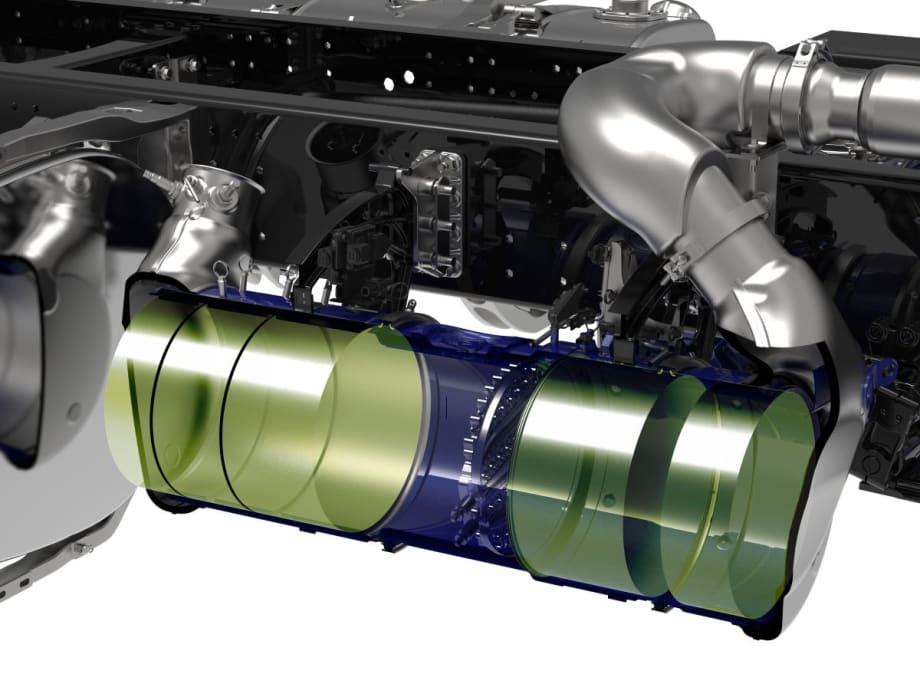
Volvo Trucks’ new engine will feature an advanced emission control system, including a fully serviceable linear exhaust aftertreatment system (EATS) and an integrated 48-volt heater used during startup and low-load situations to achieve the stringent ultra-low NOx targets.
Image: Volvo Trucks North America
Volvo Trucks North America announced that it will apply for certification of its CARB-24 Omnibus compliant engine. The OEM added that it expects the new engine meet the California Air Resources Board’s 2024 emissions standards and be available to order in the near future.
The engine is designed to obtain a certification at the 0.05g NOx rating with reduced particulate matter (PM) emissions.
Upon successful certification, deliveries of all new VNL and VNR model trucks with CARB-24 Omnibus compliant engines are expected to begin in the fourth quarter of this year.
This new engine continues Volvo's ambition towards zero emissions in heavy-duty transportation by 2040, the company said.
Lower Emissions, Enhanced Fuel Efficiency
The engine will be built on the new Volvo D13 VGT (Variable Geometry Turbo) engine platform, which was launched last month at TMC. Volvo Trucks was the first North American OEM to launch a truck with a 24-volt electrical architecture.
Once certified, customers will be able to order the CARB-24 Omnibus compliant engine in the all-new Volvo VNL and VNR models, with expected available configurations of 425 HP/1750 lb. ft. torque or 455 HP/1850 lb. ft. torque.
In addition to less NOx and PM, the new D13 VGT engine will enhance fuel efficiency through several innovations. Volvo said this is thanks to its shorter seven-wave piston for improved combustion, a longer connecting rod to reduce friction, a precision needle control valve for optimized fuel flow, and a variable displacement oil pump to minimize parasitic losses.
The improvement in fuel efficiency also is expected to have a direct and significant impact on CO2 reduction.
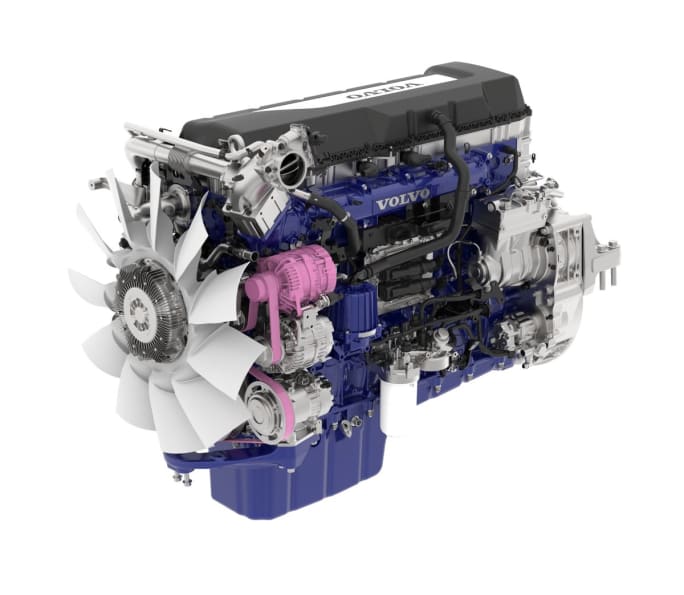
Volvo's CARB24 engine will be built on the new Volvo D13 VGT (Variable Geometry Turbo) engine platform.
Image: Volvo Trucks North America
Volvo Trucks’ new engine will feature an advanced emission control system, including a fully serviceable linear exhaust aftertreatment system (EATS) and an integrated 48-volt heater used during startup and low-load situations to achieve the stringent ultra-low NOx targets. Each EATS component is designed for individual servicing or replacement, minimizing waste and maximizing operational lifespan.
This new engine complements Volvo Trucks’ earlier CARB-24 engine launch for the legacy VNL and VNR models.

Volvo Trucks North America executives made the announcement at the Advanced Clean Transportation (ACT) Expo.
Photo: Jack Roberts
CARB’s Omnibus regulations aim to reduce NOx emissions by 75% and PM by 50% from heavy-duty on-road engines for engine model years 2024 through 2026 — compared to current U.S. Environmental Protection Agency (EPA) standards.
"To help customers successfully navigate evolving regulations, Volvo has developed an engine that is intended to meet both EPA and CARB requirements,” said Johan Agebrand, director of product marketing, Volvo Trucks North America.
“We continue to invest in powertrain and vehicle advancements that support our sustainability goals and our commitment to environmental stewardship. The Volvo VNR Electric continues to lead the Class 8 battery electric truck market in North America with over 40 percent market share and continue investments in developing other zero- and near-zero tailpipe emissions technologies.”
More Fuel Smarts

How Volvo Updated Its D13 for EPA 2027 [Watch]
Volvo’s updated D13 promises lower emissions without sacrificing performance or fuel economy. Take a closer look at what changed inside the engine in this HDT Spotlight video.
Read More →
Diesel Price Spike Shortens Payback for Natural Gas Trucks, Report Says
Energy Vision estimates fleets could recover the higher purchase price of an RNG-fueled Class 8 tractor in 1.3 to 2.8 years under current fuel-price scenarios.
Read More →
Calstart Becomes Catalyst Mobility, Reflecting Broader Focus
Calstart is now Catalyst Mobility, reflecting the nonprofit’s growing national role in clean transportation, including zero-emission trucks, infrastructure and incentive programs.
Read More →

Record Diesel Prices Squeeze Trucking Fleets
Average U.S. diesel prices have climbed to nearly $6 a gallon, surpassing the 2022 record as tight refinery capacity and Middle East disruptions keep fuel costs elevated.
Read More →
How Fuel Delivery Shapes Engine Performance
Fuel delivery depends on more than what happens at the injector. For fleet, maintenance and technical professionals, looking at the full path from pump to injector can provide useful context for understanding engine performance.
Read More →
East Coast Port Launches $45M Electric Truck Push
The Port Authority of New York and New Jersey announced millions in incentives for zero-emission drayage trucks, yard tractors, and new charging hubs near the port.
Read More →
California Bill Could Shed Light on Electric Truck Prices
Why do battery-electric Class 8 trucks remain so expensive? A California bill headed to Gov. Gavin Newsom would give fleets and state agencies more visibility into what manufacturers charge.
Read More →
Detroit Opens Orders for EPA 2027 Engines
Detroit isn’t starting from scratch to meet EPA 2027 diesel emissions standards. Its Gen 6 DD13 and DD15 engines keep much of today’s platform while updating the fuel and aftertreatment systems.
Read More →
Zero-Emission Truck Corridor Planned for West Coast
California, Oregon, Washington, British Columbia and Baja California are coordinating plans for truck charging and hydrogen fueling from Canada to Mexico.
Read More →
A Closer Look at Kenworth’s Electric T880E Vocational Truck [Video]
Learn more about Kenworth's T880E battery-electric vocational truck at the Paccar Technical Center, including its range, applications, upfitting considerations, and PTO options, in this HDT Spotlight video.
Read More →