





Related: Volvo's New Electric Truck Goes to Work on the West Coast
Volvo Inks Long-Term Autonomous Research Agreement With Nvidia
Volvo's new research agreement with American technology developer Nvidia, is focused on creating a flexible, scalable autonomous driving system to used in future commercial vehicles.
June 18, 2019
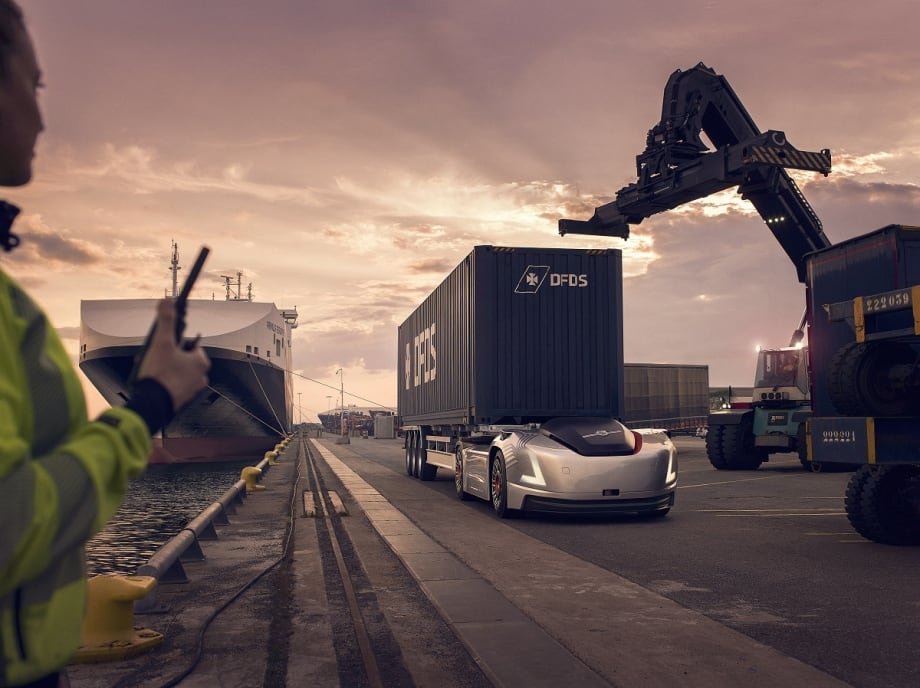
Volvo plans to use NVIDIA's end-to-end artificial intelligence platform for training, simulation and in-vehicle computing, with the goal of developing vehicle systems that can safely handle fully autonomous driving on public roads and highways.
Photo: Volvo Trucks
2 min to read
Coming on the heels of the Swedish truck maker’s deployment of its Vera, autonomous tractor prototype, in the port of Gothenburg in early June, Volo has now announced a signed agreement with American autonomous vehicle developer Nvidia to jointly develop the decision making system of autonomous commercial vehicles and machines. Volvo plans to use Nvidia's end-to-end artificial intelligence platform for training, simulation and in-vehicle computing, with the goal of developing vehicle systems that can safely handle fully autonomous driving on public roads and highways.
The joint control solution will be built on Nvidia's full software stack for sensor processing, perception, map localization and path planning, enabling a wide range of possible autonomous driving applications, such as freight transport, refuse and recycling collection, public transport, construction, mining, forestry and more, Volvo said.
"Automation creates real-life benefits for both our customers and the society in terms of safety, energy efficiency and as a consequence productivity. We continue to gradually introduce automated applications in the entire spectrum of automation, from driver support systems to fully autonomous vehicles and machines. This partnership with Nvidia is an important next step on that journey," said Martin Lundstedt, president and CEO of the Volvo Group.
The partnership with Nvidia will focus on the development of a flexible, scalable autonomous driving system, which is planned to be used first in commercial pilots and later in commercial offerings from the Volvo Group. The agreement signed between the Volvo Group and Nvidia is a long-term partnership spanning several years. Work will begin immediately with personnel from the two companies being co-located in Gothenburg, Sweden, and Santa Clara, California.
"Trucking is the world's largest network – a network that through online shopping puts practically anything, anywhere in the world, quickly within our reach," said Jensen Huang, Nvidia founder and CEO. "The latest breakthroughs in AI and robotics bring a new level of intelligence and automation to address the transportation challenges we face. We are thrilled to partner with Volvo Group to reinvent the future of trucking."
"Automation is a key technology area for the Volvo Group. With this partnership we will further increase our speed of development and strengthen our long-term capabilities and assets within automation, to the benefit of our customers in different segments and markets," added Lars Stenqvist, Volvo Group chief technology officer.
The strategic partnership covers end-to-end computing fundamental to autonomous vehicles. It includes accelerated computing technology in the datacenter for training deep neural networks; large-scale simulation for hardware-in-the-loop testing and validation of autonomous vehicle systems; and finally deployment of the Nvidia Drive platform in the vehicle running the full software stack for 360-degree sensor processing, mapping and path planning.
More Fleet Management

Sponsored•September 16, 2026
Color Match Smarter: Tools That Restore & Perform
For fleet managers and collision repair professionals keeping heavy-duty trucks on the road, getting the color right the first time isn't just about appearance — it's about efficiency, turnaround time, and bottom-line results. Discover how today's digital color tools are transforming the repair process from guesswork to precision.
Read More →
FMCSA Pauses Biennial-Update Enforcement Amid Motus Transition
Carriers whose updates were due on or after June 1 have more time, while FMCSA works to stabilize its new registration system and warns of phishing sites impersonating its new carrier registration system, Motus.
Read More →
Sponsored•September 14, 2026
2026 Blueprint for Countering Smarter Supply Chain Theft
Cargo theft is no longer just the cost of doing business. It's a multi-billion-dollar criminal enterprise exploiting vulnerabilities across your fleet, drivers, and supply chain.
Read More →


Sponsored•September 1, 2026
How Telematics Improves Visibility, Control, and Performance in Refrigerated Fleets
Explore how telematics help refrigerated fleets improve visibility, uptime, efficiency, compliance, and cargo protection across connected cold chain operations.
Read More →
What the U.S.-Canada Trade War Means for Trucking
Escalating U.S.-Canada tariffs could disrupt cross-border freight, reduce truck volumes, raise costs, and create new uncertainty for carriers on both sides of the border.
Read More →
What Are Trucking’s Top Concerns for 2026?
The American Transportation Research Institute wants to know what's worrying trucking fleet managers, drivers, and other stakeholders in its annual Industry Issues survey.
Read More →
American Trucking Associations Looks for a New Leader
ATA President and CEO Chris Spear abruptly left his job at the association on August 21, at a pivotal time for the trucking industry.
Read More →
Public Wi-Fi Cybersecurity Risks: How Truck Drivers and Fleets Can Protect Their Data
Public Wi-Fi can expose truck drivers and fleets to credential theft, malware, and other cyber threats. Here’s how to reduce the risk on the road.
Read More →
For Nicky Cupp, Fleet Innovation Starts With Frustration
HDT Truck Fleet Innovator Nicky Cupp turns everyday pain points at Fraley & Schilling into opportunities for better technology and smarter processes.
Read More →
Adam Buttgenbach’s Approach to Electric Trucks: Start With Where They Fit
HDT Truck Fleet Innovator Adam Buttgenbach helped PepsiCo build one of North America’s largest EV fleets by focusing on where electric trucks make operational sense.
Read More →