




Volvo Expert: Truck Safety Begins and Ends with All of Us
ORLANDO – Getting beyond the always sobering yet stultifying dry facts and figures that safety experts often recite to make their case, Volvo Trucks’ Traffic and Product Safety Director Carl Johan Almqvist presented a common-sense take on why vehicle accidents occur and what we can all do to help prevent them.


Volvo's Carl Johan Almqvist: “The multimillion dollar question is why do accidents happen?” Photo: David Cullen
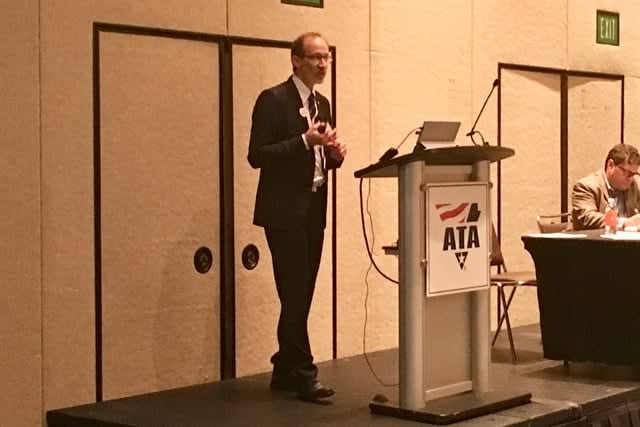
Volvo's Carl Johan Almqvist: “The multimillion dollar question is why do accidents happen?” Photo: David Cullen
ORLANDO – Getting beyond the always sobering yet stultifying dry facts and figures that safety experts often recite to make their case, Volvo Trucks’ Traffic and Product Safety Director Carl Johan Almqvist presented a common-sense take on why vehicle accidents occur and what we can all do to help prevent them.
“Every year, about 1.2 million people are killed in road traffic accidents worldwide,” he said in opening his talk on Oct. 27 here at the American Trucking Associations’ Management Conference & Exhibition. “That’s the equivalent in lives lost to having 10 airliners crash every day. If that were to happen, we would ground all airplanes.” But, he pointed out, we don’t “see” highway fatalities in the same way — as massive losses of human life.
Almqvist, who helped direct the latest annual Volvo Trucks Safety Report (produced by the Swedish OEM’s Accident Research Team), then said one of the first obstacles pretty much everyone has to overcome to sharply reduce the carnage on roads across the global is the “it won’t happen to me” feeling.
He said to instead think of who it will it happen to. “But is it ever okay,” he asked, “the number of people killed? Is it okay if it is someone in your family?” Almqvist said the recognition that it matters that anyone has to die in accidents is why “Volvo’s vision is to have zero accidents with our trucks.” He added that what no one wants to talk about “must be talked about or [improvement] will never happen.
“The multimillion dollar question is why do accidents happen?” Almqvist continued. He said that in his own globetrotting travels, no matter where he has gone, he has heard tell that “one major cause is ‘bad luck.’ But is it really about that? No, it’s not. But what we do know is that 90% of the accidents the world over are caused by human factors.” As an aside, he remarked that “that’s why it’s getting so popular to talk about getting rid of drivers.”
Almqvist pointed out there are several factors that, once added into the driving mix, will very negatively affect human performance behind the wheel: Distraction, misuse of alcohol and drugs, and speed. He gave particular attention to that last contributing factor, stating that speed plays a large role in accident causation because “humans are not equipped with a speed sensor. We do have a ‘height sensor’ that keeps us from falling. But we have no sense of how fast we are going.”
He then presented a snapshot of the fatality rates resulting from accidents for which trucks were held responsible both here and overseas. In the European Union, the rate was 15% while for the U.S., it was 11.5%.
The detailed 2017 Volvo Trucks Safety Report cited by Almqvist identified the following as being among “the most important focus areas” for advancing truck safety:
Increase seatbelt use by truck drivers
“Secure driver awareness” as well as direct and indirect visibility from the cab
Improve both direct and indirect visibility
Enable driver-coaching services that provide direct feedback to the driver, both when it comes to safer driving and more economical driving.
Develop Active Safety Systems—these have “great potential when it comes to truck occupants as well as fellow road users… Active Safety Systems aim by design not merely to mitigate an accident but also to avoid it.”
More Fleet Management

Color Match Smarter: Tools That Restore & Perform
For fleet managers and collision repair professionals keeping heavy-duty trucks on the road, getting the color right the first time isn't just about appearance — it's about efficiency, turnaround time, and bottom-line results. Discover how today's digital color tools are transforming the repair process from guesswork to precision.
Read More →
FMCSA Pauses Biennial-Update Enforcement Amid Motus Transition
Carriers whose updates were due on or after June 1 have more time, while FMCSA works to stabilize its new registration system and warns of phishing sites impersonating its new carrier registration system, Motus.
Read More →
2026 Blueprint for Countering Smarter Supply Chain Theft
Cargo theft is no longer just the cost of doing business. It's a multi-billion-dollar criminal enterprise exploiting vulnerabilities across your fleet, drivers, and supply chain.
Read More →


How Telematics Improves Visibility, Control, and Performance in Refrigerated Fleets
Explore how telematics help refrigerated fleets improve visibility, uptime, efficiency, compliance, and cargo protection across connected cold chain operations.
Read More →
What the U.S.-Canada Trade War Means for Trucking
Escalating U.S.-Canada tariffs could disrupt cross-border freight, reduce truck volumes, raise costs, and create new uncertainty for carriers on both sides of the border.
Read More →
What Are Trucking’s Top Concerns for 2026?
The American Transportation Research Institute wants to know what's worrying trucking fleet managers, drivers, and other stakeholders in its annual Industry Issues survey.
Read More →
American Trucking Associations Looks for a New Leader
ATA President and CEO Chris Spear abruptly left his job at the association on August 21, at a pivotal time for the trucking industry.
Read More →
Public Wi-Fi Cybersecurity Risks: How Truck Drivers and Fleets Can Protect Their Data
Public Wi-Fi can expose truck drivers and fleets to credential theft, malware, and other cyber threats. Here’s how to reduce the risk on the road.
Read More →
For Nicky Cupp, Fleet Innovation Starts With Frustration
HDT Truck Fleet Innovator Nicky Cupp turns everyday pain points at Fraley & Schilling into opportunities for better technology and smarter processes.
Read More →
Adam Buttgenbach’s Approach to Electric Trucks: Start With Where They Fit
HDT Truck Fleet Innovator Adam Buttgenbach helped PepsiCo build one of North America’s largest EV fleets by focusing on where electric trucks make operational sense.
Read More →