





Related: Volvo Offers Sneak-Peek of All-New Class 8 Electric Tractor
Volvo Chief: Technology Driving an Industry in Transition
Electrification, autonomous trucks, and connectivity are transforming the goods transportation industry. Martin Lundstedt, President and CEO of the Volvo Group, explored these topics at the Heavy Duty Manufacturers Association’s lunch briefing during the North American Commercial Vehicle Show in Atlanta Oct. 29.
October 30, 2019
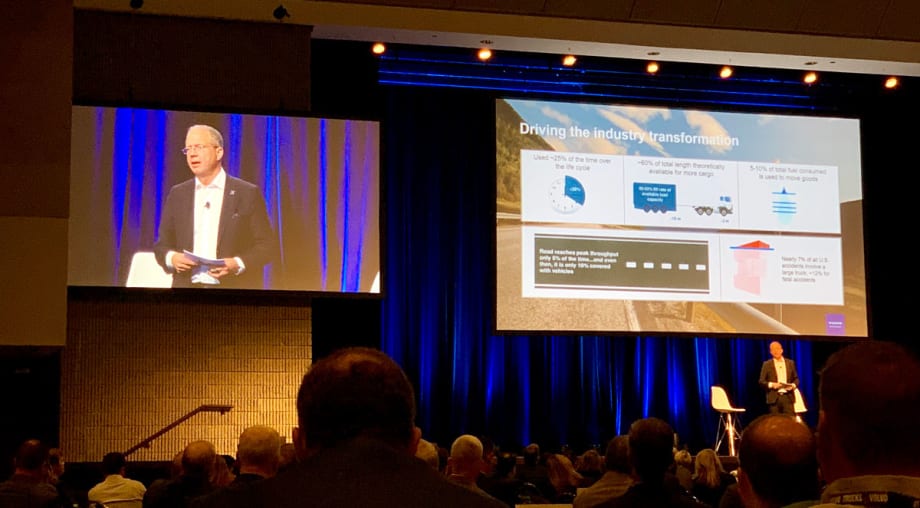
Martin Lundstedt, president and CEO of the Volvo Group, speaks to HDMA members at NACV.
Photo by Deborah Lockridge
3 min to read
Electrification, autonomous trucks, and connectivity are transforming the trucking industry. said Martin Lundstedt, President and CEO of the Volvo Group. He explored these topics addressing a crowd of trucking industry suppliers at the Heavy Duty Manufacturers Association’s lunch briefing during the North American Commercial Vehicle Show in Atlanta Oct. 29.
With 8 billion people projected to be living in an increasingly digital world by 2030, he said, “With that population that means that transportation needs will continue to grow and increase, both goods and people – but it needs to be considerably more sustainable,” in order to leave the world in good shape for future generations.
Some of the things driving the industry transformation, he said, include:
Vehicles are only used about 25 percent of the time over their life cycle, sitting idle and unproductive the rest of the time
Only about 40-50% of available load capacity is actually used, meaning more of a vehicle’s length is theoretically available for cargo
5-10% of total fuel consumed is used to move goods
Roads reach their peak throughput only 5% of the time, and even then, it is only 10% covered with vehicles
Nearly 7% of all U.S. accidents involve a large truck – and about 12% of fatal crashes.
“In Volvo, what we are going for is safety, that should continue to be the main priority,” he said – but at the same time, obviously new technologies offer great potential for more efficiency and productivity.
Lundstedt said the new technologies transforming the transportation system are electrification, autonomous technologies, and connectivity.
“They are interesting, but they must be put in context,” he said. “How do we get out the benefits?”
As a project that covers all three technologies, he highlighted Vera, an electric, connected and autonomous tractor, designed for repetitive assignments in logistics centers, factories and ports, Vera doesn’t even have a cab for a driver. Vera now is being used in its first real-world job – providing autonomous transport between a logistics center and the port terminal in Volvo’s hometown of Gothenburg, Sweden.
Moving to e-mobility, Lundstedt pointed to the Volvo Lights project (Volvo Low Impact Green Heavy Transport Solutions) where it’s conducting real-world tests of battery electric Volvo VNRs at the southern California ports, working with California’s South Coast Air Quality Management District and over a dozen industry partners. Volvo has said it plans to have the EVNRs available for sale by the end of 2020.
Also under the Volvo Group, Mack offers the LR electric for waste/refuse applications.
Autonomous trucks, he said, have a great deal of potential in areas such as safety, energy efficiency, and productivity, and predicted they “will come quickly into our business.” There are many applications the Volvo Group is involved with where autonomous trucks make sense, such as port drayage, mines, and cross dock operations. “This is an area where we are putting a lot of effort.”
Volvo recently announced it is establishing a new business division that will focus the company’s engineering, design and financial efforts to accelerate the development, commercialization and sales of self-driving vehicles. And earlier this year, Volvo Group announced a partnership with Nnvidia to develop advanced AI platform for autonomous trucks.
The third area where there is huge potential, he said, is “growing digitization.”
Today there are 1 million connected Volvo group vehicles. “We are collecting enormous amounts of data. The capability of collection, analysis and action have improved tremendously.”
This connectivity is enabling new levels of customer service and uptime, he said, allowing for more informed and specific advice.
Lundstedt emphasized that a large proportion of its investment in developing new technologies focuses on what he called “well-known technology,” such as powertrains, aerodynamics, and safety systems.
“Yes, we are investing heavily in new technologies, but equality heavily into what we call well known; there’s a lot that can be done in those areas, as well.”
More Fleet Management

Why Private Fleets Are Taking More Freight
Private fleets are putting their own trucks on demanding customers and high-cost lanes as companies seek greater control over service, costs, and capacity.
Read More →
Sponsored•September 16, 2026
Color Match Smarter: Tools That Restore & Perform
For fleet managers and collision repair professionals keeping heavy-duty trucks on the road, getting the color right the first time isn't just about appearance — it's about efficiency, turnaround time, and bottom-line results. Discover how today's digital color tools are transforming the repair process from guesswork to precision.
Read More →
FMCSA Pauses Biennial-Update Enforcement Amid Motus Transition
Carriers whose updates were due on or after June 1 have more time, while FMCSA works to stabilize its new registration system and warns of phishing sites impersonating its new carrier registration system, Motus.
Read More →


Sponsored•September 14, 2026
2026 Blueprint for Countering Smarter Supply Chain Theft
Cargo theft is no longer just the cost of doing business. It's a multi-billion-dollar criminal enterprise exploiting vulnerabilities across your fleet, drivers, and supply chain.
Read More →
Sponsored•September 1, 2026
How Telematics Improves Visibility, Control, and Performance in Refrigerated Fleets
Explore how telematics help refrigerated fleets improve visibility, uptime, efficiency, compliance, and cargo protection across connected cold chain operations.
Read More →
What the U.S.-Canada Trade War Means for Trucking
Escalating U.S.-Canada tariffs could disrupt cross-border freight, reduce truck volumes, raise costs, and create new uncertainty for carriers on both sides of the border.
Read More →
What Are Trucking’s Top Concerns for 2026?
The American Transportation Research Institute wants to know what's worrying trucking fleet managers, drivers, and other stakeholders in its annual Industry Issues survey.
Read More →
American Trucking Associations Looks for a New Leader
ATA President and CEO Chris Spear abruptly left his job at the association on August 21, at a pivotal time for the trucking industry.
Read More →
Public Wi-Fi Cybersecurity Risks: How Truck Drivers and Fleets Can Protect Their Data
Public Wi-Fi can expose truck drivers and fleets to credential theft, malware, and other cyber threats. Here’s how to reduce the risk on the road.
Read More →
For Nicky Cupp, Fleet Innovation Starts With Frustration
HDT Truck Fleet Innovator Nicky Cupp turns everyday pain points at Fraley & Schilling into opportunities for better technology and smarter processes.
Read More →