




Volvo Announces New VNL Powertrain Enhancements
Volvo has announced a host of improvements to its D13 engine and I-Shift automated transmission.

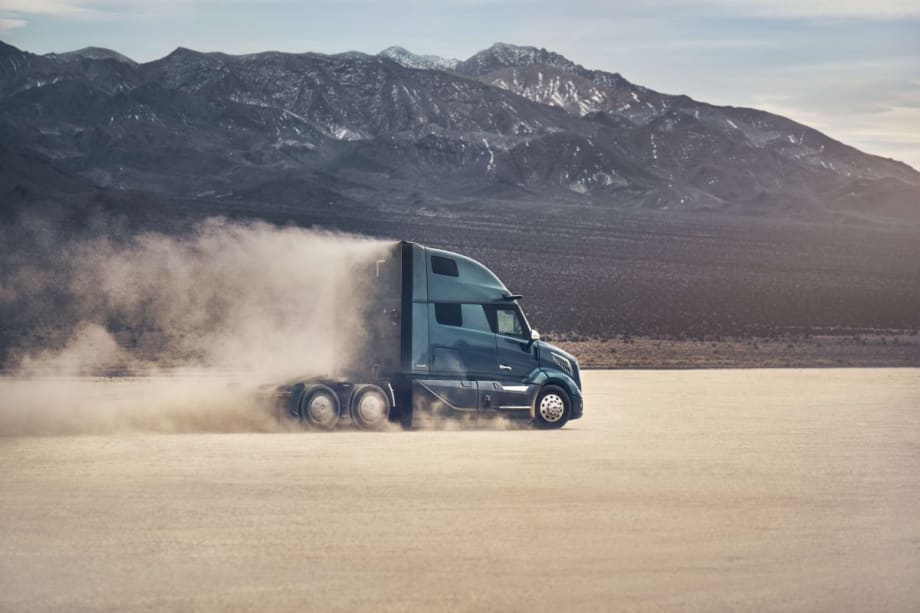
Volvo is upgrading powertrain options for its new VNL tractor -- and will no longer offer manual transmissions as an option, the OEM announced.
Photo: Volvo Trucks North America
Volvo Trucks North America is building on the launch of its “reimagined” VNL tractor last month by enhancing the Volvo D13 engine and I-Shift transmission. Design enhancements to the D13 engine include a new wave piston with a shorter piston height, as well as a longer connecting rod; smaller injector needle control valves; a variable vane oil pump; and improvements to the turbo compounding (TC) unit and turbocharger.
To further drive the fuel efficiency benefits of I-Shift, Volvo Trucks engineers introduced enhancements that improve shift speeds by up to 30%. These efficiency increases are critical to Volvo Trucks’ customers’ bottom line, while also providing tremendous reductions in carbon emissions, the OEM said in a press release.
More Than Just a VNL Facelift
“Bringing the all-new Volvo VNL to the market has been seven years in the making,” said Peter Voorhoeve, president of Volvo Trucks North America. “As we’ve said, this is not just a face lift, it’s a 90% redesign of the product and the platform for all future powertrain solutions. A 10% fuel efficiency increase is the result of radically improved aerodynamics and a dedication to improving upon our already class-leading powertrain offering. Setting the new standard for the North American trucking industry, these efficiency improvements represent not only a quantum leap forward in the way our customers do business, but also in our collective efforts to reduce carbon emissions. A 10% savings in a nearly 300,000 Class 8 truck market would equate to the same carbon reductions delivered by 30,000 battery-electric Class 8 trucks. Efficiency gains in our all-new Volvo VNL are crucial to our three-pillar strategy for decarbonizing heavy-duty transportation.”
Redesigned Volvo D13 Engine
Improvements to the D13 engine are abundant for the launch of the new Volvo VNL, according to Volvo. Its engineers looked at every area possible to improve combustion, reduce friction, make a reliable product even more robust, and reduce fuel consumption to increase customers' uptime and profitability.
These improvements include smaller needle control valves in the fuel injectors provide improved fuel flow into the D13 engine's combustion chamber. The control valve size reduction provides for more precise and rapid control over the fuel flow rate out of the injector tip, leading to improved fuel atomization, better combustion efficiency, and enhanced engine performance.
In 2017, Volvo Trucks introduced its patented six-wave piston, which received broad industry recognition for its results in reducing fuel consumption. With the launch of the new Volvo VNL, Volvo Trucks has introduced an improved seven-wave piston that provides further directional control of the air and fuel mixture to create even more efficient combustion. Additionally, the piston height was decreased and paired with a longer connecting rod to minimize cylinder sidewall pressure, decreasing friction and improving overall performance. These improvements provide smoother internal movement, reducing parasitic loss and increasing the overall efficiency and engine longevity.
Turbo-Compounding Improvements
Because the turbo compounding unit on the Volvo D13 engine is a pivotal element in enhancing fuel efficiency, Volvo Trucks engineers focused on opportunities to further optimize its design. To minimize heat loss and increase efficiency, complete insulation was added to both the turbocharger and the turbo compounding unit. Internally, the turbo compounding unit refinements include a smaller compressor and turbine wheel. This strategic improvement enables the system to recover surplus energy more effectively, converting it into usable power.
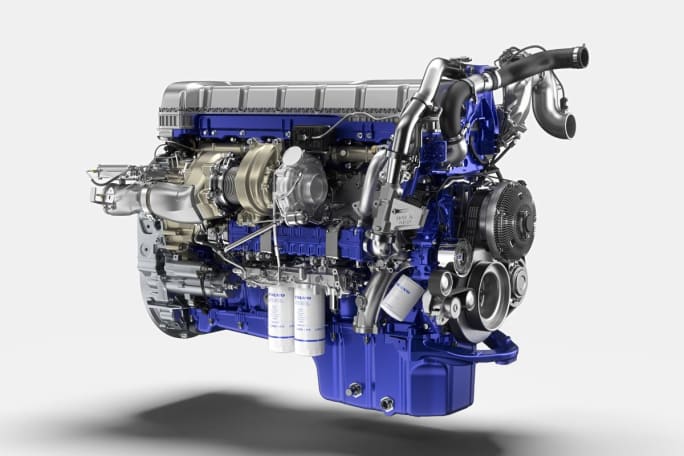
Volvo has announced a host of upgrades to its D13 diesel engine, which the OEM said further increase its fuel efficiency and reliability.
Photo: Volvo Trucks North America
“The advancements made in the latest generation of the Volvo D13 engine are nothing short of remarkable,” said Duane Tegels, product marketing manager for powertrain, Volvo Trucks North America. “While our previous generation D13, particularly the D13TC engine, performed extremely well, our dedicated team of engineers were able to seek out and successfully implement changes to make it even more reliable and efficient than ever before. When you’re designing a truck to change everything, every detail inside the engine matters. Where there are opportunities to make improvements, our team is focused on continuing to work towards decarbonizing our product offering.”
A New Variable Displacement Oil Pump
The integration of a variable displacement oil pump within an engine represents a pivotal advancement in optimizing oil pressure regulation while effectively minimizing parasitic losses. This pump employs adjustable vanes that dynamically adapt to the engine's oil pressure demands, ensuring a consistent and precise delivery of oil throughout various operating conditions. By dynamically altering the vane angles, the pump can tailor its output to match the engine's requirements, thereby preventing excess oil flow when not needed and maintaining optimal pressure when demanded. This adaptability not only enhances engine efficiency by reducing the energy required to drive the pump but also minimizes unnecessary strain on the engine components, resulting in improved fuel economy and reduced wear and tear over time.
No More Manual Transmissions
The latest iteration of the I-Shift transmission now features up to 30% faster shifting speeds compared to its predecessor, according to Volvo.
When Volvo Trucks introduced the I-Shift transmission in the North American market in 2007, it was met with skepticism. Today, the OEM noted, automated manual transmissions have become the industry standard, with traditional manual transmissions almost non-existent outside of extremely rare applications.
The efficiency gains and reliability achieved with the I-Shift have led Volvo Trucks to officially mark the end of its manual transmission offering, the company said.
The increase in shifting speeds on the newest version of the I-Shift has been achieved through an overhaul of the software, electronics, clutch mechanisms, and precision engineering, Volvo said. Additionally, Volvo engineers have redefined algorithms, reduced clutch throw, and introduced an enhanced clutch brake system to revolutionize gear shifts, significantly reducing the transition times between gears to ensure seamless power delivery. This improvement not only amplifies acceleration, but also minimizes energy loss during gear changes, resulting in heightened overall efficiency.
“Vehicle efficiency transcends mere engine performance; it encompasses the synergy between various components, where the transmission plays a pivotal role,” said Tegels. “The transmission's ability to optimize gear shifts, reduce energy loss, and harmonize power delivery significantly influences overall vehicle efficiency, showcasing that a holistic approach beyond the engine is vital in achieving optimal performance and fuel economy.”
More Equipment

How Volvo Updated Its D13 for EPA 2027 [Watch]
Volvo’s updated D13 promises lower emissions without sacrificing performance or fuel economy. Take a closer look at what changed inside the engine in this HDT Spotlight video.
Read More →
Michelin Tire Improves Efficiency and Durability for Regional Fleets
The Michelin X Multi Energy D2 is a regional haul drive tire engineered to help fleets improve fuel efficiency, durability and traction in demanding stop-and-go operations.
Read More →
ZF Expands Commercial Vehicle Push in North America
ZF is expanding its North American commercial-vehicle presence with new transmission applications, electrification, trailer technology and autonomous-driving systems.
Read More →
Tesla Wants a Self-Driving Semi. Are Cameras Enough?
Could Tesla’s camera-only autonomous driving technology work on an 80,000-pound Semi? In this commentary, HDT's Deborah Lockridge takes a look at Tesla, Cybercab, and how autonomous trucks see the road.
Read More →
Kodiak: Driverless Long-Haul Truck Launch on Track for 2026
Kodiak AI says its driverless long-haul safety case is 93% complete and it remains on track to begin commercial operations by year-end 2026.
Read More →
What DOT’s Automated Vehicle Strategy Means for Trucking
The U.S. Department of Transportation issued a new automated-vehicle strategy that outlines plans for driverless-truck regulations, cross-state freight corridors, and federal safety standards.
Read More →
East Coast Port Launches $45M Electric Truck Push
The Port Authority of New York and New Jersey announced millions in incentives for zero-emission drayage trucks, yard tractors, and new charging hubs near the port.
Read More →
PlusAI Going Public to Fund Autonomous Truck Launch
A SPAC deal could provide PlusAI with up to $300 million as it works toward a 2027 commercial launch of factory-built autonomous trucks.
Read More →
NHTSA Moves to Rewrite Truck Fuel-Economy Rules
The National Highway Traffic Safety Administration says it lacks authority to regulate medium- and heavy-duty truck engines separately from complete vehicles, but the existing standards have not yet been eliminated.
Read More →
Detroit Opens Orders for EPA 2027 Engines
Detroit isn’t starting from scratch to meet EPA 2027 diesel emissions standards. Its Gen 6 DD13 and DD15 engines keep much of today’s platform while updating the fuel and aftertreatment systems.
Read More →