




U.S. Allows Cross Border Trucking for the First Time
U.S. trucks will for the first time be allowed to make deliveries in Mexico under a year-long pilot program that expands cross border trucking operations with Mexico, U.S. Transportation Secretary Mary E. Peters announced toda
U.S. trucks will for the first time be allowed to make deliveries in Mexico under a year-long pilot program that expands cross border trucking operations with Mexico, U.S. Transportation Secretary Mary E. Peters announced today
during a visit to truck inspection facilities in El Paso, Texas.
U.S. trucks will get to make deliveries into Mexico while a select group of Mexican trucking companies will be allowed to make deliveries beyond the 20-25 mile commercial zones currently in place along the Southwest border.
Today's announcement prompted support from the American Trucking Associations, and condemnation from the Teamsters Union.
"Such regulation of Mexican carriers operating in the United States will ensure a level playing field in cross-border operations," said Clayton Boyce, vice president of Public Affairs for ATA. "Ensuring a level playing field also requires that when U.S. carriers are to begin operations in Mexico, the permitting and regulatory processes put in place by the government of Mexico must be fair, clear and transparent."
Meanwhile, Jim Hoffa, the general president of the Teamsters Union, likened the pilot program to "a game of Russian Roulette on America's highways.
"As with the Dubai Ports debacle, President Bush is willing to risk our national security by giving unfettered access to America's transportation infrastructure to foreign companies and their government sponsors. Mexico refuses to meet their end of the bargain, yet President Bush rewards them with open access to American highways. It is the American driving public who will pay the consequences.
"Where is the Inspector's General report that tells us that Mexico is meeting U.S. standards?" Hoffa asked. "Why is the President willing to move forward when his own Inspector General has stated that Mexico cannot meet its obligations?"
Secretary Peters said the new demonstration program was designed to simplify a process that currently requires Mexican truckers to stop and wait for U.S. trucks to arrive and transfer cargo. She said this process wastes money, drives up the cost of goods, and leaves trucks loaded with cargo idling inside U.S. borders.
The Secretary added that under current rules, U.S. trucks are not allowed into Mexico because the United States refused to implement provisions of the North American Free Trade Agreement that would have permitted safe cross-border trucking.
"The United States has never shied away from opportunities to compete, to open new markets and to trade with the world. Now that safety and security programs are in place, the time has come for us to move forward on this longstanding promise with Mexico," Secretary Peters said.
"We are committed to retaining a high level of security and safety standards under this program," said Homeland Security Secretary Michael Chertoff. "The tough security measures we already have in place will remain unchanged, resulting in a smart and secure approach to safeguarding the border, while allowing for American and Mexican carriers to deliver cargo outside of arbitrary commercial zones."
"Today's announcement is another sign of the strength of the U.S.-Mexico relationship and a further step towards making our economies globally competitive, promoting mutual economic growth and prosperity while continuing to protect the safety of our borders," said Commerce Secretary Carlos M. Gutierrez.
"Safety is the No. 1 priority and strict U.S. safety standards won't change," Secretary Gutierrez continued. "We will continue to work closely with President Calderon and his administration on ways we can further enhance the commerce of our countries and the competitiveness of our hemisphere without sacrificing safety or security."
Secretary Peters noted that the Department of Transportation has put in place a rigorous inspection program to ensure the safe operation of Mexican trucks crossing the border. On Thursday, Peters and Mexican Secretary of Communications and Transportation Luis Téllez announced a program to have U.S. inspectors conduct in-person safety audits to make sure that participating Mexican companies comply with U.S. safety regulations. The regulations require all Mexican truck drivers to hold a valid commercial drivers license, carry proof they are medically fit, comply with all U.S. hours-of-service rules and be able to understand questions and directions in English.
Secretary Peters said those Mexican truck companies that may be allowed to participate in the one-year program will all be required to have insurance with a U.S. licensed firm and meet all U.S. safety standards. Companies that meet these standards will be allowed to make international pick up and deliveries only and will not be able to move goods from one U.S. city for delivery to another, haul hazardous materials or transport passengers.
The first Mexican trucks to be authorized under the program will begin traveling beyond U.S. border areas once the initial in-person safety inspections are done and proof-of-insurance verified. Secretary Peters noted that with the announcement of the program, Mexico will begin to consider applications from U.S. trucking firms for licensing rights to operate within Mexico. Approximately 100 U.S. operators would be licensed by Mexico for cross-border operations.
In 2001, Congress authorized the cross border inspection program and listed 22 safety requirements that had to be in place before other steps were implemented. The Secretary noted that the Department's independent Inspector General's reports have confirmed success in meeting the congressional requirements. In addition, Secretary Peters said the Department has invested $500 million since 1995 to modernize border safety facilities and hire and train the over 500 federal and state inspectors who inspect trucks crossing the border every day.
"We have years of experience, we have a rigorous safety inspection plan in place and we have the facilities and the trained professionals to carry it out," Secretary Peters said. "Through this new pilot program, we are finding a better way to do business with one of this nation's largest trading partners, and in doing so, bringing U.S. drivers more opportunity, U.S. consumers more buying power and the U.S. economy even more momentum," she added.
Additional information on the cross border inspection program can be found at http://www.dot.gov/affairs/cbtsip/
More Drivers
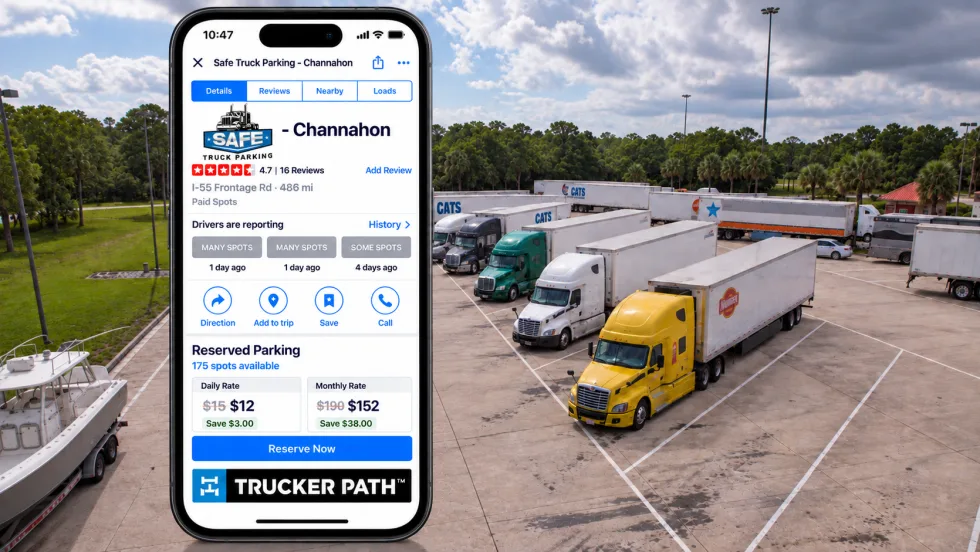
Trucker Path Expands Reserved Parking Network
Trucker Path has added close to 6,000 more truck parking spaces to its Trucker Path Reserved Parking Network with the addition of Safe Truck Parking.
Read More →
EEOC Sues Texas Trucking Company Over Driver Age Limits
The agency says Trancasa USA rejected applicants over 65 and applied tougher driving-record standards to those over 60.
Read More →
Nussbaum, Roehl Announce Second Driver Pay Increase This Year
This year has seen a swath of major truck driver pay increases as freight capacity has tightened.
Read More →
From One Generation to the Next: How Mentorship Builds Safer Truck Drivers
After three decades in trucking, Harold Perry shares what he's learned about driver safety, mentorship, and helping the next generation build confidence behind the wheel.
Read More →
Truck Drivers Need More Than Another Alert
Fleets have more visibility into truck health, safety events, and driver activity than ever. The next challenge is turning all that information into useful guidance for the person who has to decide what to do next.
Read More →
FMCSA Removes 110 Truck Driver Training Schools from Certified ELDT List
Federal regulators also are targeting more than 160 additional training providers and launching a nationwide audit of third-party CDL skills testers as part of a broader crackdown on trucking fraud.
Read More →
Hours of Service Pilot Programs: FMCSA Readies for 2027 Rollout
Two pilot programs could eventually reshape hours-of-service rules, giving truck drivers options to pause their 14-hour clock or use longer split sleeper rest periods.
Read More →
Medical Cards, English Proficiency Reshape Roadcheck Violations
Medical-card violations jumped to the top of the driver out-of-service list during CVSA’s 2026 International Roadcheck, while English-language proficiency violations appeared among the leading violations for the first time.
Read More →
Driver Trust Can Make or Break the Success of Fleet Safety Technology
New Teletrac Navman research suggests that onboarding, transparency about driver data, and positive feedback can play a significant role in how commercial drivers respond to safety and coaching technology.
Read More →
EEOC Sues KLLM Over Alleged Sex Discrimination in Driver Training
KLLM is facing a federal sex-discrimination lawsuit over policies the EEOC alleges put female truck driver trainees at a disadvantage.
Read More →