





Transportation Secretary Promises to Go After 'Bad Actors' in Trucking
Understanding English Language Proficiency Requirements for Drivers
Enforcement officials began enforcing English-language proficiency on June 25. Commercial drivers who fail a two-step assessment will be placed out of service.
June 23, 2025
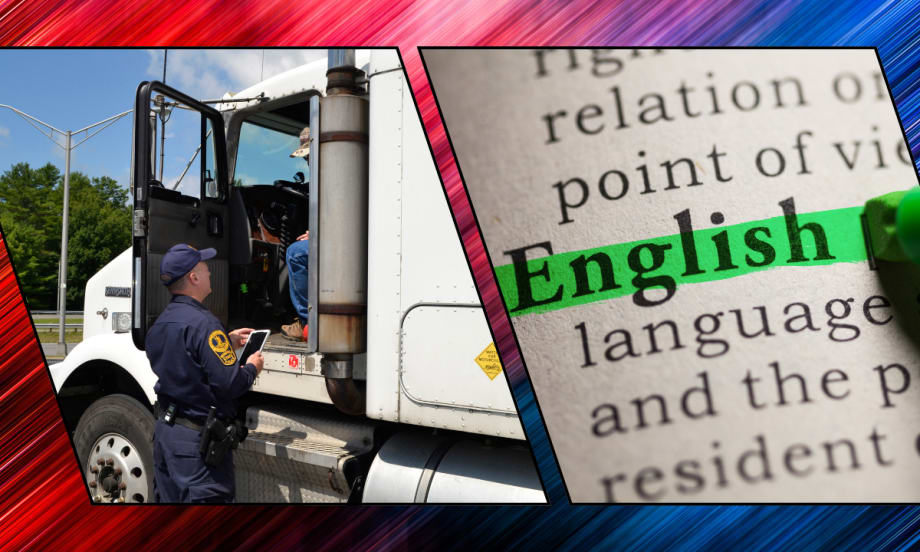
Commercial truck drivers who can't pass an English Language Proficiency test will be put out of service.
Image: HDT Graphic, CVSA photo
3 min to read
Enforcement officials will begin enforcing English-language proficiency on June 25, 2025. Commercial drivers who fail a two-step assessment will be placed out of service.
Federal regulations have long required that commercial motor vehicle drivers must be able to read and speak the English language well enough to:
Converse with the general public and law enforcement.
Understand highway traffic signs and signals.
Understand official inquiries and respond.
Make entries on reports and records.
However, in 2016, the Federal Motor Carrier Safety Administration issued guidance that violators were no longer to be placed out of service.
Recent Trump administration actions have eliminated that guidance.
Reinstating English Language Proficiency Enforcement for Commercial Drivers
On April 28, President Trump issued Executive Order 14286, reinforcing that English proficiency is a non-negotiable safety requirement for commercial drivers.
The Commercial Vehicle Safety Alliance shortly afterward called an emergency meeting to change its out-of-service criteria to comply.
Transportation Secretary Sean Duffy followed up on May 20, issuing an order stating that starting on June 25, failing the English requirement would result in immediate out-of-service status.
In U.S.–Mexico border zones, the driver will be cited for the violation but not placed OOS.
The Two-Step English Proficiency Screening Process
If the inspector’s initial interaction with a commercial driver suggests that the driver may not understand the given instructions, the inspector should proceed with an English Language Proficiency (ELP) assessment.
First, inspectors conduct a conversational interview in English (no interpreters or translation tools allowed). This is not a fluency assessment.
If passed, the driver is then tested on reading and interpreting standard U.S. traffic signs.
Failing either step can result in citation and immediate out-of-service status.
Deaf or hard-of-hearing drivers with FMCSA exemptions are exempt from oral-testing requirements.
What Should Motor Carriers Do?
If fleets believe a driver was incorrectly placed out of service for this violation, they have the option to file a DataQ.
DataQs is an FMCSA system that allows users to request and track a review of federal and state data issued by FMCSA that users believe to be incomplete or incorrect.
According to FMCSA guidance, motor carriers should assess a driver’s qualifications, including the ability to comply with the ELP requirements, during the driver qualification process.
The ELP assessment should include processes to evaluate whether the driver can sufficiently communicate with law enforcement officers (e.g., during a roadside inspection) and to understand highway traffic signs they may encounter while driving.
Assessing English Proficiency During the Driver Qualification Process
According to an email to members from the New Jersey Motor Truck Association, FMCSA recommends that a motor carrier manager conduct a driver interview in English as part of the driver qualification process in order to make sure it's complying with the regulations.
That interview should include inquiries that would show whether the driver could answer questions related to:
The origin and destination of a recent or planned trip.
The amount of time spent on duty, including driving time and the record of duty status (or logbook).
The information contained in the driver's license.
Information contained in shipping papers for the load transported/to be transported.
Vehicle equipment subject to inspection.
Interpreters, I-Speak cards, cue cards, smartphone apps, and On-Call Telephone Interpretation Service, should not be used during this ELP interview.
FMCSA also recommends that the manager explain to the driver that the ELP regulation requires the driver to understand and explain the meaning of U.S. highway signs. The manager should select various signs from the Federal Highway Administration’s Manual on Uniform Traffic Control Devices, as well as examples of dynamic message signs, and ask the driver to explain the meaning of the signs.
The driver’s explanation may be in any language, provided the manager can understand the driver’s explanation.
After successfully completing the ELP assessment, the manager may proceed with the rest of the interview in a language other than English, as appropriate.
More Drivers

Truck Drivers Need More Than Another Alert
Fleets have more visibility into truck health, safety events, and driver activity than ever. The next challenge is turning all that information into useful guidance for the person who has to decide what to do next.
Read More →
FMCSA Removes 110 Truck Driver Training Schools from Certified ELDT List
Federal regulators also are targeting more than 160 additional training providers and launching a nationwide audit of third-party CDL skills testers as part of a broader crackdown on trucking fraud.
Read More →
Hours of Service Pilot Programs: FMCSA Readies for 2027 Rollout
Two pilot programs could eventually reshape hours-of-service rules, giving truck drivers options to pause their 14-hour clock or use longer split sleeper rest periods.
Read More →
Medical Cards, English Proficiency Reshape Roadcheck Violations
Medical-card violations jumped to the top of the driver out-of-service list during CVSA’s 2026 International Roadcheck, while English-language proficiency violations appeared among the leading violations for the first time.
Read More →
Driver Trust Can Make or Break the Success of Fleet Safety Technology
New Teletrac Navman research suggests that onboarding, transparency about driver data, and positive feedback can play a significant role in how commercial drivers respond to safety and coaching technology.
Read More →
EEOC Sues KLLM Over Alleged Sex Discrimination in Driver Training
KLLM is facing a federal sex-discrimination lawsuit over policies the EEOC alleges put female truck driver trainees at a disadvantage.
Read More →
FMCSA Moves to Codify English Language Requirements for Commercial Drivers
By changing regulations on English-language proficiency requirements for commercial drivers, rather than relying on a guidance memo, the FMCSA said future administrations won't be able to walk back the Trump administration's stricter enforcement with just a memo.
Read More →
Drivers Put Western Star Trucks to the Test at Star Nation Experience
Watch to get an inside look at the Western Star trucks, technology, and community behind the Star Nation Experience 2026!
Read More →
Trump Administration Looks to Put More Veterans Behind the Wheel
The Freedom Haulers program pulls together existing and expanded programs at several federal agencies to recruit veterans to drive commercial heavy-duty trucks and cut the red tape for them to get a CDL, training, and employment.
Read More →
Putting Mack’s Command Steer to the Test
A test drive of Mack’s Command Steer active steering system evaluates how it can make truck driving easier and less tiring.
Read More →