




Related: Suicide by Flatbed on TV’s ‘Blue Bloods’ is Guilty of Technical Errors
Underride Legislation Faces Opposition from Trucking Groups
Reintroduced bipartisan legislation to mandate underride guards on large commercial trucks was met with opposition from the trucking industry, with both ATA and the OOIDA voicing their objections to the proposed rule.

Steven Martinez・Web Editor
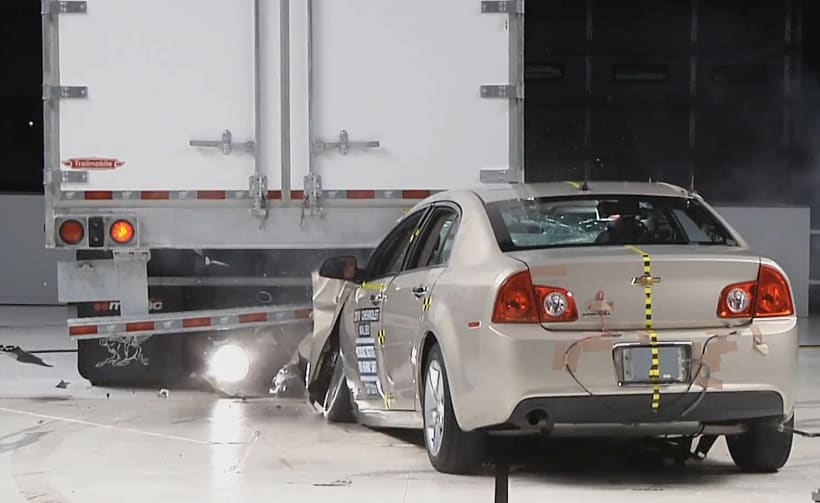
Reintroduced bipartisan legislation to mandate Underride guards on large commercial trucks was met with opposition from the trucking industry, with both ATA and the OOIDA voicing their objections to the proposed rule.
Photo via IIHS
3 min to read
Reintroduced legislation that would mandate underride guards on large commercial trucks was met with opposition from the trucking industry, with both American Trucking Associations and the Owner-Operator Independent Drivers Association voicing their objections to the proposed rule.
The Stop Underrides Act would require underride guards on the sides and front of trucks and trailers exceeding 10,000 pounds in gross vehicle weight and would also seek to update the standards for rear underride guards. The bill has bipartisan support and was co-sponsored by U.S. Senators Kirsten Gillibrand (D-NY) and Marco Rubio (R-FL) and U.S. Representatives Steve Cohen (D-TN-9) and Mark DeSaulnier (D-CA-11).
“Hundreds of individuals across the nation are lost to underride collisions every year, with Florida unfortunately ranking among the top states for reported fatalities. I am proud to join my Senate colleagues in reintroducing the Stop Underrides Act,” said Senator Rubio of the proposed legislation. “As a parent with kids of driving age, I look forward to working in a bipartisan fashion to advance efforts to keep our roads safer.”
A similar bill was proposed in 2017 but was referred to a committee and failed to make it to a vote. Two significant trucking groups, ATA and OOIDA have publicly opposed the mandate.
In a comment to the media, ATA criticized the bill for its inflexibility stating that it "ignores the potential technical issues it raises, as well as the diversity of our industry and other technologies for addressing these and other crashes."
“The trucking industry spends more than $9.5 billion on improving highway safety – including investments in a number of technologies proven to reduce crashes. ATA believes the government should focus on crash avoidance technologies and strategies rather than expensive and unproven collision mitigation equipment," the group stated. "This legislation, while well-intended and a heartfelt response to family tragedy, seeks to address a certain type of truck-involved accident through a highly prescriptive mandate."
OOIDA echoed similar sentiments saying that such requirements cannot be accommodated on most trucking equipment and would yield little if any safety benefit.
In a letter to congress, the OOIDA president and CEO Todd Spencer said that while OOIDA supports efforts to improve highway safety, the standard proposed by the bill goes overboard and would be prohibitively expensive for fleets to implement.
OOIDA said that the bill would also run into problems requiring the equipment on vehicles and trailers that would not be able to accommodate them because of the broad standard of the legislation requiring the guards on all commercial trucks over a certain weight.
“We agree the existing rear underride guard on trailers – commonly referred to as a “DOT Bumper” in the United States – could be enhanced to reduce the risk of rear underrides for personal automobiles. If the Canadian standard was applied in the U.S. on the manufacture of new trailers, we would not oppose it,” Spencer wrote. “Unfortunately, H.R. 1511 goes too far. Regarding rear underride guards, it would mandate truckers install them on trailers that can’t physically accommodate them, such as low boys, household goods trailers, auto transporters, etc. The mandate would retroactively apply to all trailers, including those nearing the end of their service.”
The Stop Underrides Act is supported by several commercial vehicle safety groups including the Commercial Vehicle Safety Alliance, Truck Safety Coalition, National Safety Council, and Road to Zero Coalition.
“As members of the law enforcement community who proactively inspect commercial motor vehicles for safe mechanical fitness during roadside safety inspections, CVSA member jurisdictions know the importance of taking steps to reduce fatalities and serious injuries on our nation’s roadways,” said Collin Mooney, executive director, CVSA. “If passed, the Stop Underrides Act will help mitigate the severity of underride crashes and make our roadways safer.”
More Safety & Compliance

FMCSA Pauses Biennial-Update Enforcement Amid Motus Transition
Carriers whose updates were due on or after June 1 have more time, while FMCSA works to stabilize its new registration system and warns of phishing sites impersonating its new carrier registration system, Motus.
Read More →
ZF Expands Commercial Vehicle Push in North America
ZF is expanding its North American commercial-vehicle presence with new transmission applications, electrification, trailer technology and autonomous-driving systems.
Read More →
Truck Drivers Need More Than Another Alert
Fleets have more visibility into truck health, safety events, and driver activity than ever. The next challenge is turning all that information into useful guidance for the person who has to decide what to do next.
Read More →
Tesla Wants a Self-Driving Semi. Are Cameras Enough?
Could Tesla’s camera-only autonomous driving technology work on an 80,000-pound Semi? In this commentary, HDT's Deborah Lockridge takes a look at Tesla, Cybercab, and how autonomous trucks see the road.
Read More →
What DOT’s Automated Vehicle Strategy Means for Trucking
The U.S. Department of Transportation issued a new automated-vehicle strategy that outlines plans for driverless-truck regulations, cross-state freight corridors, and federal safety standards.
Read More →
NYC Expands Speed, Pedestrian Safety Tech Across Fleet
New York City is expanding intelligent speed assistance and pedestrian-alert systems across its municipal fleet, moving the technologies from pilot programs into vehicle procurement and retrofit requirements.
Read More →
FMCSA Removes 110 Truck Driver Training Schools from Certified ELDT List
Federal regulators also are targeting more than 160 additional training providers and launching a nationwide audit of third-party CDL skills testers as part of a broader crackdown on trucking fraud.
Read More →
Beyond DOT Compliance: What Makes a Trucking Fleet Truly Safe?
A trucking fleet can follow every rule and still make unsafe decisions. The real test comes when safety conflicts with freight, productivity, or cost.
Read More →
Hours of Service Pilot Programs: FMCSA Readies for 2027 Rollout
Two pilot programs could eventually reshape hours-of-service rules, giving truck drivers options to pause their 14-hour clock or use longer split sleeper rest periods.
Read More →
New Guide Offers Pet Safety Tips for Truck Drivers
Hundreds of thousands of pets travel in truck cabs. A new safety guide from Volvo Trucks and the Center for Pet Safety offers practical advice for truck drivers who bring dogs and cats along for the ride.
Read More →