




UAW Workers Ratify Mack 5-Year Agreement
Unionized Mack Trucks workers on Nov. 15 ratified a new five-year collective bargaining agreement after more than five weeks on strike.

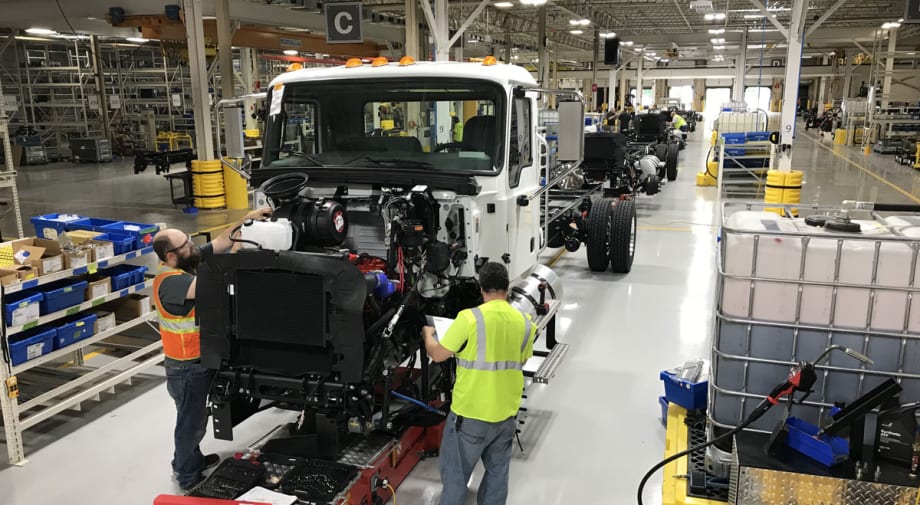
A Mack MD7 on the assembly line at the Macungie, Pennsylania, plant, taken before UAW workers went on strike.
Photo: Mack Trucks
Unionized Mack Trucks workers on Nov. 15 overwhelmingly ratified a new five-year collective bargaining agreement after more than five weeks on strike.
According to the United Auto Workers, after 39 days on strike, UAW members at Mack Trucks voted by 93% to ratify their new contract "with significant local improvements."
The master agreement is the same tentative agreement that workers rejected in early October, triggering the strike action. The agreement covers about 3,900 employees at Mack production facilities in Macungie (Lehigh Valley), Pennsylvania; Middletown, Pennsylvania; Hagerstown, Maryland; Baltimore, Maryland, and Jacksonville, Florida.
“The new agreement guarantees significant wage growth and delivers excellent benefits for our employees and their families,” said Mack President Stephen Roy in a news release announcing the ratification. “At the same time, it will safeguard our competitiveness and allow us to continue making the necessary investments in our people, plants and products.”
‘Last Best and Final Offer’
The UAW has been on strike at Mack facilities since Oct. 9 after 73% of members voted against ratification of a new five-year collective bargaining agreement that had been reached between Mack and the union’s negotiating team.
The two sides made little to no progress on the master agreement since the tentative contract was rejected.
On Nov. 7, UAW reported that its bargaining committee met with Mack to continue negotiations, but it said those negotiations had gone nowhere and that Mack told union negotiators that the Oct. 1 master agreement offer made by the company was their “last best and final offer.”
According to published reports, Local Union 677 leaders sent a letter to UAW members that negotiations were over and the company would start hiring replacement workers to restart production at the Macungie facility if the deal were not ratified.
During the strike, Mack has been using about 500 non-union workers at its Hagerstown plant helping the company maintain support for the New River Valley plant. This group consists of non-union employees from Hagerstown and volunteers from other Volvo Group sites, as well as personnel from dealers, suppliers and a staffing service, the company explained on its UAW update website.
“Hagerstown supplies powertrains to other Volvo Group sites. We’re committed to protecting our business, and to minimizing the impact of the strike on our Volvo Trucks customers and fellow Volvo Group colleagues, as much as we can,” Mack said.
Why Was the Deal Initially Rejected?
“After almost two decades of concessionary contracts, the members are ready to make up lost ground,” said the UAW in a Mack negotiations update on Oct. 20.
In an Oct. 26 update, UAW said the two most important issues from the members were an increase in general wages and reinstating cost of living increases (aka COLA) back into the master agreement, which had been frozen in 2012.
According to Mack, the tentative agreement employees were voting on “includes the strong wage and benefit package the company offered at the master contract level and tentatively agreed to by the parties on Oct. 1, as well as a number of revised terms negotiated with the UAW on local agreements impacting LVO, Hagerstown, Baltimore and Jacksonville.”
Mack has said the tentative agreement that previously was agreed to by UAW negotiators would deliver a 10% general wage increase in year one for all employees, and a compounded 20% general wage increase over five years. It would also eliminate one wage progression step, giving all employees a faster path to full pay, and health insurance premiums would not increase through the term of the contract.
More Equipment

How Volvo Updated Its D13 for EPA 2027 [Watch]
Volvo’s updated D13 promises lower emissions without sacrificing performance or fuel economy. Take a closer look at what changed inside the engine in this HDT Spotlight video.
Read More →
Michelin Tire Improves Efficiency and Durability for Regional Fleets
The Michelin X Multi Energy D2 is a regional haul drive tire engineered to help fleets improve fuel efficiency, durability and traction in demanding stop-and-go operations.
Read More →
ZF Expands Commercial Vehicle Push in North America
ZF is expanding its North American commercial-vehicle presence with new transmission applications, electrification, trailer technology and autonomous-driving systems.
Read More →
Tesla Wants a Self-Driving Semi. Are Cameras Enough?
Could Tesla’s camera-only autonomous driving technology work on an 80,000-pound Semi? In this commentary, HDT's Deborah Lockridge takes a look at Tesla, Cybercab, and how autonomous trucks see the road.
Read More →
Kodiak: Driverless Long-Haul Truck Launch on Track for 2026
Kodiak AI says its driverless long-haul safety case is 93% complete and it remains on track to begin commercial operations by year-end 2026.
Read More →
What DOT’s Automated Vehicle Strategy Means for Trucking
The U.S. Department of Transportation issued a new automated-vehicle strategy that outlines plans for driverless-truck regulations, cross-state freight corridors, and federal safety standards.
Read More →
East Coast Port Launches $45M Electric Truck Push
The Port Authority of New York and New Jersey announced millions in incentives for zero-emission drayage trucks, yard tractors, and new charging hubs near the port.
Read More →
PlusAI Going Public to Fund Autonomous Truck Launch
A SPAC deal could provide PlusAI with up to $300 million as it works toward a 2027 commercial launch of factory-built autonomous trucks.
Read More →
NHTSA Moves to Rewrite Truck Fuel-Economy Rules
The National Highway Traffic Safety Administration says it lacks authority to regulate medium- and heavy-duty truck engines separately from complete vehicles, but the existing standards have not yet been eliminated.
Read More →
Detroit Opens Orders for EPA 2027 Engines
Detroit isn’t starting from scratch to meet EPA 2027 diesel emissions standards. Its Gen 6 DD13 and DD15 engines keep much of today’s platform while updating the fuel and aftertreatment systems.
Read More →