





How Autonomous Trucks Could Transform Middle Mile Deliveries
Tyson Foods, Gatik Deploying Class 7 Autonomous Trucks
Tyson Foods and Gatik announced a joint project aimed at putting autonomous trucks to work hauling refrigerated products in Arkansas.
September 6, 2023
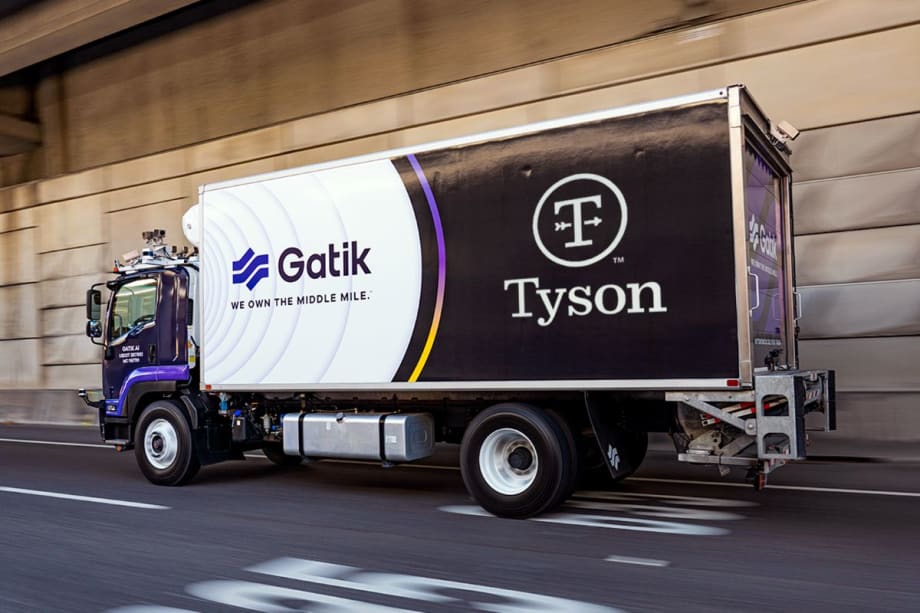
Tyson Foods will begin running autonomous middle-mile logistics in Arkansas using Gatik self-driving technology focused on short-haul operations.
Photo: Gatik
3 min to read
Tyson Foods and Gatik AI announced a multi-year collaboration to deploy autonomous refrigerated box trucks on Tyson routes in Northwest Arkansas.
Gatik is an autonomous technology developer focused on middle-mile logistics. Its trucks are equipped with multiple sensors, custom-designed for short-haul B2B operations.
The two will work together to autonomously deliver Tyson’s frozen protein products to distribution and storage facilities around Northwest Arkansas. Gatik’s fleet will move fresh and frozen Tyson, Jimmy Dean and BallPark food products from a Tyson food processing plant to multiple cold-storage facilities, including Tyson’s own distribution center, where products are organized for final distribution to Tyson’s customers.
The project will deploy autonomous trucks operating 18 hours a day delivering products to distribution and storage facilities in the Rogers and Springdale, Arkansas, areas. A safety driver will initially be present in the cab to monitor the autonomous system and take command of operating the truck if required.
Moving into Heavier-Duty Trucks
This is the first time Gatik is introducing Class 7 autonomous box trucks into its fleet, offering increased delivery capacity.
The company also pointed out that the Tyson deal takes Gatik beyond retailers, grocers, distributors, and e-commerce companies, integrating into the supply chain of the world’s largest consumer packaged goods companies.
The deployment will introduce Gatik trucks equipped with commercial-grade autonomous technology to the Tyson supply chain, operating on predetermined short-haul, repeated routes.
In a press release, Gatik noted that in the midst of an ongoing nationwide truck driver shortage, autonomous trucks are “an innovative and safe way to free up drivers for other transportation positions while ensuring continuous supply chain reliability.”
Additionally, Gatik said, research shows that autonomous trucks operate with increased efficiency and sustainability, leading to reduced emissions and enhanced fuel economy.
A High-Frequency Approach to Goods Movement
The collaboration will include multiple Gatik trucks, with the potential for future expansion. The autonomous trucks are equipped with a 26-foot temperature-controlled box purpose-built to transport refrigerated and frozen goods.
The benefits of Gatik’s autonomous middle mile solution are expected to provide Tyson Foods with increased asset utilization within its short-haul logistics network, assist with inventory objectives, and support "a transition to a more responsive, high-frequency approach to goods movement," according to the announcement.
“At Tyson Foods we are innovating and using automation throughout our business, including transportation,” said Patrick Simmons, vice president of transportation for Tyson Foods. “Working with Gatik allows us to strategically place our drivers where they are needed most while still reliably and safely transporting protein from the plant to distribution centers.”
Gatik CEO and co-founder Gautam Narang added, “At a time when market conditions for traditional transportation networks are leading to increasingly fine margins, our partnership with Tyson is poised to drive long-term innovation and supply chain resiliency while delivering tangible, near-term value.”
The Tyson Foods deal intensifies Gatik's operations in Arkansas, having become the first autonomous trucking company to operate driver-out in Arkansas in 2021.
More Fleet Management

Sponsored•September 16, 2026
Color Match Smarter: Tools That Restore & Perform
For fleet managers and collision repair professionals keeping heavy-duty trucks on the road, getting the color right the first time isn't just about appearance — it's about efficiency, turnaround time, and bottom-line results. Discover how today's digital color tools are transforming the repair process from guesswork to precision.
Read More →
FMCSA Pauses Biennial-Update Enforcement Amid Motus Transition
Carriers whose updates were due on or after June 1 have more time, while FMCSA works to stabilize its new registration system and warns of phishing sites impersonating its new carrier registration system, Motus.
Read More →
Sponsored•September 14, 2026
2026 Blueprint for Countering Smarter Supply Chain Theft
Cargo theft is no longer just the cost of doing business. It's a multi-billion-dollar criminal enterprise exploiting vulnerabilities across your fleet, drivers, and supply chain.
Read More →


Sponsored•September 1, 2026
How Telematics Improves Visibility, Control, and Performance in Refrigerated Fleets
Explore how telematics help refrigerated fleets improve visibility, uptime, efficiency, compliance, and cargo protection across connected cold chain operations.
Read More →
What the U.S.-Canada Trade War Means for Trucking
Escalating U.S.-Canada tariffs could disrupt cross-border freight, reduce truck volumes, raise costs, and create new uncertainty for carriers on both sides of the border.
Read More →
What Are Trucking’s Top Concerns for 2026?
The American Transportation Research Institute wants to know what's worrying trucking fleet managers, drivers, and other stakeholders in its annual Industry Issues survey.
Read More →
American Trucking Associations Looks for a New Leader
ATA President and CEO Chris Spear abruptly left his job at the association on August 21, at a pivotal time for the trucking industry.
Read More →
Public Wi-Fi Cybersecurity Risks: How Truck Drivers and Fleets Can Protect Their Data
Public Wi-Fi can expose truck drivers and fleets to credential theft, malware, and other cyber threats. Here’s how to reduce the risk on the road.
Read More →
For Nicky Cupp, Fleet Innovation Starts With Frustration
HDT Truck Fleet Innovator Nicky Cupp turns everyday pain points at Fraley & Schilling into opportunities for better technology and smarter processes.
Read More →
Adam Buttgenbach’s Approach to Electric Trucks: Start With Where They Fit
HDT Truck Fleet Innovator Adam Buttgenbach helped PepsiCo build one of North America’s largest EV fleets by focusing on where electric trucks make operational sense.
Read More →