




TuSimple Self-Driving Trucks to Test Hauling Mail for USPS
The United States Postal Service has awarded self-driving truck technology developer TuSimple with a contract to perform five round trips hauling USPS trailers as part of a two-week pilot program.

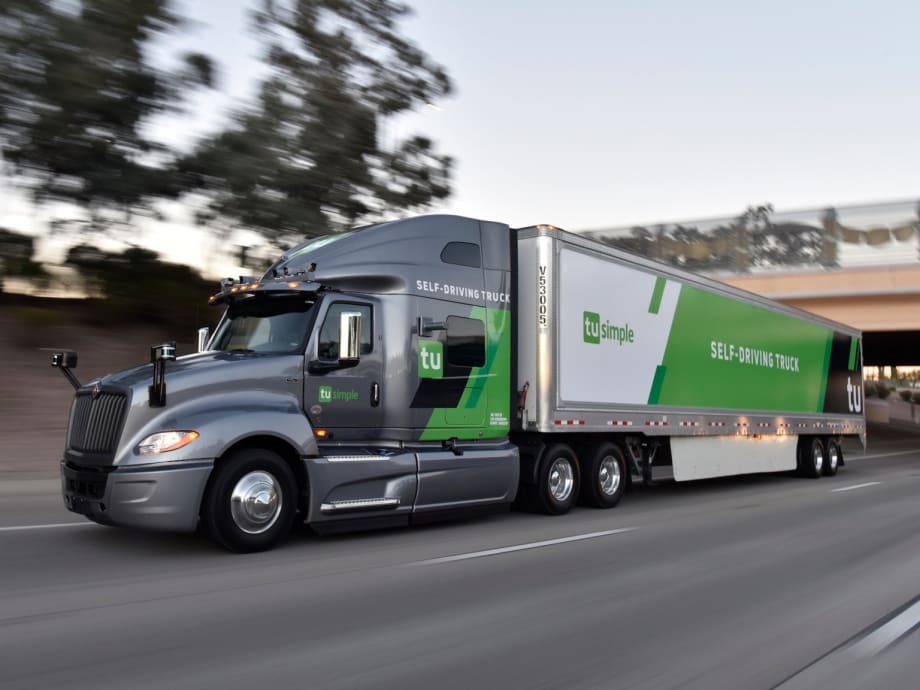
TuSimple self-driving trucks will haul USPS trailers more than 1,000 miles between the Postal Service’s Phoenix and Dallas distribution centers.
Photo via TuSimple
The United States Postal Service has awarded Self-driving truck technology developer TuSimple with a contract to perform five round trips hauling USPS trailers as part of a two-week pilot program.
TuSimple will be tasked with hauling USPS trailers more than 1,000 miles between the Postal Service’s Phoenix, Arizona and Dallas, Texas distribution centers.
The self-driving trucks will have a safety engineer and driver on board for the duration of the pilot to monitor the vehicle’s performance and to ensure public safety. It is the first time that TuSimple will expand its operations outside of Arizona and marks the company’s self-driving debut in Texas.
The Postal Service is exploring the feasibility of using autonomous delivery vehicle technology to reduce fuel costs, increase safe truck operation and improve its fleet utilization rate through longer hours of operation.
TuSimple will run a series of its self-driving trucks for 22 hours each, which includes overnight driving along the Interstate 10, 20 and 30 corridors on a route that travels through Arizona, New Mexico and Texas. TuSimple expects this to be a central route for the company because there is already strong demand from other customers for runs between Arizona and Texas.
Long-haul routes with short turnaround times are well suited for self-driving trucks because they are normally accomplished with driving teams of two, according to TuSimple. TuSimple expects self-driving operations to eventually free human drivers to focus on the shorter, more dynamic and closer to home routes.
"It is exciting to think that before many people will ride in a robo-taxi, their mail and packages may be carried in a self-driving truck," said Xiaodi Hou, founder, president and chief technology officer, TuSimple. "Performing for the USPS on this pilot in this particular commercial corridor gives us specific use cases to help us validate our system, and expedite the technological development and commercialization progress."
More Equipment

How Volvo Updated Its D13 for EPA 2027 [Watch]
Volvo’s updated D13 promises lower emissions without sacrificing performance or fuel economy. Take a closer look at what changed inside the engine in this HDT Spotlight video.
Read More →
Michelin Tire Improves Efficiency and Durability for Regional Fleets
The Michelin X Multi Energy D2 is a regional haul drive tire engineered to help fleets improve fuel efficiency, durability and traction in demanding stop-and-go operations.
Read More →
ZF Expands Commercial Vehicle Push in North America
ZF is expanding its North American commercial-vehicle presence with new transmission applications, electrification, trailer technology and autonomous-driving systems.
Read More →
Tesla Wants a Self-Driving Semi. Are Cameras Enough?
Could Tesla’s camera-only autonomous driving technology work on an 80,000-pound Semi? In this commentary, HDT's Deborah Lockridge takes a look at Tesla, Cybercab, and how autonomous trucks see the road.
Read More →
Kodiak: Driverless Long-Haul Truck Launch on Track for 2026
Kodiak AI says its driverless long-haul safety case is 93% complete and it remains on track to begin commercial operations by year-end 2026.
Read More →
What DOT’s Automated Vehicle Strategy Means for Trucking
The U.S. Department of Transportation issued a new automated-vehicle strategy that outlines plans for driverless-truck regulations, cross-state freight corridors, and federal safety standards.
Read More →
East Coast Port Launches $45M Electric Truck Push
The Port Authority of New York and New Jersey announced millions in incentives for zero-emission drayage trucks, yard tractors, and new charging hubs near the port.
Read More →
PlusAI Going Public to Fund Autonomous Truck Launch
A SPAC deal could provide PlusAI with up to $300 million as it works toward a 2027 commercial launch of factory-built autonomous trucks.
Read More →
NHTSA Moves to Rewrite Truck Fuel-Economy Rules
The National Highway Traffic Safety Administration says it lacks authority to regulate medium- and heavy-duty truck engines separately from complete vehicles, but the existing standards have not yet been eliminated.
Read More →
Detroit Opens Orders for EPA 2027 Engines
Detroit isn’t starting from scratch to meet EPA 2027 diesel emissions standards. Its Gen 6 DD13 and DD15 engines keep much of today’s platform while updating the fuel and aftertreatment systems.
Read More →