




TuSimple Teams With Community College to Offer Autonomous Truck Driving Certification
Autonomous technology developer TuSimple has formed a partnership with Pima Community College in Tuscon, Arizona, to launch what it says is the first autonomous driving certificate program for truck drivers.

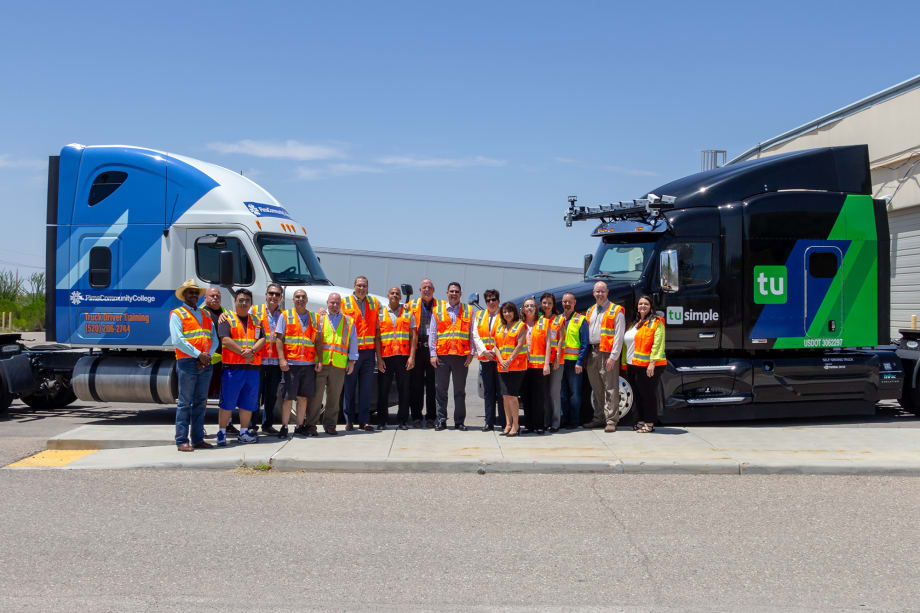
TuSimple has partnered with Pima Community College in Tucson to offer what it says is the industry's first educational curriculum focused on autonomous truck proficiency.
Photo: TuSimple
Autonomous trucks may drive themselves down the road. But that doesn’t mean they don’t require driver training to operate safely. To meet this emerging need, autonomous technology developer TuSimple has formed a partnership with Pima Community College in Tuscon, Arizona, to launch what it says is the first autonomous driving certificate program for truck drivers.
The Autonomous Vehicle Driver and Operations Specialist program will equip truck drivers with the knowledge and skills to expand their roles in this new and rapidly expanding industry. The certificate will prepare individuals for jobs such as training the autonomous system as test drivers, operating the vehicle in situations where autonomous driving is not suitable, and remotely monitoring the system from a command center.
The Autonomous Vehicle Driver and Operations Specialist certificate program will teach experienced truck drivers how to operate and work with autonomous trucks in as quickly as one semester. The program requires a Class A commercial driver’s license prior to enrollment, as drivers will build on their trucking knowledge with each course.
TuSimple and Pima Community College co-created a curriculum for the certificate program that comprises five courses:
Introduction to Autonomous Vehicles
Industrial Safety
Computer Hardware Components
Electrical Systems I
Transportation and Traffic Management
TuSimple will prioritize hiring graduates of the certificate program for jobs at its Tucson testing and development center.
The program will be offered at Pima Community College in Tucson starting in September; registration will begin in August. Once launched, Pima Community College and TuSimple will collaborate with other schools interested in offering the same program.
“It’s clear that the future of truck transportation will offer new employment opportunities for today’s drivers but it will require a set of new skills,” said Lee Lambert, Chancellor, Pima Community College. “Working with TuSimple to develop this Autonomous Vehicle Driver and Operations Specialist certificate program ensures our students will build competencies in multiple areas – from logistics and information technology to automated industrial technology. These areas are being transformed by autonomy and drivers will need training in order to interact with autonomous trucks.”
“In keeping with TuSimple’s mission to create the safest autonomous driving fleet, an essential aspect of the training program is to ensure that drivers have access to appropriate training for this new technology and employment opportunities,” said Xiaodi Hou, TuSimple founder, president and chief technology officer. “We commend Pima Community College for offering this innovative and exciting program that can help address the acute driver shortage. The program offers driving professionals a smooth transition into an emerging field that requires different skill sets in addition to existing truck driving knowledge by providing training.”
For information or to enroll, call Pima Community College’s Center for Transportation Training at 520-206-2744.
More Safety & Compliance

FMCSA Pauses Biennial-Update Enforcement Amid Motus Transition
Carriers whose updates were due on or after June 1 have more time, while FMCSA works to stabilize its new registration system and warns of phishing sites impersonating its new carrier registration system, Motus.
Read More →
ZF Expands Commercial Vehicle Push in North America
ZF is expanding its North American commercial-vehicle presence with new transmission applications, electrification, trailer technology and autonomous-driving systems.
Read More →
Truck Drivers Need More Than Another Alert
Fleets have more visibility into truck health, safety events, and driver activity than ever. The next challenge is turning all that information into useful guidance for the person who has to decide what to do next.
Read More →
Tesla Wants a Self-Driving Semi. Are Cameras Enough?
Could Tesla’s camera-only autonomous driving technology work on an 80,000-pound Semi? In this commentary, HDT's Deborah Lockridge takes a look at Tesla, Cybercab, and how autonomous trucks see the road.
Read More →
What DOT’s Automated Vehicle Strategy Means for Trucking
The U.S. Department of Transportation issued a new automated-vehicle strategy that outlines plans for driverless-truck regulations, cross-state freight corridors, and federal safety standards.
Read More →
NYC Expands Speed, Pedestrian Safety Tech Across Fleet
New York City is expanding intelligent speed assistance and pedestrian-alert systems across its municipal fleet, moving the technologies from pilot programs into vehicle procurement and retrofit requirements.
Read More →
FMCSA Removes 110 Truck Driver Training Schools from Certified ELDT List
Federal regulators also are targeting more than 160 additional training providers and launching a nationwide audit of third-party CDL skills testers as part of a broader crackdown on trucking fraud.
Read More →
Beyond DOT Compliance: What Makes a Trucking Fleet Truly Safe?
A trucking fleet can follow every rule and still make unsafe decisions. The real test comes when safety conflicts with freight, productivity, or cost.
Read More →
Hours of Service Pilot Programs: FMCSA Readies for 2027 Rollout
Two pilot programs could eventually reshape hours-of-service rules, giving truck drivers options to pause their 14-hour clock or use longer split sleeper rest periods.
Read More →
New Guide Offers Pet Safety Tips for Truck Drivers
Hundreds of thousands of pets travel in truck cabs. A new safety guide from Volvo Trucks and the Center for Pet Safety offers practical advice for truck drivers who bring dogs and cats along for the ride.
Read More →