




Trucking Conditions Index Drops, Environment Still Positive
FTR’s Trucking Conditions Index measure for May dropped to a three-year low of 4.91 due to softer capacity, pricing, and fuel prices. The index is expected to move into significantly more positive territory as the anticipated regulatory drag in 2016 and 2017 dramatically tightens capacity.
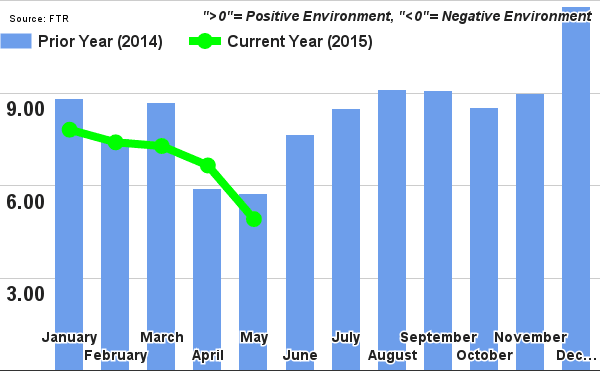
The index has fallen since January and except for April, has been lower than in 2014.
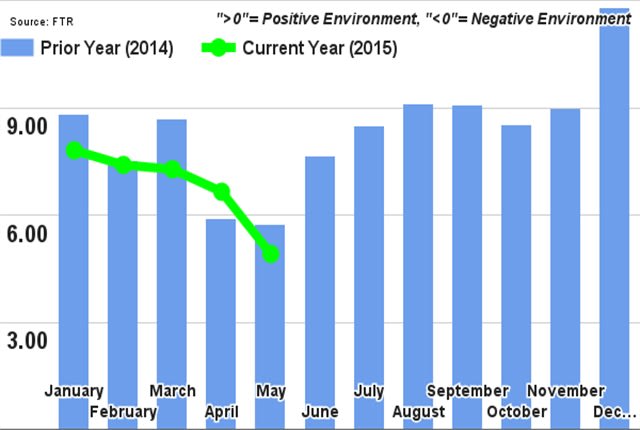
The index has fallen since January and except for April, has been lower than in 2014.
FTR’s Trucking Conditions Index measure for May dropped to a three-year low of 4.91 due to softer capacity, pricing, and fuel prices. The number is 25% lower than an earlier tally, but still in positive territory because overall conditions remain good, the research firm said.
Tight capacity from earlier in the year has eased following the partial suspension of the latest Hours of Service changes. FTR predicts the Trucking Conditions Index will soon move up into significantly more positive territory as the anticipated regulatory drag in 2016 and 2017 dramatically tightens capacity.
For the overall trucking environment, improvements in productivity and reductions in fuel prices have kept costs in check until now. However, with the recovery now fully maturing, fuel and other costs, like labor, should increase, putting more pressure on rates in early 2016, the FTR report said.
"While the market has notably softened, conditions for fleets are still quite positive and indicate how well they are able to manage the current headwinds,” said Jonathan Starks, FTR’s director of transportation analysis. “One significant benefit is that fuel costs have dropped substantially and have yet to significantly rise.
“A sharp rise in diesel (fuel) would be very troubling for many of the marginal carriers. Another benefit has been the slow growing freight environment which has allowed fleets to re-engineer their lanes in order to take better advantage of drivers’ hours.
“While the capacity situation has definitely eased since last year, it is still well above historical levels and should keep contract rates, at minimum, stable with a potential to grow stronger by early 2016,” Starks said. “Overall, the market is stable, and we see that path continuing until we get into 2016, when recession and regulatory risks begin to rise significantly.”
The Trucking Conditions Index tracks the changes representing five major conditions in the U.S. truck market: freight volumes, capacity utilization, fuel price, cost of capital, and fleet bankruptcies. The individual metrics are combined into a single index that tracks the market conditions that influence fleet behavior. Details of the May TCI are found in the July issue of FTR’s Trucking Update.
More Fleet Management

Nominations Open for HDT Emerging Leaders
Heavy Duty Trucking is looking for accomplished trucking fleet professionals under 40 who are making an impact and helping lead the industry forward.
Read More →
Why Private Fleets Are Taking More Freight
Private fleets are putting their own trucks on demanding customers and high-cost lanes as companies seek greater control over service, costs, and capacity.
Read More →
Color Match Smarter: Tools That Restore & Perform
For fleet managers and collision repair professionals keeping heavy-duty trucks on the road, getting the color right the first time isn't just about appearance — it's about efficiency, turnaround time, and bottom-line results. Discover how today's digital color tools are transforming the repair process from guesswork to precision.
Read More →


FMCSA Pauses Biennial-Update Enforcement Amid Motus Transition
Carriers whose updates were due on or after June 1 have more time, while FMCSA works to stabilize its new registration system and warns of phishing sites impersonating its new carrier registration system, Motus.
Read More →
2026 Blueprint for Countering Smarter Supply Chain Theft
Cargo theft is no longer just the cost of doing business. It's a multi-billion-dollar criminal enterprise exploiting vulnerabilities across your fleet, drivers, and supply chain.
Read More →
How Telematics Improves Visibility, Control, and Performance in Refrigerated Fleets
Explore how telematics help refrigerated fleets improve visibility, uptime, efficiency, compliance, and cargo protection across connected cold chain operations.
Read More →
What the U.S.-Canada Trade War Means for Trucking
Escalating U.S.-Canada tariffs could disrupt cross-border freight, reduce truck volumes, raise costs, and create new uncertainty for carriers on both sides of the border.
Read More →
What Are Trucking’s Top Concerns for 2026?
The American Transportation Research Institute wants to know what's worrying trucking fleet managers, drivers, and other stakeholders in its annual Industry Issues survey.
Read More →
American Trucking Associations Looks for a New Leader
ATA President and CEO Chris Spear abruptly left his job at the association on August 21, at a pivotal time for the trucking industry.
Read More →
Public Wi-Fi Cybersecurity Risks: How Truck Drivers and Fleets Can Protect Their Data
Public Wi-Fi can expose truck drivers and fleets to credential theft, malware, and other cyber threats. Here’s how to reduce the risk on the road.
Read More →