





You also might like – The Rise of ADAS: The Fleet Experience
Truck of the Future Project to Address Blind Zones in AI Pilot
The Together for Safer Roads coalition, with Anheuser-Busch InBev, Republic Services, and the New York City Department of Citywide Administrative Services, will work with a behavioral AI company to test ways to reduce blind zones around the truck as part of the Truck of the Future project.
June 14, 2021

A new pilot project will use artificial intelligence to help identify pedestrians and other vulnerable road users in truck blind zones.
Photo: Together for Safer Roads
2 min to read
The Together for Safer Roads coalition, with Anheuser-Busch InBev, Republic Services, and the New York City Department of Citywide Administrative Services, will work with a behavioral AI company to test ways to reduce blind zones around the truck as part of the new Truck of the Future project.
About one-quarter of all truck-related deaths in the U.S. are due to vision-related, low-speed maneuvers, according to TSR, and international research has found that driver visibility is related to over one-third of truck crashes with vulnerable road users such as pedestrians and bicyclists.
Last fall, TSR announced the Truck of the Future initiative to identify and test commercially viable technological solutions to eliminate collisions between commercial trucks and other vehicles caused by driver visibility. TSR President David Braunstein called the project a “call to arms regarding an underappreciated aspect of road safety.”
The winner of the inaugural Truck of the Future program is a UK-based company, Humanising Autonomy. A “behavior AI company,” it uses a methodology combining behavioral psychology, statistical artificial intelligence, and novel deep learning algorithms to understand, infer and predict the full spectrum of human behaviors.
Humanising Autonomy will use its computer vision and behavior AI technology to add a nuanced understanding of vulnerable road user behavior to fleets. The software will help improve fleet driver visibility and reaction times, and the project will leverage the hardware and video telematics abilities of the company's integration partners, StreamMax and VisionTrack. Deployments will take place in collaboration with Anheuser-Busch, Republic Services, and NYC DCAS in the New York metro area and in Guadalajara, Mexico.
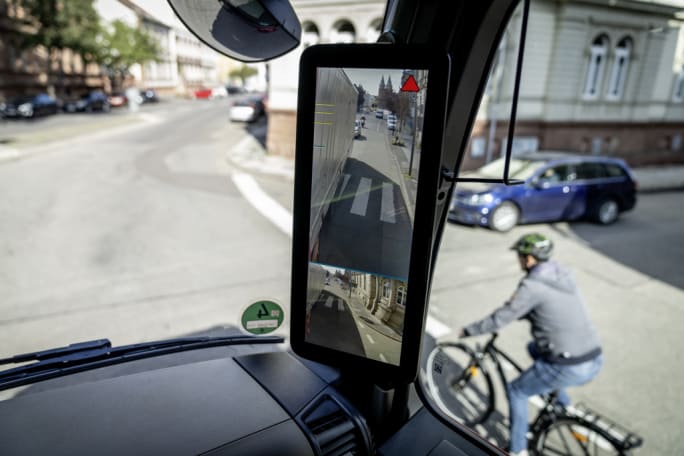
While some truck makers have been developing technology to help detect vulnerable road users in blind zones, Together for Safer Roads is looking to push technology in this area even further with its Truck of the Future project.
Photo: Daimler Trucks
“This cutting-edge technology will help an important part of the road-using community across the country and the world as we continue to expand our work internationally,” Braunstein said in an announcement. “Our goal has always been to create stronger partnerships between public and private fleets and the cities within their operational spheres. This development in fleet safety will help to bridge that existing divide.”
Together for Safer Roads is a global non-profit organization that works with government, businesses and community stakeholders on local projects, fleet safety management and technology initiatives to prevent traffic crashes, injuries and deaths. TSR was started in conjunction with the UN's Decade of Road safety and has partners around the world. TSR's members include AB InBev, AT&T, CalAmp, Geotab, Lyft, Marsh, PepsiCo, Republic Services, Samsara, UPS and others.
TSR is using the Truck of the Future announcement to also launch its Summer of Innovation, in which the organization will highlight all of the Safer Roads Studios initiatives.
More Safety & Compliance

FMCSA Pauses Biennial-Update Enforcement Amid Motus Transition
Carriers whose updates were due on or after June 1 have more time, while FMCSA works to stabilize its new registration system and warns of phishing sites impersonating its new carrier registration system, Motus.
Read More →
ZF Expands Commercial Vehicle Push in North America
ZF is expanding its North American commercial-vehicle presence with new transmission applications, electrification, trailer technology and autonomous-driving systems.
Read More →
Truck Drivers Need More Than Another Alert
Fleets have more visibility into truck health, safety events, and driver activity than ever. The next challenge is turning all that information into useful guidance for the person who has to decide what to do next.
Read More →
Tesla Wants a Self-Driving Semi. Are Cameras Enough?
Could Tesla’s camera-only autonomous driving technology work on an 80,000-pound Semi? In this commentary, HDT's Deborah Lockridge takes a look at Tesla, Cybercab, and how autonomous trucks see the road.
Read More →
What DOT’s Automated Vehicle Strategy Means for Trucking
The U.S. Department of Transportation issued a new automated-vehicle strategy that outlines plans for driverless-truck regulations, cross-state freight corridors, and federal safety standards.
Read More →
NYC Expands Speed, Pedestrian Safety Tech Across Fleet
New York City is expanding intelligent speed assistance and pedestrian-alert systems across its municipal fleet, moving the technologies from pilot programs into vehicle procurement and retrofit requirements.
Read More →
FMCSA Removes 110 Truck Driver Training Schools from Certified ELDT List
Federal regulators also are targeting more than 160 additional training providers and launching a nationwide audit of third-party CDL skills testers as part of a broader crackdown on trucking fraud.
Read More →
Beyond DOT Compliance: What Makes a Trucking Fleet Truly Safe?
A trucking fleet can follow every rule and still make unsafe decisions. The real test comes when safety conflicts with freight, productivity, or cost.
Read More →
Hours of Service Pilot Programs: FMCSA Readies for 2027 Rollout
Two pilot programs could eventually reshape hours-of-service rules, giving truck drivers options to pause their 14-hour clock or use longer split sleeper rest periods.
Read More →
New Guide Offers Pet Safety Tips for Truck Drivers
Hundreds of thousands of pets travel in truck cabs. A new safety guide from Volvo Trucks and the Center for Pet Safety offers practical advice for truck drivers who bring dogs and cats along for the ride.
Read More →