





Related: Volvo Delivers First Electric Trucks to Customers in Sweden
Truck Makers: Europe Not Ready For Low CO2 Trucks
The European Union has established tight carbon-dioxide emission limits for heavy-duty commercial vehicles.
February 20, 2019
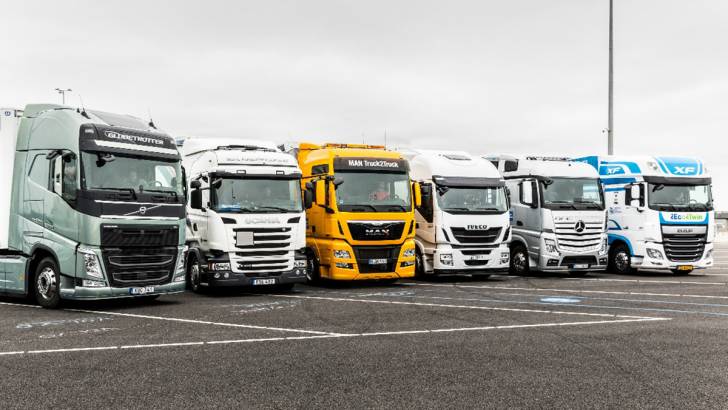
European truck makers question whether infrastructure will be in place to fuel or charge the alternatively powered trucks that may need to be built to meet the CO2 limits.
Photo: European Automobile Manufacturers’ Association (ACEA)
3 min to read
Member states of the European Union and the EU Parliament reached a tentative deal on February 19 to establish tight carbon-dioxide emission limits for heavy-duty commercial vehicles. The two-tiered compromise agreement still needs to be endorsed by member states and the European Parliament, but those actions are regarded as formalities.
The rules will require that between 2025 and 2029 new trucks must emit on average 15% less CO2, compared to 2019 truck emission levels. Then starting in 2030, they will be required to emit on average 30% less CO2 than in 2019.
“Those targets are binding, and truck manufacturers which do not comply will have to pay a financial penalty in the form of an excess emissions premium,” the EU stated in a press release. On the other hand, making the new rule something of a carrot-and-stick deal, the EU also said it was “strengthening” incentives for OEMs to build low- and zero-emission trucks.
In addition, the EU has established “specific measures” to ensure “robust and reliable data” on emissions, which will be obtained through onboard devices that “monitor the actual fuel and energy consumption of heavy-duty vehicles.”
In December, the EU placed such CO2 standards on cars and light vans. The truck limits are another step in the 28-nation bloc’s stated plan to fight global warming by slashing greenhouse gas emissions to a “net zero” level by 2050.
An EU statement described the deal as “a further stepping stone for modernizing he European mobility sector and preparing it for climate neutrality in the second half of the century.”
“With the first-ever EU emission standards for trucks agreed, we are completing the legal framework to reach the European target of cutting greenhouse gas emissions by at least 40% by 2030,” commented EU Commissioner for Climate Action and Energy Miguel Arias Cañete. “The new targets and incentives will help tackle emissions, as well as bring fuel savings to transport operators and cleaner air for all Europeans. For the EU industry, this is an opportunity to embrace innovation towards zero-emission mobility and further strengthen its global leadership in clean vehicles.”
No sooner than the rules were announced, theEuropean Automobile Manufacturers’ Association (ACEA) declared that it was “most particularly concerned about the highly ambitious CO2 reduction targets” set for trucks. “These targets are highly demanding, especially as their implementation does not depend solely on the commercial vehicle industry, and the baseline for the targets is still unknown.” The truck OEM members of ACEA are DAF Trucks, Daimler Trucks, Iveco, MAN Truck & Bus, Scania, Volkswagen Commercial Vehicles, and Volvo Group.
ACEA’s main concern is a lack of infrastructure to fuel or charge the alternatively powered trucks that may need to be built to meet the CO2 limits. To that point, the association stated that "data shows that currently there is no public charging or refueling infrastructure suitable for electric or hydrogen trucks whatsoever. Even in the case of truck-specific filling stations for natural gas (CNG and LNG), availability remains very low and patchy across Europe.”
In addition, ACEA argues that the need for the 28 EU member states “to implement an EU-wide infrastructure action plan is all the more urgent in light of the mandatory sales quotas for zero-emission trucks that the EU institutions have agreed to introduce from 2025 onwards.”
“We can now only call upon [EU] member states to urgently step up their efforts to roll out the infrastructure required for charging and refuelling the alternatively powered trucks which will need to be sold en masse if these targets are to be met,” said ACEA Secretary General Erik Jonnaert in a statement.
Jonnaert added that truck operators cannot be expected to ““suddenly start buying electric or other alternatively powered trucks if there is no business case for them and it is not possible to easily charge the vehicles along all major EU motorways. Policy makers must act to ensure that the zero-emission trucks that manufacturers will be mandated to produce can actually be bought and operated by our customers.”
More Fuel Smarts

How Volvo Updated Its D13 for EPA 2027 [Watch]
Volvo’s updated D13 promises lower emissions without sacrificing performance or fuel economy. Take a closer look at what changed inside the engine in this HDT Spotlight video.
Read More →
Diesel Price Spike Shortens Payback for Natural Gas Trucks, Report Says
Energy Vision estimates fleets could recover the higher purchase price of an RNG-fueled Class 8 tractor in 1.3 to 2.8 years under current fuel-price scenarios.
Read More →
Calstart Becomes Catalyst Mobility, Reflecting Broader Focus
Calstart is now Catalyst Mobility, reflecting the nonprofit’s growing national role in clean transportation, including zero-emission trucks, infrastructure and incentive programs.
Read More →

Record Diesel Prices Squeeze Trucking Fleets
Average U.S. diesel prices have climbed to nearly $6 a gallon, surpassing the 2022 record as tight refinery capacity and Middle East disruptions keep fuel costs elevated.
Read More →
Sponsored•September 9, 2026
How Fuel Delivery Shapes Engine Performance
Fuel delivery depends on more than what happens at the injector. For fleet, maintenance and technical professionals, looking at the full path from pump to injector can provide useful context for understanding engine performance.
Read More →
East Coast Port Launches $45M Electric Truck Push
The Port Authority of New York and New Jersey announced millions in incentives for zero-emission drayage trucks, yard tractors, and new charging hubs near the port.
Read More →
California Bill Could Shed Light on Electric Truck Prices
Why do battery-electric Class 8 trucks remain so expensive? A California bill headed to Gov. Gavin Newsom would give fleets and state agencies more visibility into what manufacturers charge.
Read More →
Detroit Opens Orders for EPA 2027 Engines
Detroit isn’t starting from scratch to meet EPA 2027 diesel emissions standards. Its Gen 6 DD13 and DD15 engines keep much of today’s platform while updating the fuel and aftertreatment systems.
Read More →
Zero-Emission Truck Corridor Planned for West Coast
California, Oregon, Washington, British Columbia and Baja California are coordinating plans for truck charging and hydrogen fueling from Canada to Mexico.
Read More →
A Closer Look at Kenworth’s Electric T880E Vocational Truck [Video]
Learn more about Kenworth's T880E battery-electric vocational truck at the Paccar Technical Center, including its range, applications, upfitting considerations, and PTO options, in this HDT Spotlight video.
Read More →