




Trailer Orders Fall in November
FTR and ACT Research report that preliminary trailer orders fell significantly in November as fleets become more cautious about freight conditions in 2020.

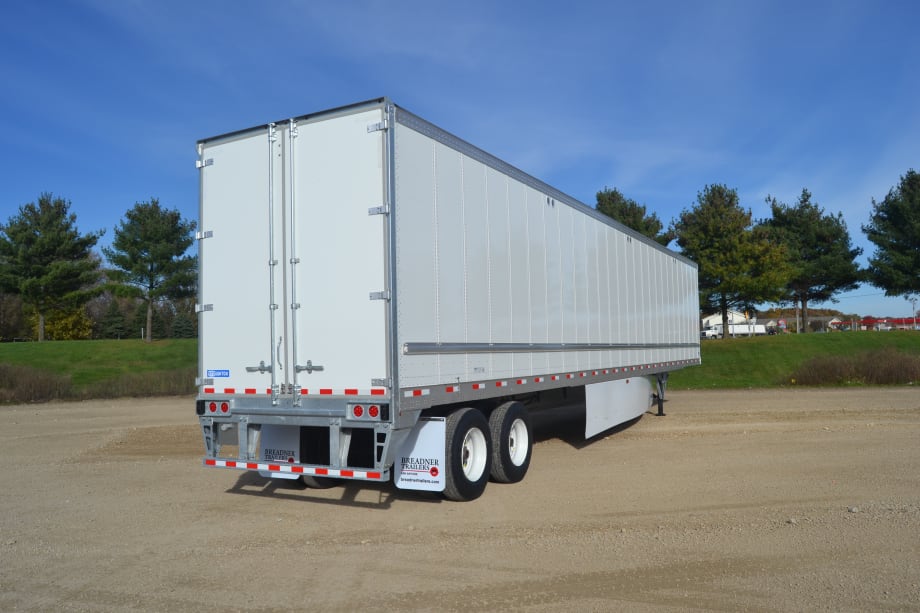
New trailer purchases have cooled off as fleets become more cautious about 2020 economic conditions.
Photo: Stoughton Trailers
Freight and transportation analysts FTR reported that preliminary trailer orders for November at 20,200 units fell 34% from October, as fleets are becoming more cautious about freight conditions in 2020. On a year-over-year comparison, orders were also down 55% from November 2018, when limits on OEM capacity resulted in carriers placing huge orders to lock in build slots throughout 2019.
The fall-off in orders comes as something of a shock to the trailer industry, which was enjoying record sales numbers until November. ACT Research reported last month that October trailer orders hit the highest level since November 2018, causing production backlogs to climb for the first time all year, according to a preliminary report from the analysts at FTR.
FTR tracked about 31,800 new orders in October, up 71% from the previous month. However, compared to October 2018, orders were down 42% as 2018 saw near record equipment orders.
Trailer orders for the last twelve months total 215,000 units, according to FTR.
FTR’s reporting tracks closely with ACT Research’s preliminary estimate for November. That transportation analytics firm’s findings indicate that trailer manufacturers booked 19.5k net orders to their orderboards last month, a 39% decline from October’s volume. Activity was 56% below November of 2018, while year-to-date net orders are just under half that of last year.
Before accounting for cancellations, ACT said, new orders of 21.1k trailers were off 43% month-over-month and 54% below last year. Final volume will be available later this week. This preliminary market estimate should be within +/- 3% of the final order tally.
“The sequential decline in November broke a four-month streak of monthly gains. That ran counter to the industry’s normal order patterns, which point to November typically ranking as the best order month of the year,” said Frank Maly, Director–CV Transportation Analysis and Research at ACT Research. He continued, “The cautious stance toward 2020 cap-ex spending is evident in both the level and pattern of fleet trailer orders as we approach year-end.”
Additionally, Maly said, “One positive take-away from the November stats is a significant easing in cancellations compared to previous months. That’s an indication that, while lower, the commitments on the orderboard appear to be firming as we close the year.” He added, “Discussions with trailer OEMs also indicate that, although they are encountering pricing pressure, quote activity remains solid, so any change in fleet confidence could quickly result in an order rebound.”
FTR analysts note OEMs have plenty of capacity to handle a more stable freight and trailer demand environment in 2020, so fleets are placing smaller orders and only ordering a few months out. Production continues to fall moderately on a per-day level, as freight growth has stalled. There is still a decent demand for dry vans and reefers, but the vocational segments, especially flatbeds, continue to weaken.
“Fleets are being more cautious with their truck orders, so it makes sense that trailer orders would follow suit,” said Don Ake, FTR vice president of commercial vehicles. “There is no reason to order in large quantities like last year. The supply of trailers has almost caught up with the demand for trailers, so ordering levels are flattening out and fleets are watching the market closely. There is still too much uncertainty regarding the economy, trade, tariffs and politics for companies to have a great deal of confidence right now for 2020.”
Ake said that while It is expected that orders will track in this range for a while, as fleets continue to place modest-sized orders for short-term needs. OEM lead times are much shorter than a year ago, so ordering patterns will be much different, and more stable, than last year’s cycle.
More Equipment

How Volvo Updated Its D13 for EPA 2027 [Watch]
Volvo’s updated D13 promises lower emissions without sacrificing performance or fuel economy. Take a closer look at what changed inside the engine in this HDT Spotlight video.
Read More →
Michelin Tire Improves Efficiency and Durability for Regional Fleets
The Michelin X Multi Energy D2 is a regional haul drive tire engineered to help fleets improve fuel efficiency, durability and traction in demanding stop-and-go operations.
Read More →
ZF Expands Commercial Vehicle Push in North America
ZF is expanding its North American commercial-vehicle presence with new transmission applications, electrification, trailer technology and autonomous-driving systems.
Read More →
Tesla Wants a Self-Driving Semi. Are Cameras Enough?
Could Tesla’s camera-only autonomous driving technology work on an 80,000-pound Semi? In this commentary, HDT's Deborah Lockridge takes a look at Tesla, Cybercab, and how autonomous trucks see the road.
Read More →
Kodiak: Driverless Long-Haul Truck Launch on Track for 2026
Kodiak AI says its driverless long-haul safety case is 93% complete and it remains on track to begin commercial operations by year-end 2026.
Read More →
What DOT’s Automated Vehicle Strategy Means for Trucking
The U.S. Department of Transportation issued a new automated-vehicle strategy that outlines plans for driverless-truck regulations, cross-state freight corridors, and federal safety standards.
Read More →
East Coast Port Launches $45M Electric Truck Push
The Port Authority of New York and New Jersey announced millions in incentives for zero-emission drayage trucks, yard tractors, and new charging hubs near the port.
Read More →
PlusAI Going Public to Fund Autonomous Truck Launch
A SPAC deal could provide PlusAI with up to $300 million as it works toward a 2027 commercial launch of factory-built autonomous trucks.
Read More →
NHTSA Moves to Rewrite Truck Fuel-Economy Rules
The National Highway Traffic Safety Administration says it lacks authority to regulate medium- and heavy-duty truck engines separately from complete vehicles, but the existing standards have not yet been eliminated.
Read More →
Detroit Opens Orders for EPA 2027 Engines
Detroit isn’t starting from scratch to meet EPA 2027 diesel emissions standards. Its Gen 6 DD13 and DD15 engines keep much of today’s platform while updating the fuel and aftertreatment systems.
Read More →