





Related: It’s Not Just Your State, Overall U.S. Road Conditions Are Getting Worse
Traffic Congestion Costs Americans $166 Billion Annually
Texas A&M Transportation Institute recently published its 2019 Urban Mobility report and the picture it paints is of an urban gridlock issue that has only been getting worse each year and costing Americans billions of dollars.
August 23, 2019
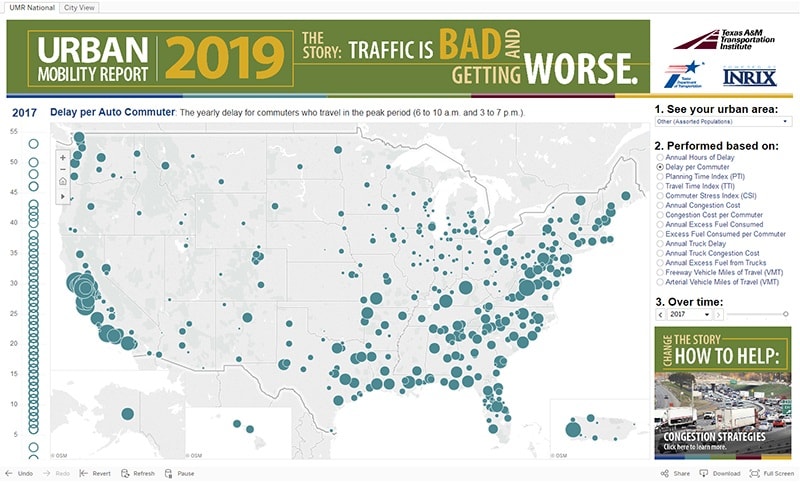
Texas A&M Transportation Institute recently published its 2019 Urban Mobility report and the picture it paints is of an urban gridlock issue that has only been getting worse each year and costing Americans billions of dollars.
Source: Texas A&M Transportation Institute
3 min to read
Time is money and when it comes to the amount of time Americans waste sitting in traffic each year, the total cost is significant – $166 billion.
Texas A&M Transportation Institute recently published its 2019 Urban Mobility report and the picture it paints is of an urban gridlock issue that has only been getting worse each year since 1982, the first year with official data on the subject.
In its report, TTI also lists ways that congestion can be addressed. The group advocates for more of everything, roads, transit, squeezing as much efficiency out of the existing system as possible, reducing demand through telework, better balancing demand and roadway capacity by adjusting work hours, and smarter land use. But TTI also admitted that there is no silver bullet when fixing the nationwide problem.
“No single approach will ever solve this complex problem,” says Tim Lomax, a report author and Regents Fellow at TTI. “We know what works. What the country needs is a robust, information-powered conversation at the local, state and national levels about what steps should be taken. We have many strategies; we have to figure out the right solution for each problem and a way to pay for them.”
Part of the problem is actually the result of a good thing, more Americans are working and driving to work. From 2016-2017, the U.S. added 1.9 million jobs, according to TTI, and with unemployment near all-time lows, more Americans are joining the workforce every month.
Since 1982, the nation’s workforce has grown almost nonstop by just over 50% to the current total of 153 million. The average number of hours per commuter lost to traffic delay has nearly tripled in that time, climbing to 54 hours a year per person. And the annual cost of those delays has nearly doubled to its current rate of $1,010 per person, per year.
“Simply put, travel demand is growing faster than the system’s ability to absorb that demand. Once considered a problem exclusive to big cities, roadway gridlock now afflicts urban areas of all sizes and consumes far more of each day, making rush hour a long-outdated reference,” said David Schrank, a TTI senior research scientist and report author.
Part of that total is due to the inefficient fuel mileage of driving in gridlock traffic. The amount of fuel wasted in stalled traffic has more than tripled since 1982, to 3.3 billion gallons a year.
TTI said that the average freeway traveler has to allow almost twice the expected trip duration to ensure dependable arrival for time-sensitive events such as medical appointments, day-care pickup and airline flights. Instead of the 20 minutes needed in light traffic, it’s best to plan a 34-minute trip, according to TTI.
Of course commuters are not the only ones using our roads with time sensitive appointments. The problem affects manufactures, carriers and shippers and those delays are also passed on to the consumer. While commercial trucks make up only 7% of road traffic, they account for 12% of congestion cost, according to TTI.
“Those minutes don’t sound like much, but they add up quickly over a year,” said Schrank “Eventually, we’re talking billions of wasted hours, and the cost of delay at that scale is just enormous.”
The 2019 Urban Mobility Report, which examines conditions in 494 urban areas in every state and Puerto Rico, is available online.
More Drivers

Truck Drivers Need More Than Another Alert
Fleets have more visibility into truck health, safety events, and driver activity than ever. The next challenge is turning all that information into useful guidance for the person who has to decide what to do next.
Read More →
FMCSA Removes 110 Truck Driver Training Schools from Certified ELDT List
Federal regulators also are targeting more than 160 additional training providers and launching a nationwide audit of third-party CDL skills testers as part of a broader crackdown on trucking fraud.
Read More →
Hours of Service Pilot Programs: FMCSA Readies for 2027 Rollout
Two pilot programs could eventually reshape hours-of-service rules, giving truck drivers options to pause their 14-hour clock or use longer split sleeper rest periods.
Read More →
Medical Cards, English Proficiency Reshape Roadcheck Violations
Medical-card violations jumped to the top of the driver out-of-service list during CVSA’s 2026 International Roadcheck, while English-language proficiency violations appeared among the leading violations for the first time.
Read More →
Driver Trust Can Make or Break the Success of Fleet Safety Technology
New Teletrac Navman research suggests that onboarding, transparency about driver data, and positive feedback can play a significant role in how commercial drivers respond to safety and coaching technology.
Read More →
EEOC Sues KLLM Over Alleged Sex Discrimination in Driver Training
KLLM is facing a federal sex-discrimination lawsuit over policies the EEOC alleges put female truck driver trainees at a disadvantage.
Read More →
FMCSA Moves to Codify English Language Requirements for Commercial Drivers
By changing regulations on English-language proficiency requirements for commercial drivers, rather than relying on a guidance memo, the FMCSA said future administrations won't be able to walk back the Trump administration's stricter enforcement with just a memo.
Read More →
Drivers Put Western Star Trucks to the Test at Star Nation Experience
Watch to get an inside look at the Western Star trucks, technology, and community behind the Star Nation Experience 2026!
Read More →
Trump Administration Looks to Put More Veterans Behind the Wheel
The Freedom Haulers program pulls together existing and expanded programs at several federal agencies to recruit veterans to drive commercial heavy-duty trucks and cut the red tape for them to get a CDL, training, and employment.
Read More →
Putting Mack’s Command Steer to the Test
A test drive of Mack’s Command Steer active steering system evaluates how it can make truck driving easier and less tiring.
Read More →