




Toyota Reveals Latest Version of its Hydrogen Fuel Cell Class 8 Truck
Toyota has unveiled the latest version of its Project Portal hydrogen fuel cell electric Class 8 truck, which it said boasts greater range and improvements to versatility and maneuverability.

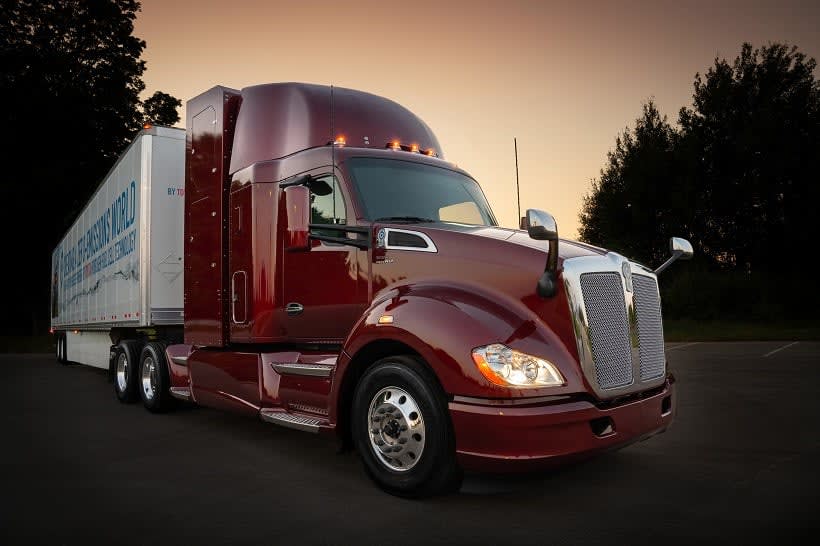
The newest iteratiion of Toyota's Project Portal hydrogen fuel cell truck features longer range and more versatility than the original version.
Toyota
Toyota unveiled the latest version of its Project Portal hydrogen fuel cell electric Class 8 truck, which it said boasts greater range and improvements to versatility and maneuverability. The truck was shown during a media briefing on July 30 at a Center for Automotive Research meeting in Traverse City. Michigan.
This Beta iteration of Project Portal expands on the original Alpha version by increasing range from 200 to 300 miles, adding on a sleeper cab, and engineering a unique "fuel cabinet combination" that increases cab space without increasing wheelbase. Power numbers remain the same, with an output of over 670 horsepower and 1,325 lbs.-ft. of torque.
“Our goal with the first truck was to see if it could be accomplished, and we did that," said Craig Scott senior manager for Toyota's North American electrified vehicle & technologies office. "This time we're looking at commercial viability.”
The Project Portal Alpha vehicle has been operating at the Ports of Long Beach and Los Angeles in Southern California since April 2017, so far logging 10,000 miles of testing and real-world drayage operations.
The improved Beta version will begin operating at the same ports in the fall. The truck was developed as a learning exercise for both Toyota and the ports to help develop the zero-emissions Class 8 vehicle for short-range, drayage duty cycles.
The truck’s powertrain is based on that of the company’s Mirai fuel cell electric car, which is soldd in limited quantities in the U.S. Toyota noted that it is one of the first hydrogen fuel cell sedans sold commercially. In fact, the Project Portal truck combines two Mirai fuel cell stacks and a 12 kWh battery to power the vehicle.
"By evaluating the first truck in our test facilities and on the actual roads in the Los Angeles area, we made a list of improvements for the Beta truck build process and performance enhancements," said Andrew Lund, chief engineer for the project. "We needed to move beyond a proof of concept, which the first truck accomplished, to something that is not only better than the original,but is also more commercially viable."
This doubling-down for Toyota on a hydrogen fuel-cell Class 8 truck is part of the company's Environmental Challenge 2050 to eliminate CO2 emissions from its Toyota Logistics facility at the Port of Long Beach.
Toyota previously announced the construction of the Tri-Gen facility which will be the first megawatt-sized carbonate fuel cell power generation plant with hydrogen fueling in the world. . The renewable plant will use agricultural waste to generate water, electricity, and hydrogen that will support Toyota Logistics Services' operations at the Port of Long Beach.
“We want to help make a difference… a significant difference when it comes to the air quality not only in the LA area but across the U.S. and around the globe,” said Scott.
Related: Toyota’s Hydrogen Fuel Cell Truck to Run Routes in California
More Fuel Smarts

How Volvo Updated Its D13 for EPA 2027 [Watch]
Volvo’s updated D13 promises lower emissions without sacrificing performance or fuel economy. Take a closer look at what changed inside the engine in this HDT Spotlight video.
Read More →
Diesel Price Spike Shortens Payback for Natural Gas Trucks, Report Says
Energy Vision estimates fleets could recover the higher purchase price of an RNG-fueled Class 8 tractor in 1.3 to 2.8 years under current fuel-price scenarios.
Read More →
Calstart Becomes Catalyst Mobility, Reflecting Broader Focus
Calstart is now Catalyst Mobility, reflecting the nonprofit’s growing national role in clean transportation, including zero-emission trucks, infrastructure and incentive programs.
Read More →

Record Diesel Prices Squeeze Trucking Fleets
Average U.S. diesel prices have climbed to nearly $6 a gallon, surpassing the 2022 record as tight refinery capacity and Middle East disruptions keep fuel costs elevated.
Read More →
How Fuel Delivery Shapes Engine Performance
Fuel delivery depends on more than what happens at the injector. For fleet, maintenance and technical professionals, looking at the full path from pump to injector can provide useful context for understanding engine performance.
Read More →
East Coast Port Launches $45M Electric Truck Push
The Port Authority of New York and New Jersey announced millions in incentives for zero-emission drayage trucks, yard tractors, and new charging hubs near the port.
Read More →
California Bill Could Shed Light on Electric Truck Prices
Why do battery-electric Class 8 trucks remain so expensive? A California bill headed to Gov. Gavin Newsom would give fleets and state agencies more visibility into what manufacturers charge.
Read More →
Detroit Opens Orders for EPA 2027 Engines
Detroit isn’t starting from scratch to meet EPA 2027 diesel emissions standards. Its Gen 6 DD13 and DD15 engines keep much of today’s platform while updating the fuel and aftertreatment systems.
Read More →
Zero-Emission Truck Corridor Planned for West Coast
California, Oregon, Washington, British Columbia and Baja California are coordinating plans for truck charging and hydrogen fueling from Canada to Mexico.
Read More →
A Closer Look at Kenworth’s Electric T880E Vocational Truck [Video]
Learn more about Kenworth's T880E battery-electric vocational truck at the Paccar Technical Center, including its range, applications, upfitting considerations, and PTO options, in this HDT Spotlight video.
Read More →