




TMW's Dave Wangler on the Cloud, Mobile, and Changing Technology
ANAHEIM, CA -- As trucking moves to take advantage of rapid changes happening in computer technology, there is both risk and opportunity, said TMW Systems President Dave Wangler in his opening remarks at TMW's Transforum 2013 user conference and in a one-on-one-interview.

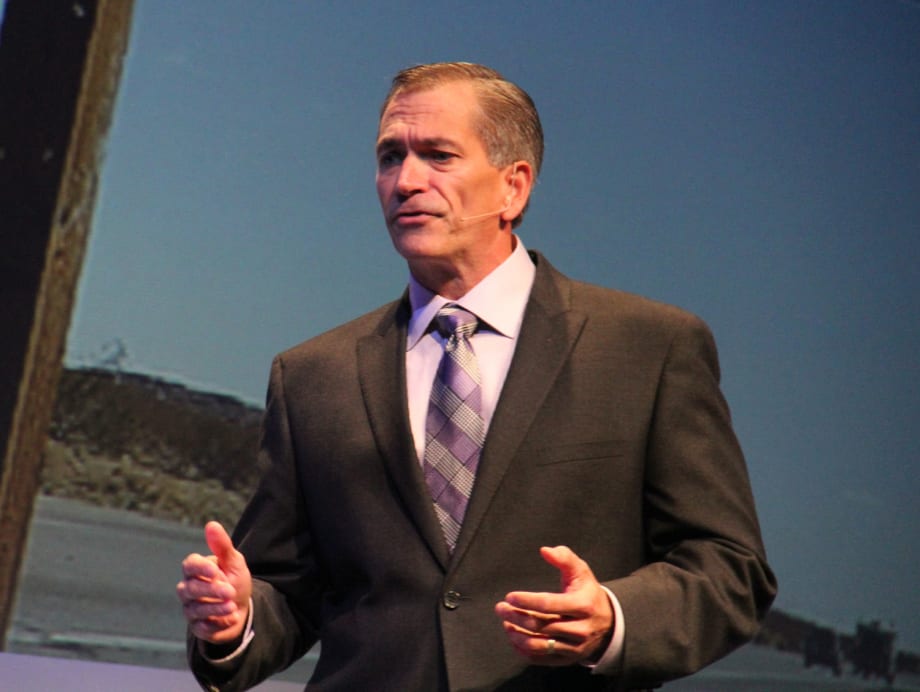
Dave Wangler, president of TMW Systems addresses attendees at the company’s Transforum user conference Sept. 23 in Anaheim.
ANAHEIM, CA -- As trucking moves to take advantage of rapid changes happening in computer technology, there is both risk and opportunity, said TMW Systems President Dave Wangler in his opening remarks at TMW's Transforum 2013 user conference and in a one-on-one-interview.
TMW kicked off its conference Monday in Anaheim with about 1,700 attendees on hand. The event featured two-and-a-half days of sessions devoted to TMW’s various products, TMW Suite, Innovative, Truck Mate, TNT maintenance software and TMW Optimization Group.
Also featured were industry updates from speakers representing private fleets, ATA, the Federal Motor Carrier Safety Administration, shippers and brokers as well as a lunchtime talk by actor Robert Duvall.
In the opening general session, TMW President Dave Wangler noted this year was the first time the user conference had been held west of the Rockies. He drew parallels between those early settlers who tamed the Wild West and fleet managers today. Noting that most of those settlers were striking out for a second chance, he said, “that desire to tear out pages someone else has written for you and to write your own story is something we feel just as urgently today. “
He also wondered if given the chance, would fleet managers adopt the same strategies they now employ?
“If you had a second chance—or third or fourth chance—to deploy a new technology solution for your company, what would you do differently this time?” he asked. “If you were charged with implementing a completely new operations or maintenance management software system, it’s possible you might choose to skip the whole on-premise concept and instead put your systems in the cloud.”
Wangler wondered what role tablets and smartphones would play, adding “there are many viable options for transportation companies to choose from today that are made possible by technology that wasn’t even ready for prime-time five years ago.” Indeed, many vendors exhibiting at the conference’s “Technology Hub” featured new mobile solutions, or offered mobile device management services.
Making such changes involves risk, he said, but “without risk, we seldom find opportunity.”
Returning to the early days of California and the gold rush, he argued that the 49ers were taking a gamble. Those entrepreneurs that set up shop selling shovels and other supplies to the miners were taking a risk, but it was a “calculated risk.” And while a few miners struck it big, the real winners were those merchants.
It’s critical to be able to distinguish between a risk and a gamble. “If you can’t tell the difference, then just about any risk might easily turn into a gamble.”
Wangler also spoke of the importance of vision, referencing the character Doc Brown from the movie “Back to the Future.” Doc has a vision of the flux capacitor. An example of a more real-life vision, Wangler said, was one a truck driver had back in 1937. Frustrated at the time it took for longshoreman to unload his truck and then load it onto a cargo ship by hand, he wondered why they couldn’t just hoist his whole truck onto the ship.
Some 20 years later, the first “container” ship sailed from a New Jersey harbor to Houston. And the company that frustrated trucker started went on to become Sea-Land services.
As for TMW, Wangler said, “we want to provide a seamless flow of information from shipper to provider to driver, and back again—one that enables better decision-making, with the most appropriate means of visualization and interaction for each and every user.”
When asked afterward about his reference to cloud computing, Wangler said he felt that hosted or cloud-based systems were the wave of the future. “I think the evidence for that is the number of new customer contracts we signed this year that opted for our cloud-based system. “It’s probably one thing if you have an existing infrastructure and people. If you are starting over or changing to a new platform, it’s something you should consider.”
Wangler said a cloud-based or hosted system makes it easier to manage all the various third-party connections a carrier may have. “You have your mobile communications, you have your fuel cards, you have EDI; you have any number of other connections. With our cloud-based hosting, we have the expertise to manage those connections."
As for their many integration partnerships, Wangler said “we feel that providing as many options as possible is critical. Our role is to support our customers’ choice in that area.” He said he sees mobile communications and TMS systems remaining distinct, but that he could also see the interplay between the in-cab solution and the front and back office solutions becoming more sophisticated and more tightly integrated from a workflow perspective.
Regarding mobile devices, Wangler said he felt that fleet managers are as opinionated about the role of mobile devices as the various mobile communications vendors are. It isn’t going to be quite as much as of a slam dunk as people think.” While noting that the leading edge says BYOD, questions remain: “How do you make sure it’s secure, how do you know it can do logs? There isn’t a one-size fits all answer.”
More Fleet Management

Color Match Smarter: Tools That Restore & Perform
For fleet managers and collision repair professionals keeping heavy-duty trucks on the road, getting the color right the first time isn't just about appearance — it's about efficiency, turnaround time, and bottom-line results. Discover how today's digital color tools are transforming the repair process from guesswork to precision.
Read More →
FMCSA Pauses Biennial-Update Enforcement Amid Motus Transition
Carriers whose updates were due on or after June 1 have more time, while FMCSA works to stabilize its new registration system and warns of phishing sites impersonating its new carrier registration system, Motus.
Read More →
2026 Blueprint for Countering Smarter Supply Chain Theft
Cargo theft is no longer just the cost of doing business. It's a multi-billion-dollar criminal enterprise exploiting vulnerabilities across your fleet, drivers, and supply chain.
Read More →


How Telematics Improves Visibility, Control, and Performance in Refrigerated Fleets
Explore how telematics help refrigerated fleets improve visibility, uptime, efficiency, compliance, and cargo protection across connected cold chain operations.
Read More →
What the U.S.-Canada Trade War Means for Trucking
Escalating U.S.-Canada tariffs could disrupt cross-border freight, reduce truck volumes, raise costs, and create new uncertainty for carriers on both sides of the border.
Read More →
What Are Trucking’s Top Concerns for 2026?
The American Transportation Research Institute wants to know what's worrying trucking fleet managers, drivers, and other stakeholders in its annual Industry Issues survey.
Read More →
American Trucking Associations Looks for a New Leader
ATA President and CEO Chris Spear abruptly left his job at the association on August 21, at a pivotal time for the trucking industry.
Read More →
Public Wi-Fi Cybersecurity Risks: How Truck Drivers and Fleets Can Protect Their Data
Public Wi-Fi can expose truck drivers and fleets to credential theft, malware, and other cyber threats. Here’s how to reduce the risk on the road.
Read More →
For Nicky Cupp, Fleet Innovation Starts With Frustration
HDT Truck Fleet Innovator Nicky Cupp turns everyday pain points at Fraley & Schilling into opportunities for better technology and smarter processes.
Read More →
Adam Buttgenbach’s Approach to Electric Trucks: Start With Where They Fit
HDT Truck Fleet Innovator Adam Buttgenbach helped PepsiCo build one of North America’s largest EV fleets by focusing on where electric trucks make operational sense.
Read More →