




Tight Capacity Pushes Trucking Conditions Index Higher
A measure of the health of the trucking industry has increased slightly, reflecting extremely tight capacity in the truckload sector, according to newly released numbers from the freight forecasting firm FTR
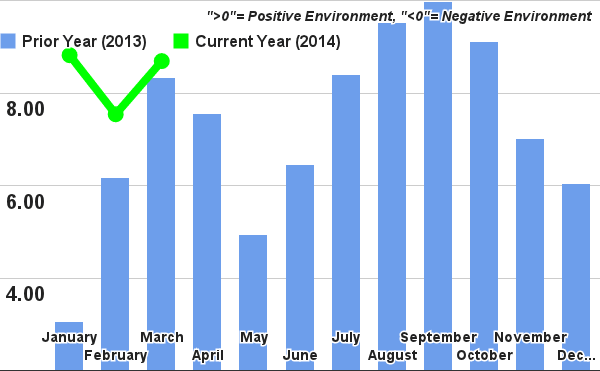
FTR Trucking Conditions Index, Jan. 2013 through March 2014. Credit: FTR
A measure of the health of the trucking industry has increased slightly, reflecting extremely tight capacity in the truckload sector, according to newly released report from the freight forecasting firm FTR.
Its Trucking Conditions Index in March rose more than one point to a reading of 8.69.
“There is a possibility for some relief of the tight truckload capacity over the next few months if freight growth slows as expected in the second quarter,” the group said in a release. “The stressed supply situation of today is caused, primarily, by regulatory drag on shipping capacity along with the winter disruptions”

FTR Trucking Conditions Index, Jan. 2013 through March 2014.
FTR
The TCI for the remainder of 2014 is expected to remain at the same level, as trucking capacity will stay tight.
“Truckers should be feeling much better now that they have finally been able to use the ever tightening truck supply to get much needed rate gains,” said Jonathan Starks, FTR’s director of transportation analysis. “It looks like much of the supply-and-demand balance is coming back down to a more ‘normal’ level as shippers are finishing their spring freight season and the backlog of loads caused by the winter weather has largely subsided.”
Starks noted ‘normal’ remains a relative term, since the industry continues to be operating at much higher levels of utilization than in the past. “Recent data shows a strong uptick in economic activity, but it will be hard to know if we are merely playing catch-up from a bad first quarter or if there is some real sustained growth occurring.”
More details of the March TCI Index are in the May issue of FTR’s Trucking Update.
More Fleet Management

Does Your Trucking Fleet Need a New TMS? [Video]
Cloud technology, AI and new integrations are changing what transportation management systems can do. But does taking advantage of those advances mean replacing your existing TMS?
Read More →
Road Ready Becomes Saegic, Launches New Trailer Telematics Gateway
Clarience Technologies is rolling out new hardware and expanding its plans for connecting trailer telematics, maintenance data, and video.
Read More →
Give Your Trucking Fleet a Cybersecurity Walkaround
Your fleet's cybersecurity policies may look good on paper. These seven checks can help you find out whether they’re working.
Read More →
Kodiak Lines Up Fleets for Driverless Trucking
An agreement for 75 trucks, a new Texas freight lane, and progress on safety validation move Kodiak closer to its planned driverless highway launch.
Read More →
ITS Logistics Settles Religious Harassment Case
The Nevada-based logistics firm agreed to pay more than $396,000 to settle a religious harassment charge involving an employee's Jewish identity.
Read More →
Your Trucks Are Busy. That Doesn’t Mean They’re Winning.
High utilization doesn’t always mean strong margins. Looking beyond the current load can help fleets make better dispatch decisions and get more value from each truck’s time.
Read More →
Why This Trucking Recovery Is Different
Freight demand remains sluggish, but rising costs and tougher enforcement have taken enough capacity out of the market to change the outlook for motor carriers.
Read More →
Platform Science Adds Dispatch and Safety Tools
Four additions to PS Fleet help fleets monitor loads, manage driver coaching, share truck locations and adjust video system settings.
Read More →
PrePass Intelligence Mines Fleet Bypass, Toll and Safety Data
PrePass Intelligence helps fleets measure bypass savings, flag potential toll overcharges, and spot suspicious transactions by combining data from separate systems.
Read More →
Motive Adds AI Agents for Fleet Operations
New tools automate follow-up on fleet data, from maintenance work orders to driver alerts, with two-way voice conversations planned for later this year.
Read More →