




Tidewater Transit and MCO Transport Named 2013 Volvo Trucks Safety Award Winners
Volvo Trucks once again honored two of its safest customers with the 2013 Volvo Trucks Safety Award during the American Trucking Associations Management Conference & Exhibition. Each fleet was presented $25,000 to be used toward safety-related activities.


Tidewater Transit Co. of Kinston, N.C., won the Volvo Trucks Safety Award in the over 20 million miles category
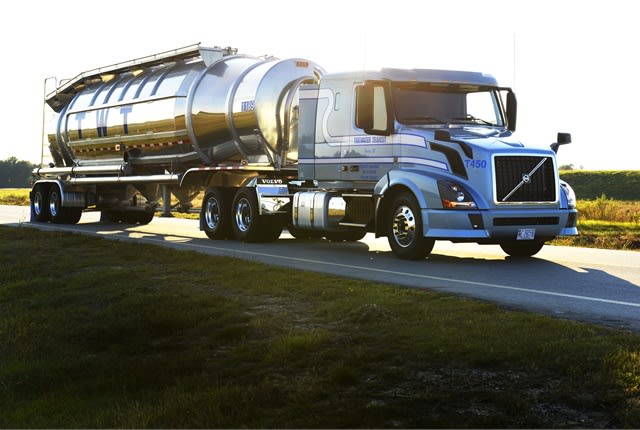
Tidewater Transit Co. of Kinston, N.C., won the Volvo Trucks Safety Award in the over 20 million miles category
ORLANDO -- Volvo Trucks once again honored two of its safest customers with the 2013 Volvo Trucks Safety Award during the American Trucking Associations Management Conference & Exhibition. Each fleet was presented $25,000 to be used toward safety-related activities.
Tidewater Transit Co. of Kinston, N.C., won the Volvo Trucks Safety Award in the over 20 million miles category. MCO Transport of Wilmington, N.C., received the Volvo Trucks Safety Award in the under 20 million miles category.
Now in its fifth year, the annual award is supported by sponsor Michelin America Truck Tires.
“Tidewater Transit and MCO Transport have made safety a top priority, and their outstanding performance reflects that commitment,” said Gӧran Nyberg, president of Volvo Trucks North American Sales & Marketing. “Like Volvo, the winners of this year’s award understand the importance of integrating safety into every facet of their operations.”
Safety has been a core value of Volvo since its inception in 1927. Volvo pioneered the three-point seat belt and today manufactures its truck cabs with high-strength steel, provides a standard driver’s side airbag and offers integrated enhanced stability and collision avoidance technologies. The Volvo I-Shift automated manual transmission, a standard feature on Volvo trucks, also helps improve driver safety by reducing fatigue and allowing drivers to give their full attention to operating the vehicle.
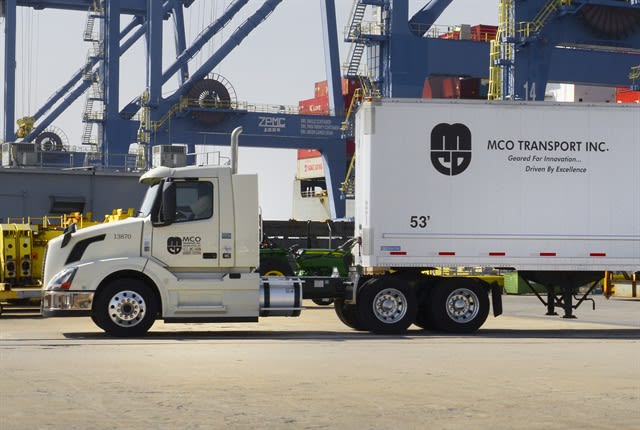
MCO Transport of Wilmington, N.C., received the Volvo Trucks Safety Award in the under 20 million miles category.
Family-owned and operated since 1949, Tidewater Transit operates 360 trucks throughout the eastern seaboard and gulf areas. The company primarily hauls dry and liquid materials – everything from sulfuric acid to plastic pellets. In 2012, Tidewater Transit recorded an accident frequency rate of just .25 while logging 31,649,340 miles on the road.
Tidewater Transit puts its new drivers through a “Top Gun” program, which pairs new hires with a Top Gun trainer, a hand-picked driver who oversees the full training of the new driver and ensures they have the knowledge and skills needed to operate on the road. Additionally, Tidewater Transit recognizes safe drivers with a quarterly cash bonus program, which includes presentation of certificates and plaques during company events when families are in attendance.
“Safety goes to the very core of what we do. We have to be safe in this industry,” said John McNairy, Tidewater Transit chairman and CEO. "We have a program called the seconds program – what can happen in a second. You can live or die in a second, you can be maimed or you can be healthy, you can be a company that's prosperous or one that's on the brink of falling apart, all in a second."
MCO Transport was established in 1975 as a commodities carrier transporting containers to and from the local port. Today, they offer transportation and warehousing services for diverse local, regional and national clients. MCO Transport operates a fleet of 88 trucks and logged 5,976,962 miles last year with just one recordable accident, equating to an accident frequency rate of .167.
MCO Transport’s multifaceted approach to safety is built around clearly defined policies and procedures. They also hold mandatory quarterly safety meetings and utilize a recognition program for drivers who receive no violations during DOT roadside inspections.
“Safety is of prime importance to MCO Transport – it’s our number one goal. We’ve made it part of our culture,” said Danny McComas, MCO Transport president. “This award is a culmination of all our effort after many years. It’s confirmation of the fact that you can run a trucking operation and always be safe.”
Bill Etheridge, director of safety for MCO, shared a couple of the company's initiatives. They put a program in place to track critical events and have drivers explain what happened. "If a driver consistently has a problem with hard brakes, maybe you need to earmark him for additional training," he noted." In addition, "we have a program to incentivize drivers to inspect their equipment, and that’s gone a long way toward improving our CSA score."
All motor carriers in the U.S. and Canada with more than five Class 8 trucks, at least one of them a Volvo, are eligible to apply for the annual awards. Winning fleets are selected based on their accident frequency rates, using the U.S. Department of Transportation definition of a “recordable accident,” and their safety and accident prevention programs.
More Fleet Management

How Telematics Improves Visibility, Control, and Performance in Refrigerated Fleets
Explore how telematics help refrigerated fleets improve visibility, uptime, efficiency, compliance, and cargo protection across connected cold chain operations.
Read More →
What the U.S.-Canada Trade War Means for Trucking
Escalating U.S.-Canada tariffs could disrupt cross-border freight, reduce truck volumes, raise costs, and create new uncertainty for carriers on both sides of the border.
Read More →
What Are Trucking’s Top Concerns for 2026?
The American Transportation Research Institute wants to know what's worrying trucking fleet managers, drivers, and other stakeholders in its annual Industry Issues survey.
Read More →

American Trucking Associations Looks for a New Leader
ATA President and CEO Chris Spear abruptly left his job at the association on August 21, at a pivotal time for the trucking industry.
Read More →
Public Wi-Fi Cybersecurity Risks: How Truck Drivers and Fleets Can Protect Their Data
Public Wi-Fi can expose truck drivers and fleets to credential theft, malware, and other cyber threats. Here’s how to reduce the risk on the road.
Read More →
For Nicky Cupp, Fleet Innovation Starts With Frustration
HDT Truck Fleet Innovator Nicky Cupp turns everyday pain points at Fraley & Schilling into opportunities for better technology and smarter processes.
Read More →
Adam Buttgenbach’s Approach to Electric Trucks: Start With Where They Fit
HDT Truck Fleet Innovator Adam Buttgenbach helped PepsiCo build one of North America’s largest EV fleets by focusing on where electric trucks make operational sense.
Read More →
Deen Albert: Let Automation Do the Math, People Make the Decisions
HDT Truck Fleet Innovator Deen Albert makes sure people are still at the heart of operations at Grand Island Express, even while adopting artificial intelligence tools. AI-assisted dispatch helped boost revenue 25% with the same number of trucks.
Read More →
Trimble’s New AI Agent Takes Aim at Fleet Back-Office Busywork
Arc Agent works across Trimble TMS products to automate repetitive tasks such as freight orders, maintenance, invoices, fuel costs and more.
Read More →
How HDT’s 2026 Truck Fleet Innovators Are Rethinking Fleet Operations
Meet five trucking leaders who are challenging assumptions, solving operational problems, and putting innovative ideas to work.
Read More →