




Related: Commentary - The Unmanned Vision
Test Site Opens for Automated and Connected Vehicles
Navistar is the latest truck maker to get involved in autonomous vehicles, with its involvement in a project that aims to implement a connected and automated mobility system on the streets of southeastern Michigan by 2021.
by Staff
July 20, 2015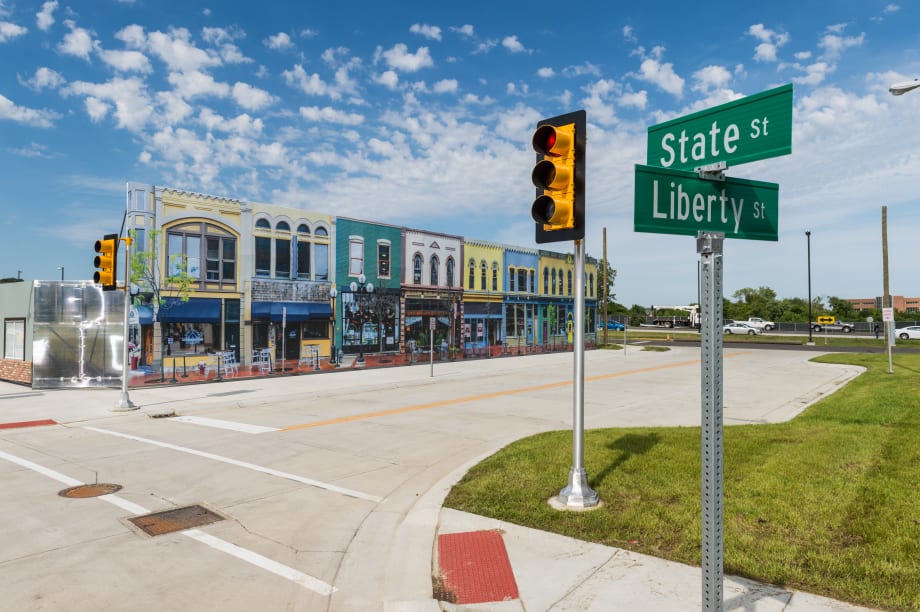
Photo via University of Michigan
2 min to read

An aeriel view of the MCity test site. Photo via University of Michigan
Navistar is the latest truck maker to get involved in autonomous vehicles, with its involvement in a new test site at the University of Michigan designed to test connected and automated vehicle technologies that will lead the way to autonomous vehicles.
As part of a development partnership, the truck maker was involved in the opening of MCity. The 32-acre simulated urban environment features a network of roads with intersections, traffic signs and signals, streetlights, building facades, sidewalks and construction obstacles.
The facility will be operated by University of Michigan’s Mobility Transformation Center. MTC is a public-private research and development partnership aimed at developing a commercially viable ecosystem of connected- and automated-driverless vehicles. A goal of the MTC and its MCity test site is to implement a connected and automated mobility system on the streets of southeastern Michigan by 2021.
It is designed to support rigorous, repeatable testing of new technologies before they are tried out on public streets and highways, according to the university.
The types of technologies that will be tested at the facility include connected technologies – vehicles talking to other vehicles or to the infrastructure, commonly known as V2V or V2I – and various levels of automation, all the way up to fully autonomous, or driverless vehicles.
Navistar is a founding member of the MTC’s Leadership Circle and the only heavy-truck manufacturer participating in the initiative. Other companies in that circle include Honda, Ford, GM, Navistar, Qualcomm, State Farm, Toyota and Verizon.
"This is an exciting opportunity for Navistar to leverage our leadership in connected vehicle technologies and collaborate with others in the industry to make connected transportation a reality," said Denny Mooney, Navistar group vice president, global product development. "The innovation of today's connected vehicle technologies will drive significant improvements in the way people, goods and services move throughout society and we're proud to play an important role in this transformation."
More Equipment

How Volvo Updated Its D13 for EPA 2027 [Watch]
Volvo’s updated D13 promises lower emissions without sacrificing performance or fuel economy. Take a closer look at what changed inside the engine in this HDT Spotlight video.
Read More →
Michelin Tire Improves Efficiency and Durability for Regional Fleets
The Michelin X Multi Energy D2 is a regional haul drive tire engineered to help fleets improve fuel efficiency, durability and traction in demanding stop-and-go operations.
Read More →
ZF Expands Commercial Vehicle Push in North America
ZF is expanding its North American commercial-vehicle presence with new transmission applications, electrification, trailer technology and autonomous-driving systems.
Read More →
Tesla Wants a Self-Driving Semi. Are Cameras Enough?
Could Tesla’s camera-only autonomous driving technology work on an 80,000-pound Semi? In this commentary, HDT's Deborah Lockridge takes a look at Tesla, Cybercab, and how autonomous trucks see the road.
Read More →
Kodiak: Driverless Long-Haul Truck Launch on Track for 2026
Kodiak AI says its driverless long-haul safety case is 93% complete and it remains on track to begin commercial operations by year-end 2026.
Read More →
What DOT’s Automated Vehicle Strategy Means for Trucking
The U.S. Department of Transportation issued a new automated-vehicle strategy that outlines plans for driverless-truck regulations, cross-state freight corridors, and federal safety standards.
Read More →
East Coast Port Launches $45M Electric Truck Push
The Port Authority of New York and New Jersey announced millions in incentives for zero-emission drayage trucks, yard tractors, and new charging hubs near the port.
Read More →
PlusAI Going Public to Fund Autonomous Truck Launch
A SPAC deal could provide PlusAI with up to $300 million as it works toward a 2027 commercial launch of factory-built autonomous trucks.
Read More →
NHTSA Moves to Rewrite Truck Fuel-Economy Rules
The National Highway Traffic Safety Administration says it lacks authority to regulate medium- and heavy-duty truck engines separately from complete vehicles, but the existing standards have not yet been eliminated.
Read More →
Detroit Opens Orders for EPA 2027 Engines
Detroit isn’t starting from scratch to meet EPA 2027 diesel emissions standards. Its Gen 6 DD13 and DD15 engines keep much of today’s platform while updating the fuel and aftertreatment systems.
Read More →