





Truck Tech Blog: Is Trucking Too Tough for Tesla?
Tesla Semi in 2023?
Supply-chain problems have caused Tesla to once again push out its estimated date for production of its battery-electric Class 8 Semi truck.
October 11, 2021
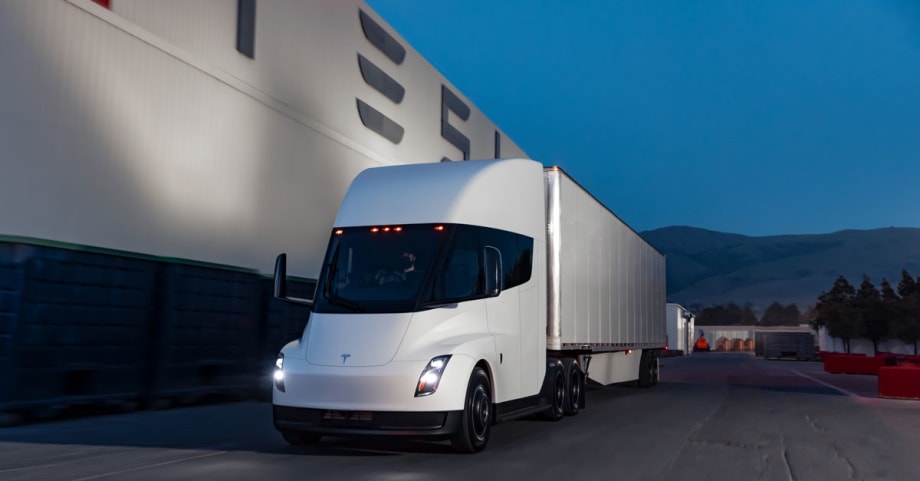
Tesla's electric Semi is now not expected until 2023.
Photo: Tesla
2 min to read
Supply-chain problems have caused Tesla to once again push out its estimated date for production of its battery-electric Class 8 Semi truck.
According to published reports, during the 2021 Tesla shareholder meeting, co-founder and CEO Elon Musk explained that supply chain issues for batteries, automotive chips, and other components have been limiting production of all Tesla products.
Musk said that no matter how many more vehicle models the company sold, it wouldn’t be able to deliver more units this year. Considering how many more batteries and chips the Semi needs compared to a Tesla passenger car, it is being delayed until these supply chains ramp up, noted CleanTechnica.
The Tesla Cybertruck is delayed until the end of 2022 for the same reasons.
“It really wouldn’t matter if we had the Semi or Cybertruck or anything, we just wouldn’t be able to make it,” Musk said.
“I think most likely what we’ll see is Cybertruck start production in the next year, and then reach volume production in 2023. And, hopefully, we can also be producing the Semi and the new Roadster in ‘23 as well. So, we should be through our severe supply chain shortages in ‘23. I’m optimistic that that will be the case.”
It’s the latest delay in a string of them since the Semi was unveiled in 2017 with a projected date of 2019 for availability. As recently as late July, a second-quarter earnings report pushed expected Semi production out to 2022. Back in January, Musk said the Tesla Semi was ready for production, held back only by a limited ability to get battery cells, but he was optimistic that the setback was only temporary.
Tesla, of course, is not the only vehicle manufacturer suffering from an inability to get critical components. Transportation intelligence firm FTR recently estimated that there are already 13,000 to 20,000 Class 8 trucks that are not yet completely built because they need semiconductors as well as other parts.
Another possible factor in this latest delay, noted CleanTechnica, is that Jerome Guillen, the longtime Tesla exec who was put over the Semi project in March, left the company in June.
Also during that shareholder’s meeting, Musk announced Tesla will move its headquarters from Silcon Valley in Fremont, California, to Austin, Texas. He cited affordability, space and convenience as some of the reasons behind the move.
Musk has been hinting at the move since May of 2020, when California COVID-19 restrictions temporarily shut down Tesla's operations in Fremont. He called the restrictions "fascist.”
More Fuel Smarts

How Volvo Updated Its D13 for EPA 2027 [Watch]
Volvo’s updated D13 promises lower emissions without sacrificing performance or fuel economy. Take a closer look at what changed inside the engine in this HDT Spotlight video.
Read More →
Diesel Price Spike Shortens Payback for Natural Gas Trucks, Report Says
Energy Vision estimates fleets could recover the higher purchase price of an RNG-fueled Class 8 tractor in 1.3 to 2.8 years under current fuel-price scenarios.
Read More →
Calstart Becomes Catalyst Mobility, Reflecting Broader Focus
Calstart is now Catalyst Mobility, reflecting the nonprofit’s growing national role in clean transportation, including zero-emission trucks, infrastructure and incentive programs.
Read More →

Record Diesel Prices Squeeze Trucking Fleets
Average U.S. diesel prices have climbed to nearly $6 a gallon, surpassing the 2022 record as tight refinery capacity and Middle East disruptions keep fuel costs elevated.
Read More →
Sponsored•September 9, 2026
How Fuel Delivery Shapes Engine Performance
Fuel delivery depends on more than what happens at the injector. For fleet, maintenance and technical professionals, looking at the full path from pump to injector can provide useful context for understanding engine performance.
Read More →
East Coast Port Launches $45M Electric Truck Push
The Port Authority of New York and New Jersey announced millions in incentives for zero-emission drayage trucks, yard tractors, and new charging hubs near the port.
Read More →
California Bill Could Shed Light on Electric Truck Prices
Why do battery-electric Class 8 trucks remain so expensive? A California bill headed to Gov. Gavin Newsom would give fleets and state agencies more visibility into what manufacturers charge.
Read More →
Detroit Opens Orders for EPA 2027 Engines
Detroit isn’t starting from scratch to meet EPA 2027 diesel emissions standards. Its Gen 6 DD13 and DD15 engines keep much of today’s platform while updating the fuel and aftertreatment systems.
Read More →
Zero-Emission Truck Corridor Planned for West Coast
California, Oregon, Washington, British Columbia and Baja California are coordinating plans for truck charging and hydrogen fueling from Canada to Mexico.
Read More →
A Closer Look at Kenworth’s Electric T880E Vocational Truck [Video]
Learn more about Kenworth's T880E battery-electric vocational truck at the Paccar Technical Center, including its range, applications, upfitting considerations, and PTO options, in this HDT Spotlight video.
Read More →