




TCA Implores Congress Not to Raise Truck Weights
The Truckload Carriers Association reiterated its support of the current five-axle, 80,000-pound federal gross vehicle weight limit for trucks.

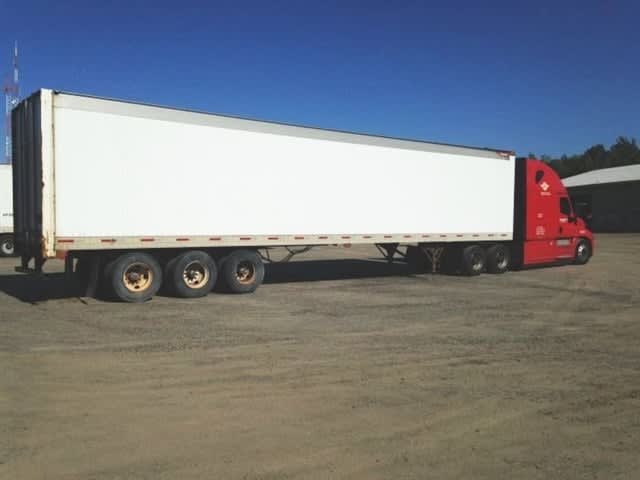
Hartt Transportation runs tri-axle vans, among other things, in Maine, where such rigs may gross 100,000 pounds. Photo: Hartt Transportation
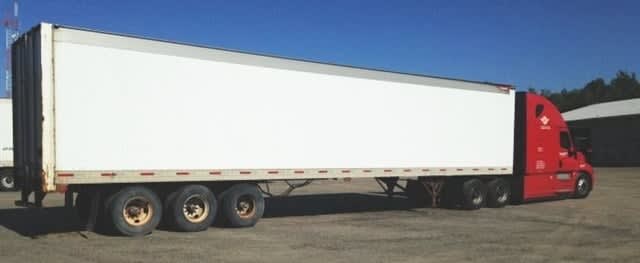
Hartt Transportation runs tri-axle vans, among other things, in Maine, where such rigs may gross 100,000 pounds.Photo: Hartt Transportation
The Truckload Carriers Association reiterated its support of the current five-axle, 80,000-pound federal gross vehicle weight limit for trucks in an April 5 letter to the leaders of both the Senate Committee on Appropriations and the House Committee on Appropriations.
TCA President John Lyboldt wrote the lawmakers that the association and its trucking company members are “concerned about allowing freight-shipping trucks to carry a maximum of 91,000 pounds with the addition of a 6th axle, up from the current 80,000 pounds standard.”
While conceding that this idea is an attempt to improve trucking productivity, he contended that “it clearly would only benefit a minority of carriers, while forcing the rest of the industry either to divert critical resources into these new configurations or risk becoming obsolete.”
Interestingly, that is often the strongest argument put up by truckload carriers that oppose liberalizing federal rules to allow 33-foot-long “turnpike” double trailers to operate on Interstate and other highways— regardless of state laws. T
TCA was among the groups that lobbied Congress successfully to keep a measure allowing twin 33s from being passed in 2015.
As to whether carriers should be allowed to run heavier when rigs are equipped with a 6th axle, about a year ago TCA did opt to ditch a two-policy position it had held since 2011 that called for increasing truck weight limits either by allowing a five-axle, 88,000-pound weight limit or six-axle, 91,000-pound limit.
In the letter, Lyboldt detailed TCA’s concern that changing the weight limit via a 6th axles would drive up both capital and operating costs for truckload carriers while not allowing them to recoup those costs through rate adjustments.
“Truckload’s shift from 48’ trailers to 53’ trailers was exactly this issue, only in reverse,” he pointed out, offering a history lesson. “Shippers who filled trailers by volume before maximizing the allowable weight put pressure on industry to move to 53’ trailers. Like the proposal today, there were pilot programs prior to it being legalized across the nation. Only half of the loads cubed out before they weighed out, yet the entire industry was forced to move.”
Lyboldt said that while “the market demands ultimate flexibility from general freight haulers, those who cannot provide the service simply disappear. As has happened before, maximum capacities become the norm. Carriers are forced to adjust their equipment to accommodate 91,000/6, despite the fact that they will likely never recoup the costs of the adjustment or haul loads requiring the 6th axle.”
He added that truckload carriers “simply cannot afford” a rule that would allow 91,000 pounds on 6 axles.
“TCA supports a policy of no increase in truck weight,” Lyboldt stated flatly in the letter. “As an association, we will continue to examine components of increasing productivity as they arise.”
Making his message crystal-clear, he added that “TCA reiterates that we are opposed to the stand-alone concept of 91,000 pounds on 6 axles; however, TCA is open to any and all discussions with key stakeholders in regards to improving overall transportation efficiency and productivity on our nation’s highways.”
More Fleet Management

How MFA Helps Protect Trucking Fleets
Multi-factor authentication adds protection when passwords are stolen. Here’s how it works and where fleets should start.
Read More →
How Better Freight Data Helps Trucking Teams Get Ahead of Disruption
Trucking and logistics teams have plenty of data. The problem is getting the right information in front of the right people soon enough to act. Better-connected data can help teams spot trouble earlier and make smarter decisions before small problems become big ones.
Read More →
Trimble: Taking Artificial Intelligence in Trucking Beyond Faster Tasks
At Insight 2026, Trimble executives argued that fleets may need to redesign workflows to get more from AI as it introduced new products and enhancements. AI’s value will depend on how fleets combine automation with their people's knowledge.
Read More →

Build a bulletproof fleet: Uniting ELDs and dash cams for total compliance
An ELD can prove compliance, but it cannot always prove what happened on the road. Discover how uniting accurate ELD data with AI-powered dash cam video can help your fleet strengthen compliance, defend against liability, protect drivers and reduce operational costs.
Read More →
Nominations Open for HDT Emerging Leaders
Heavy Duty Trucking is looking for accomplished trucking fleet professionals under 40 who are making an impact and helping lead the industry forward.
Read More →
Why Private Fleets Are Taking More Freight
Private fleets are putting their own trucks on demanding customers and high-cost lanes as companies seek greater control over service, costs, and capacity.
Read More →
Color Match Smarter: Tools That Restore & Perform
For fleet managers and collision repair professionals keeping heavy-duty trucks on the road, getting the color right the first time isn't just about appearance — it's about efficiency, turnaround time, and bottom-line results. Discover how today's digital color tools are transforming the repair process from guesswork to precision.
Read More →
FMCSA Pauses Biennial-Update Enforcement Amid Motus Transition
Carriers whose updates were due on or after June 1 have more time, while FMCSA works to stabilize its new registration system and warns of phishing sites impersonating its new carrier registration system, Motus.
Read More →
2026 Blueprint for Countering Smarter Supply Chain Theft
Cargo theft is no longer just the cost of doing business. It's a multi-billion-dollar criminal enterprise exploiting vulnerabilities across your fleet, drivers, and supply chain.
Read More →
What the U.S.-Canada Trade War Means for Trucking
Escalating U.S.-Canada tariffs could disrupt cross-border freight, reduce truck volumes, raise costs, and create new uncertainty for carriers on both sides of the border.
Read More →