




Six Axles and 91,000 Pounds: Will It Fly?
The latest congressional proposal authorizing a 91,000-pound weight limit adds productivity, but doesn’t always make operational or economic sense.

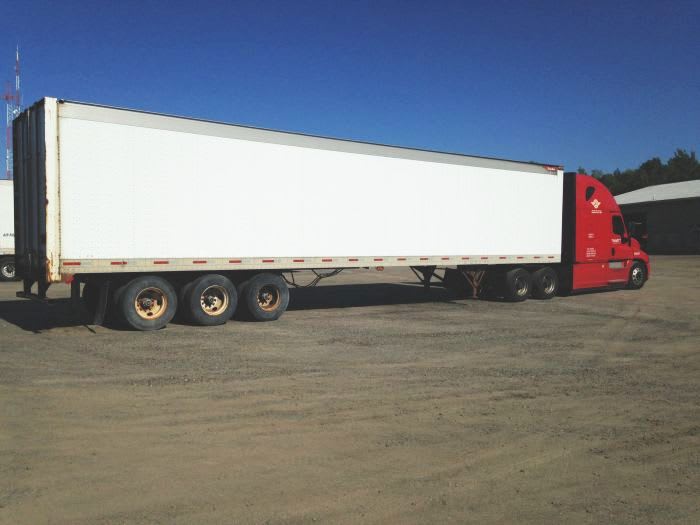
Hartt Transportation runs tri-axle vans, among other things, in Maine, where such rigs may gross 100,000 pounds. Some tractors are specially spec’ed for pulling heavy water tankers, but normal road tractors also are used. Photos: Hartt Transportation
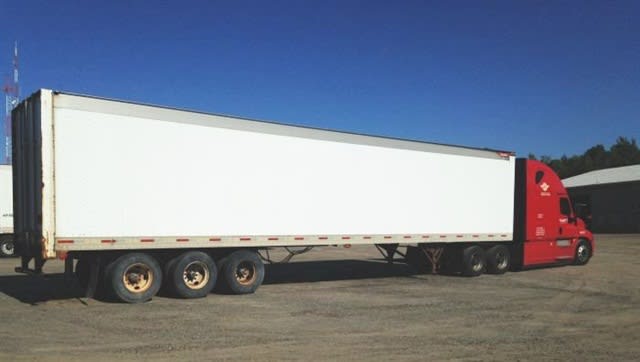
Hartt Transportation runs tri-axle vans, among other things, in Maine, where such rigs may gross 100,000 pounds. Some tractors are specially spec’ed for pulling heavy water tankers, but normal road tractors also are used. Photos: Hartt Transportation
Today’s standard freight-hauling rig in the U.S. is the five-axle semi, limited to 80,000 pounds gross combination weight on most federal and many state highways. That might change under a bill now in Congress. A proposal from Rep. Reid Ribble (R-Wis.) would allow states to authorize 91,000 pounds GCW on six axles. Productivity — hauling more freight with fewer trucks — is the goal of the bill, dubbed the Safe, Flexible, and Efficient (SAFE) Trucking Act.
Don’t hold your breath for it to become law, though, because many people inside and outside the industry are opposed.
The railroad lobby has already lined up against it, as it always does because the rails fear losing more freight to truckers. The Truckload Carriers Association opposes it, and in a letter to Congressman Ribble, explained that only a few truckers would actually benefit – probably haulers of dry and liquid bulk commodities. Van and reefer operators might be forced to convert to the higher-capacity trailers by pushy shippers. TCA said it would cost $8,000 to $24,800 for retrofitting or spec’ing stronger components in a new rig to haul the extra pounds.
This sort of thing has happened before, most recently the switch from 48- to 53-foot van trailers in the 1980s and ‘90s. Some early adopting carriers got higher rates, then when 53s became common, shippers demanded the longer trailers. Their definition of a “truckload” went from what they could push into a 48 to what a 53 would hold.
Opponents say it would work the same way with higher legal gross weight. “You can always get more weight in that will let you keep their business,” says Kirk Altrichter, vice president, maintenance, at Crete Carrier Corp. “But you won’t get more in rates.”
Still, like all productivity ideas, this one’s mechanically interesting. It puts the extra axle on the trailer, changing its tandem to a tridem. That’s a fairly simple change with a decent increase in capacity. Tri-axle trailers now operate in Maine, which allows 100,000 pounds on six axles on state roads. They originally were prohibited on Interstates 95 and 295 because of federal restrictions, forcing operation on older, narrower, hilly highways. But help from U.S. Sen. Susan Collins got them legalized on the Interstates.
East Manufacturing builds tri-axle aluminum flatbeds, dumps and walking-floor trailers for Maine and other areas, says Charlie Wells, vice president of sales and marketing.
Fifty tons gross is also allowed in some nearby states and Canadian provinces, says Gary Bangor, manager of Hale Trailer’s Portland branch, which sells East and other products.
“An aluminum flatbed only weighs 13,000 pounds, with a bunk kit (for logs), so it can haul 67,000 pounds with a 20,000-pound tractor,” Bangor says. “If you’re hauling something else and don’t need the 1,000-pound bunk kit, you can haul more cargo.”
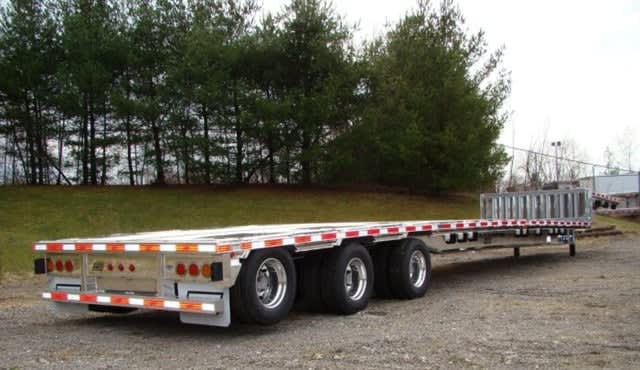
Tridem-equipped dropdeck, flatbed and dump trailers are commonly produced by East and other manufacturers. A proposal in Congress would allow one of these to carry 11,000 pounds more gross weight, or 91,000 pounds total.
The extra axle, suspension parts, and wheels and tires would weigh 2,500 to 3,000 pounds, leaving 8,000 to 8,500 pounds of possible additional payload under the 91,000-pound proposal, figures Jim Burg, owner of James Burg Trucking, which operates five-, seven- and 11-axle rigs in Michigan and nearby states. He strongly believes in fostering extra productivity when it makes sense.
“Extra maintenance with one extra axle is minuscule, about 0.5 cent a mile,” he says. “But not all commodities let you gain extra revenue.” For instance, steel plate or beam won’t be increased in thickness or length just because there’s more legal capacity on a rig. And consignees order what they need, so some shipments are smaller and lighter than what a truck could carry.
Burg raises other operating questions: “Would the new rule allow that extra axle to be lifted for turning? In Michigan we’re allowed to, but it says ‘for a reasonable amount of time.’ What’s reasonable? It’s up to the officer who sees it. Use a steerable axle? That’s more weight, expense and maintenance. There’ll be extra registration fees and extra fuel costs. And not all state routes and even local roads will allow this equipment.”
The six-axle, 91,000-pound tractor-trailer meets the B-formula, which requires minimum spacing between axle groups, the Federal Highway Administration reportedly told Rep. Ribble. But a previous proposal, 97,000 pounds on six axles, wouldn’t have without more vehicle length. The B-formula, summarized in a table, is an algebraic equation computed by engineers after pavement tests in the early 1950s.
Back to economics, a third axle costs about $10,000, Bangor says. Among operators in Maine, he says, “payback is not really discussed; it’s just the way it’s always been done. Everybody has them.“
The tridem-equipped trailer and its tractor must otherwise be strong enough to take the added poundage, said TCA in its letter to the congressman. That might mean a stronger frame and kingpin, higher-rated tires and a more powerful engine in the tractor. That’s where the association got its high-end estimate.
But is that really so? Todd Cotier, maintenance director at Hartt Transportation in Bangor, says some of his tractors are geared to pull the heavier trailers in hilly terrain, but “today everyone has more horsepower than they really need anyway, and our sleeper-cab road tractors can pull them without a problem.”
What about safety? For stopping power, the third trailer axle adds two brakes, totaling 12 sets on the six-axle, 91,000-pound rig. Simple math says that’s about 7,583 pounds per brake. There are 10 sets on today’s five-axle, 80,000-pounder, or 8,000 pounds per brake. That should mean the heavier rig would stop as well or better. At the same time, extra payload might be piled high, making for a higher center of gravity and a bit more danger of a rollover.
All in all, the concept works where the need to stay competitive requires the stronger, more costly equipment. But if shippers’ attitudes and the need to turn a profit are considered, logic points to staying with the current five-axle, 80,000-pound rig.
More Equipment
Continental Introduces New Regional Truck Tires
Continental says its new Generation 5 steer and drive tires for regional operations offer longer tread life, with estimated mileage gains of 22% and 19%, respectively.
Read More →
Tekmodo Introduces CargoBright Brand for Translucent Trailer Roofs
CargoBright is designed to diffuse daylight across the cargo area while performing as a working vehicle roof.
Read More →
Fleet Economics Shape Electric Truck Outlook
ACT Research expects costs, charging infrastructure, and technology improvements to drive zero-emission commercial vehicle adoption as federal regulations and incentives retreat.
Read More →
Kodiak Targets Dallas–Houston for Driverless Trucks
The company says its autonomous trucks are completing the I-45 run without a safety observer taking control. It plans to remove the observer by the end of 2026.
Read More →
Kodiak Hauls Produce in California Autonomous Truck Pilot
Kodiak AI and DTL Transport have begun hauling produce between Fresno and Los Angeles under California’s new rules for testing heavy-duty autonomous trucks. A safety driver remains behind the wheel.
Read More →
Used-Truck Remarketing Math Is Changing
Used-truck value is no longer just a concern at trade-in. Decisions made throughout a truck’s first life can influence what it’s worth years later.
Read More →
How Volvo Updated Its D13 for EPA 2027 [Watch]
Volvo’s updated D13 promises lower emissions without sacrificing performance or fuel economy. Take a closer look at what changed inside the engine in this HDT Spotlight video.
Read More →
Michelin Tire Improves Efficiency and Durability for Regional Fleets
The Michelin X Multi Energy D2 is a regional haul drive tire engineered to help fleets improve fuel efficiency, durability and traction in demanding stop-and-go operations.
Read More →
ZF Expands Commercial Vehicle Push in North America
ZF is expanding its North American commercial-vehicle presence with new transmission applications, electrification, trailer technology and autonomous-driving systems.
Read More →
Tesla Wants a Self-Driving Semi. Are Cameras Enough?
Could Tesla’s camera-only autonomous driving technology work on an 80,000-pound Semi? In this commentary, HDT's Deborah Lockridge takes a look at Tesla, Cybercab, and how autonomous trucks see the road.
Read More →