




Talking Turkey on Cap-and-Trade
With the Senate starting work on its version of a cap-and-trade system to limit carbon emissions, opponents are gearing up for a fight. "This cap-and-trade is a turkey,
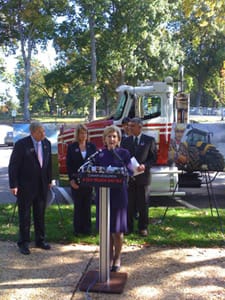
The Capitol Hill press conference Wednesday included Sen. Kay Bailey Hutchison (center), and from left, Sen. Kit Bond, Barbara Windsor, first vice chairman of American Trucking Associations, and Richard Cortese, a grain and livestock farmer from Texas.
With the Senate starting work on its version of a cap-and-trade system to limit carbon emissions, opponents are gearing up for a fight.
"This cap-and-trade is a turkey,"
said Sen. Kit Bond, R-Mo., yesterday. "I don't care how many gee gaws you put on it, that baby's never going to fly."
Bond and Sen. Kay Bailey Hutchison, R-Texas, yesterday unveiled a new study that claims the Senate cap-and-trade proposal amounts to a $3.6 trillion fuel tax.
"We must stop this tax," Hutchison said. "Even environmentalists say this (proposal) will have no impact on global warming."
The Senators were reacting to a proposal by Sens. Barbara Boxer, D-Calif., and John Kerry, D-Mass., that is similar to a bill passed earlier this year by the House. The cap-and-trade mechanism would limit greenhouse gas emissions and set up a market in which emissions can be bought or sold. The idea is to make carbon-based energy more expensive in order to encourage investment in cleaner energy and promote more efficient use of energy, with the long-term objective of slowing global warming and decreasing U.S. dependence on foreign oil.
Bond and Hutchison were headliners at a Capitol Hill press conference put together by American Trucking Associations, which opposes cap-and-trade. On hand from ATA was Barbara Windsor, president and CEO of Hahn Transportation. Windsor, who is first vice chairman of ATA and slated to become chairman next October, said that cap-and-trade will not reduce trucking's carbon emissions because trucking is not a discretionary user of fuel.
"Proponents of an economy-wide cap and trade system believe that by increasing the price of fuel, fuel users will either purchase more fuel efficient vehicles or convert to alternative-fueled vehicles," Windsor said. "These options are not currently available to the trucking industry in any meaningful manner."
Bond and Hutchison said their study shows the House cap-and-trade bill would impose a $2 trillion tax on gasoline, a $1.3 trillion tax on diesel and a $330 billion tax on aviation fuel, for the total of $3.6 trillion over 35 years. They said the Senate version of the bill would be even more expensive.
Neither is inclined to look for ways to work with a cap-and-trade system, mitigating its impact on core industries such as trucking and farming by carving out exceptions. It's the concept that's flawed, they said.
"When government gets in and tries to start picking winners and losers, who gets excepted, who doesn't, you're still going to wind up hitting people who should not be hit," said Sen. Bond.
Hutchison said it is hard to make exceptions because the proposal works by putting the cost of emissions on fuel refiners, who would have to pass that cost through to customers in trucking and elsewhere.
"We can improve the environment and economy through American ingenuity and technological advancement, not with taxes and mandates that increase costs and burden American families and businesses," Hutchison said.
Bond added that according to the administrator of the Environmental Protection Agency, unless India and China adopt a similar system - which they have said they will not - that cap-and-trade would have only a slight impact on global temperatures. "Our best hope of reducing emissions is to develop technology and share it with India and China," he said.
Both Bond and Hutchison support the idea of using nuclear energy to produce electricity, arguing that it would reduce the emissions associated with burning coal and that new technologies can greatly reduce the amount of hazardous waste created by old-fashioned nuclear power plants.
Bond said he is among those who believe the question of whether or not man-made emissions are contributing to global warming is not yet settled.
The majority of the U.S. and international scientific establishment has concluded that man-made emissions have contributed to a dangerous warming trend. The National Oceanic and Atmospheric Administration, which has led a years-long research effort by more than a dozen federal agencies, says "global warming is unequivocal and primarily human-induced."
Climate-related changes are under way, affecting water, energy, transportation agriculture, ecosystems and health, NOAA says. Among other problems, the agency predicts more frequent and intense heat waves, heavy downpours leading to flooding and rising sea levels that threaten coastal areas.
More Drivers

Platform Science Adds Dispatch and Safety Tools
Four additions to PS Fleet help fleets monitor loads, manage driver coaching, share truck locations and adjust video system settings.
Read More →
When Language Stops the Truck: The Return of ELP Out-of-Service Orders
English language proficiency rules for commercial drivers aren’t new, but renewed out-of-service enforcement has raised the stakes. Here’s what carriers need to know before a driver reaches a roadside inspection.
Read More →
Samsara Launches Custom AI Agent Builder
Agent Studio lets fleets create AI tools for hours-of-service monitoring, reporting and driver support, including agents that communicate by phone.
Read More →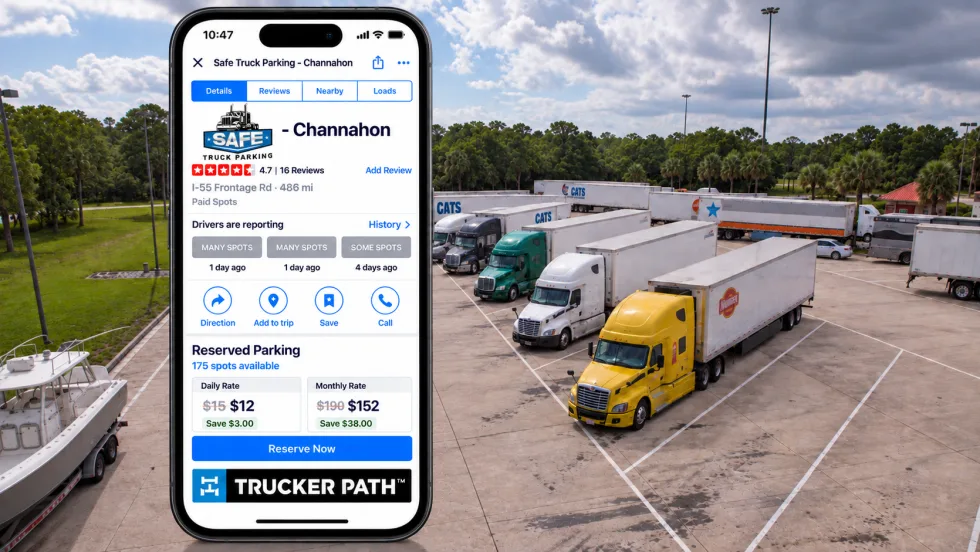
Trucker Path Expands Reserved Parking Network
Trucker Path has added close to 6,000 more truck parking spaces to its Trucker Path Reserved Parking Network with the addition of Safe Truck Parking.
Read More →
EEOC Sues Texas Trucking Company Over Driver Age Limits
The agency says Trancasa USA rejected applicants over 65 and applied tougher driving-record standards to those over 60.
Read More →
Nussbaum, Roehl Announce Second Driver Pay Increase This Year
This year has seen a swath of major truck driver pay increases as freight capacity has tightened.
Read More →
From One Generation to the Next: How Mentorship Builds Safer Truck Drivers
After three decades in trucking, Harold Perry shares what he's learned about driver safety, mentorship, and helping the next generation build confidence behind the wheel.
Read More →
Truck Drivers Need More Than Another Alert
Fleets have more visibility into truck health, safety events, and driver activity than ever. The next challenge is turning all that information into useful guidance for the person who has to decide what to do next.
Read More →
FMCSA Removes 110 Truck Driver Training Schools from Certified ELDT List
Federal regulators also are targeting more than 160 additional training providers and launching a nationwide audit of third-party CDL skills testers as part of a broader crackdown on trucking fraud.
Read More →
Hours of Service Pilot Programs: FMCSA Readies for 2027 Rollout
Two pilot programs could eventually reshape hours-of-service rules, giving truck drivers options to pause their 14-hour clock or use longer split sleeper rest periods.
Read More →