




Swift Public Offering Could Raise $1 Billion
Swift Transportation could go public as soon as this week, in an initial public offering that some estimate could raise $1 billion
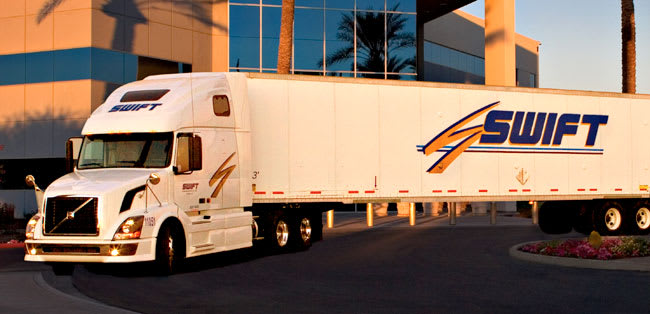
Swift Transportation could go public as soon as this week, in an initial public offering that some estimate could raise $1 billion.
Briefing.com predicts the IPO for the Phoenix-based company will go for $13 to $15 per share. Swift Transportation, which is changing its name from Swift Holdings Corp., will trade on the New York Stock Exchange under the ticker SWFT beginning today.
A Nov. 30 filing with the U.S. Securities and Exchange Commission calls for 77.4 million shares to be registered and a proposed offering price of $14. That would make the IPO worth about $1 billion. Most of that will be used to pay off debt.
It's not the first time the company has been public. In 2007, co-founder Jerry Moyes led a $2.4 billion buyout to take the country's largest truckload carrier private.
Bloomberg points out that the IPO values the trucking company at 25 percent less than it was worth when Moyes took the company private in 2007, after three years of losses.
As of Sept. 30, Swift operated a fleet of 16,200 tractors, 48,600 trailers and 4,500 intermodal containers in the United States and Mexico. The company posted a net loss of $77.1 million on total operating revenue of $2.15 billion in the nine months ended Sept. 30.
Those losses are less than 2007 and 2009, and the company says revenue for the first nine months of this year rose 12.9 percent compared to the same period last year.
Moyes, 66, co-founded Swift in 1966 with a single truck. He stepped down as chief executive officer in 2005. He is not selling any shares, according to published reports.
A Weekly Trader Extra column at Barron's says the IPO is "Not a Swift Idea." Author Andrew Bary points out that "Swift has been losing money since its 2007 leveraged buyout and still would have a substantial amount of debt and interest expense after the IPO, which could be one of the largest of the year if completed."
Bary explains that "The IPO is part of a complex series of financial actions, including the refinancing of bank loans, the repurchase of existing public bonds and the issuance of new public debt and a new bank credit facility. All this is designed to cut Swift's debt to about $1.8 billion and reduce interest expense, now running at about $240 million annually by about $100 million."
More Drivers

Samsara Launches Custom AI Agent Builder
Agent Studio lets fleets create AI tools for hours-of-service monitoring, reporting and driver support, including agents that communicate by phone.
Read More →
Trucker Path Expands Reserved Parking Network
Trucker Path has added close to 6,000 more truck parking spaces to its Trucker Path Reserved Parking Network with the addition of Safe Truck Parking.
Read More →
EEOC Sues Texas Trucking Company Over Driver Age Limits
The agency says Trancasa USA rejected applicants over 65 and applied tougher driving-record standards to those over 60.
Read More →
Nussbaum, Roehl Announce Second Driver Pay Increase This Year
This year has seen a swath of major truck driver pay increases as freight capacity has tightened.
Read More →
From One Generation to the Next: How Mentorship Builds Safer Truck Drivers
After three decades in trucking, Harold Perry shares what he's learned about driver safety, mentorship, and helping the next generation build confidence behind the wheel.
Read More →
Truck Drivers Need More Than Another Alert
Fleets have more visibility into truck health, safety events, and driver activity than ever. The next challenge is turning all that information into useful guidance for the person who has to decide what to do next.
Read More →
FMCSA Removes 110 Truck Driver Training Schools from Certified ELDT List
Federal regulators also are targeting more than 160 additional training providers and launching a nationwide audit of third-party CDL skills testers as part of a broader crackdown on trucking fraud.
Read More →
Hours of Service Pilot Programs: FMCSA Readies for 2027 Rollout
Two pilot programs could eventually reshape hours-of-service rules, giving truck drivers options to pause their 14-hour clock or use longer split sleeper rest periods.
Read More →
Medical Cards, English Proficiency Reshape Roadcheck Violations
Medical-card violations jumped to the top of the driver out-of-service list during CVSA’s 2026 International Roadcheck, while English-language proficiency violations appeared among the leading violations for the first time.
Read More →
Driver Trust Can Make or Break the Success of Fleet Safety Technology
New Teletrac Navman research suggests that onboarding, transparency about driver data, and positive feedback can play a significant role in how commercial drivers respond to safety and coaching technology.
Read More →