




Survey Offers Snapshot of Fleet Effects of COVID-19
Fewer fleets reported an increase in business for April than they did a month earlier for March, according to HDT’s May COVID-19 fleet survey, which also revealed month-over-month changes in the main ways fleets were protecting the health and safety of their employees.
June 4, 2020

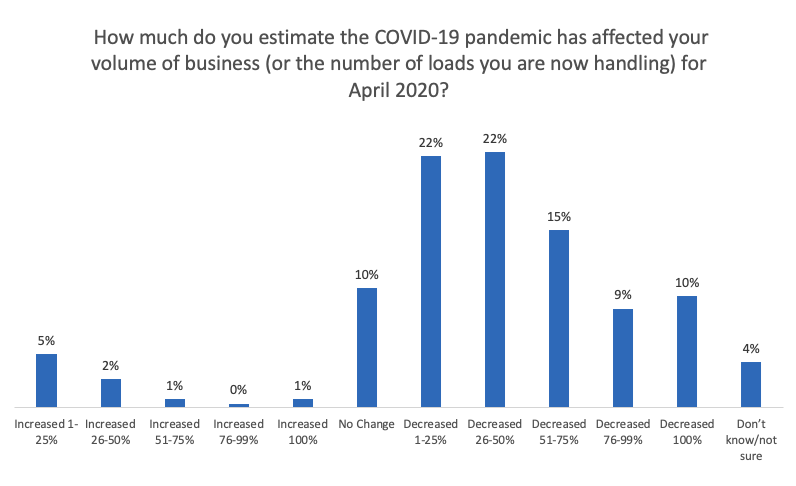
The way COVID-19 affected business levels changed from April to May.
Graph: HDT Research
5 min to read
Fewer fleets reported an increase in business for April than they did a month earlier for March, according to HDT’s May COVID-19 fleet survey, which also revealed month-over-month changes in the main ways fleets were protecting the health and safety of their employees.
Only 9% of respondents reported an increase in business, compared to 21% of those surveyed the previous month. Only 10% reported no change, compared to 18% the previous month. Meanwhile, 78% of respondents reported a drop in business in April, compared to 53% in the previous month’s survey.
The survey, conducted May 7-26, was sent out by email to Heavy Duty Trucking’s subscriber base as well as through invitations on social media. The results are based on 302 responses.
When looking at the results by fleet size, smaller operators were more likely to report a drop in business than larger fleets. Among responding fleets of 100 trucks or fewer, about 80% of respondents reported a drop in business in April, but only 61% of fleets of 100 and over.
Among the smallest operators, respondents with 1-4 trucks, nearly one-fourth, 23%, said business had entirely dried up in April. About another one-fourth, 27%, had seen business drop by 51-99%. Only 2% of these fleets had seen an increase in business; 13% saw no change and 13% saw it drop by 1-25%.
Fleets of 5-24 trucks were the most likely to have taken advantage of the Payroll Protection Plan loans made available via the CARES act, at 70%; 51% of fleets 25-99 trucks did. The smallest and largest fleets were least likely to have taken advantage of these loans, with 23% of 1-4 truck fleets and 21% of 100-plus-truck fleets. 30% of the larger fleets said they were ineligible for the loans. Among the smallest fleets, 19% said they were ineligible, 23% said they didn’t feel it was necessary, 11% didn’t know how, and 12% said the funds had already run out.
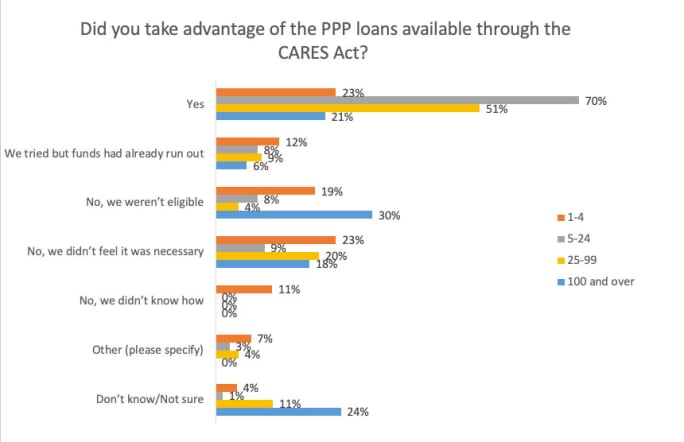
Fleet size played a role in whether companies took advantage of the PPP program.
Graph: HDT Research
Working from home is a factor for many fleets; 26% said they had up to 24% of their workforce working from home. 58% said they have no one working from home during the pandemic. However, if you look at the size breakdown, larger fleets were much more likely to have significant portions of their workforce telecommuting, likely because for the smallest fleets, their truck is most likely their workplace. For fleets of 25-99 trucks, 39% had up to 24% of their workforce working from home, and for fleets of 100 or more that number climbed to 46%.
Only 22% of respondents had workforce members furloughed and/or laid off as a result of the pandemic. Both the smallest fleets (1-4 trucks) and the largest (at least 100 trucks) were most likely to have furloughs or layoffs, at 27% and 26%, respectively. The majority of those owner-operator fleets, however, at 60%, were reporting a 100% decrease in workforce, presumably the result of owner-operators who had to park their trucks because business dried up or rates weren’t worth taking the truck on the road. Of those 100-truck-plus fleets, 44% said they had furloughed up laid off 25% or less of their workforce, and 33% said those furloughs affected 26-50% of their workforce.
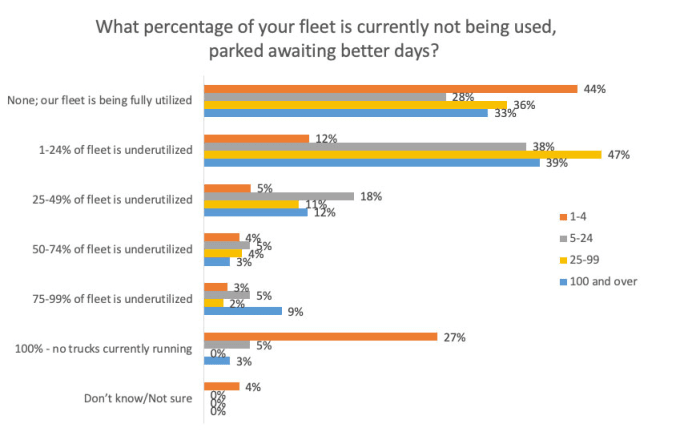
The smallest fleets, one- to four-truck owner-operators, were most likely to have parked their trucks due to COVID-19 effects.
Graph: HDT Research
Health and Safety during the Pandemic
More fleets reported having someone at the company test positive in this month’s survey – 9%, as compared to 3% in the previous months’ survey. The percent of respondents who said they have not been able to get tests to know one way or the other was steady at 7%.
In both surveys, nearly two-thirds of respondents, 65%, said they have not had any drivers refuse to work or not show up to work due to coronavirus concerns. In both surveys, the overwhelming majority said the percentage of drivers who were absent was less than 25%.
When asked what steps fleets have taken to protect employee health, the most common tactics were:
Provided masks (73%)
Provided cleaning solutions (67%)
Provided hand sanitizer (66%)
Social distancing (66%)
Provided gloves (63%)
Cleaned facilities more frequently (57%)
In the first survey, conducted in late March/early April, the most common action (67%) was communicating to employees about best practices (such as hand washing, social distancing, sanitizing practices, etc.). Initiating or expanding communications about policies and best practices in this most recent survey only came in at 35%. The most common methods of communication in the May survey were email (60%), followed by text (56%), more frequent phone calls to drivers (43%), and paper flyers or letters (42%).
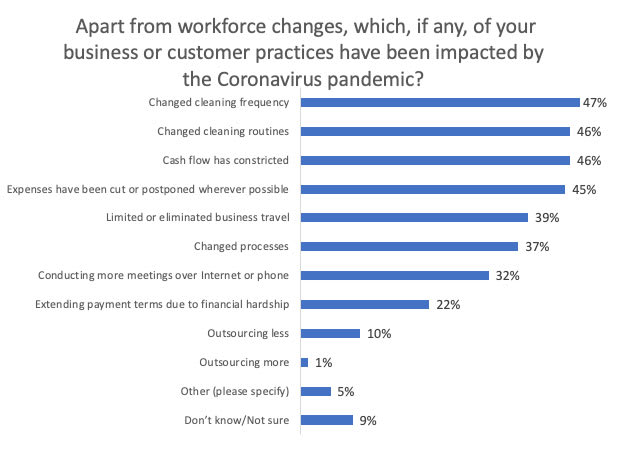
Cleaning changes were the most common non-workforce-related practice reported.
Graph: HDT Research
Only 11% had closed some or all facilities entirely. In the May survey, compared to 16% in the previous month’s survey.
Drivers face many challenges at shippers and receivers, with 71% reporting drivers were seeing mask requirements, 66% reporting drivers unable to use restroom facilities, and 65% required to remain in their truck.
Looking ahead
Although the pandemic resulted in cheaper diesel prices, half of respondents said their attitudes and practices regarding fuel economy and sustainability had not changed. In fact, 13% said they plan to focus more on sustainability in the future, with only 1% said they would focus on that less.
When asked whether vehicle acquisition plans would change in the next three months, 44% said they would remain unchanged. That figure varied greatly by fleet size, with 61% of 1-4 truck fleets, which may not have had any buying plans anyway, saying those plans would remain unchanged, but only 26% of fleets 100 and over. 31% of those larger fleets said they would be acquiring fewer vehicles, 8% said they planned to acquire more vehicles, and 28% said it was too soon to tell or they would make decisions based on market conditions.
The majority of fleets said the pandemic had not stimulated interest in investigating or adopting fleet technology products, but of those 100-truck-plus fleets, 18% said it had, with 57% interested in paperless document management. Cloud-based software was also high on the list, with 43% of 100-and-over fleets interested. A number of these larger fleets also were interested in maintenance management, online parts ordering, and leasing.
More Fleet Management

Sponsored•September 16, 2026
Color Match Smarter: Tools That Restore & Perform
For fleet managers and collision repair professionals keeping heavy-duty trucks on the road, getting the color right the first time isn't just about appearance — it's about efficiency, turnaround time, and bottom-line results. Discover how today's digital color tools are transforming the repair process from guesswork to precision.
Read More →
FMCSA Pauses Biennial-Update Enforcement Amid Motus Transition
Carriers whose updates were due on or after June 1 have more time, while FMCSA works to stabilize its new registration system and warns of phishing sites impersonating its new carrier registration system, Motus.
Read More →
Sponsored•September 14, 2026
2026 Blueprint for Countering Smarter Supply Chain Theft
Cargo theft is no longer just the cost of doing business. It's a multi-billion-dollar criminal enterprise exploiting vulnerabilities across your fleet, drivers, and supply chain.
Read More →


Sponsored•September 1, 2026
How Telematics Improves Visibility, Control, and Performance in Refrigerated Fleets
Explore how telematics help refrigerated fleets improve visibility, uptime, efficiency, compliance, and cargo protection across connected cold chain operations.
Read More →
What the U.S.-Canada Trade War Means for Trucking
Escalating U.S.-Canada tariffs could disrupt cross-border freight, reduce truck volumes, raise costs, and create new uncertainty for carriers on both sides of the border.
Read More →
What Are Trucking’s Top Concerns for 2026?
The American Transportation Research Institute wants to know what's worrying trucking fleet managers, drivers, and other stakeholders in its annual Industry Issues survey.
Read More →
American Trucking Associations Looks for a New Leader
ATA President and CEO Chris Spear abruptly left his job at the association on August 21, at a pivotal time for the trucking industry.
Read More →
Public Wi-Fi Cybersecurity Risks: How Truck Drivers and Fleets Can Protect Their Data
Public Wi-Fi can expose truck drivers and fleets to credential theft, malware, and other cyber threats. Here’s how to reduce the risk on the road.
Read More →
For Nicky Cupp, Fleet Innovation Starts With Frustration
HDT Truck Fleet Innovator Nicky Cupp turns everyday pain points at Fraley & Schilling into opportunities for better technology and smarter processes.
Read More →
Adam Buttgenbach’s Approach to Electric Trucks: Start With Where They Fit
HDT Truck Fleet Innovator Adam Buttgenbach helped PepsiCo build one of North America’s largest EV fleets by focusing on where electric trucks make operational sense.
Read More →