




Survey: CSA Continued Concern for Carriers and Shippers
Carriers are concerned about CSA 2010 regulations, but they have found some of their shippers to be concerned about CSA scores as well, according to Transport Capital Partners' Second Quarter 2012 Business Expectations Survey.
Carriers are concerned about CSA 2010 regulations, but they have found some of their shippers to be concerned about CSA scores as well, according to Transport Capital Partners' Second Quarter 2012 Business Expectations Survey.
A little more than 72% of carriers surveyed say that some of their customers are concerned about CSA scores. Only 21% say customers are not concerned, and 6% said all of their customers are concerned.
"The integrity of the data and predictive values has forced negative response from carriers' organizations, showing a growing concern amongst both carriers and shippers to this latest regulation," says Richard Mikes, a TCP partner.
"CSA continues to be a major concern for the carriers, especially over the last few months as FMCSA has inadequately responded to the concerns of carriers," says Lana Batts, TCP partner.
Last quarter, TCP found that 65% of carriers surveyed are using three or more methods to comply with the regulations. This was significantly higher than two years ago when TCP found that 50% of truckload carriers were unprepared for CSA 2010 regulations.
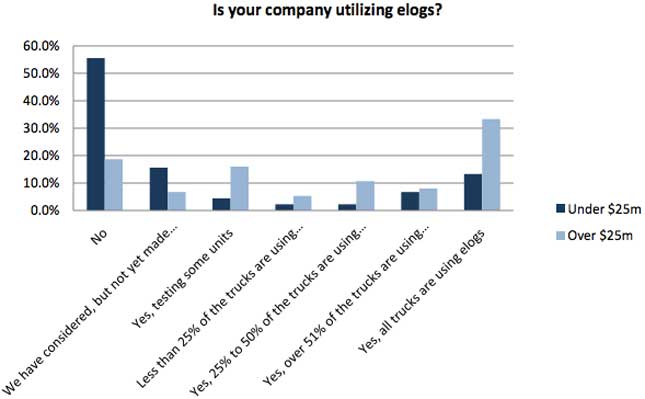
While 33% of the larger carries surveyed are using electronic logs on all their trucks, more than 55% of the smaller carriers are not using e-logs. This disparity indicates just how difficult FMCSA's job will be in using e-logs to enforce hours-of-service regulations using electronics.
"Larger carriers have been more rapid in adoption and appear equipped to implement required training of drivers and support staff through their operations," Batts says. "For smaller carriers, these changes can be much more of a burden."
Cost of implementing CSA regulations is also a concern for carriers. Seventy-five percent of carriers surveyed indicate that the cost of compliance per driver has been $500 or more, and 35% indicate the costs are over $1,000 per driver per year year.
"Carriers are clearly frustrated with the level of costs and complexity emanating from the feds, while at the same time half of them tell us they are not getting adequate returns, and face escalating driver costs and an uncertain economy," Mikes says.
TCP is a firm providing advisory services to the transportation industry, including mergers and acquisitions. Its Business Expectation Survey asks trucking company executives core questions every quarter on recent rate trends, future volume and rate expectations and interest in buying or selling their firms in the future.
More Drivers

EEOC Sues Texas Trucking Company Over Driver Age Limits
The agency says Trancasa USA rejected applicants over 65 and applied tougher driving-record standards to those over 60.
Read More →
Nussbaum, Roehl Announce Second Driver Pay Increase This Year
This year has seen a swath of major truck driver pay increases as freight capacity has tightened.
Read More →
From One Generation to the Next: How Mentorship Builds Safer Truck Drivers
After three decades in trucking, Harold Perry shares what he's learned about driver safety, mentorship, and helping the next generation build confidence behind the wheel.
Read More →
Truck Drivers Need More Than Another Alert
Fleets have more visibility into truck health, safety events, and driver activity than ever. The next challenge is turning all that information into useful guidance for the person who has to decide what to do next.
Read More →
FMCSA Removes 110 Truck Driver Training Schools from Certified ELDT List
Federal regulators also are targeting more than 160 additional training providers and launching a nationwide audit of third-party CDL skills testers as part of a broader crackdown on trucking fraud.
Read More →
Hours of Service Pilot Programs: FMCSA Readies for 2027 Rollout
Two pilot programs could eventually reshape hours-of-service rules, giving truck drivers options to pause their 14-hour clock or use longer split sleeper rest periods.
Read More →
Medical Cards, English Proficiency Reshape Roadcheck Violations
Medical-card violations jumped to the top of the driver out-of-service list during CVSA’s 2026 International Roadcheck, while English-language proficiency violations appeared among the leading violations for the first time.
Read More →
Driver Trust Can Make or Break the Success of Fleet Safety Technology
New Teletrac Navman research suggests that onboarding, transparency about driver data, and positive feedback can play a significant role in how commercial drivers respond to safety and coaching technology.
Read More →
EEOC Sues KLLM Over Alleged Sex Discrimination in Driver Training
KLLM is facing a federal sex-discrimination lawsuit over policies the EEOC alleges put female truck driver trainees at a disadvantage.
Read More →
FMCSA Moves to Codify English Language Requirements for Commercial Drivers
By changing regulations on English-language proficiency requirements for commercial drivers, rather than relying on a guidance memo, the FMCSA said future administrations won't be able to walk back the Trump administration's stricter enforcement with just a memo.
Read More →